How do you write a Google review response that helps your SEO?
November 15, 2026 · 11 min read
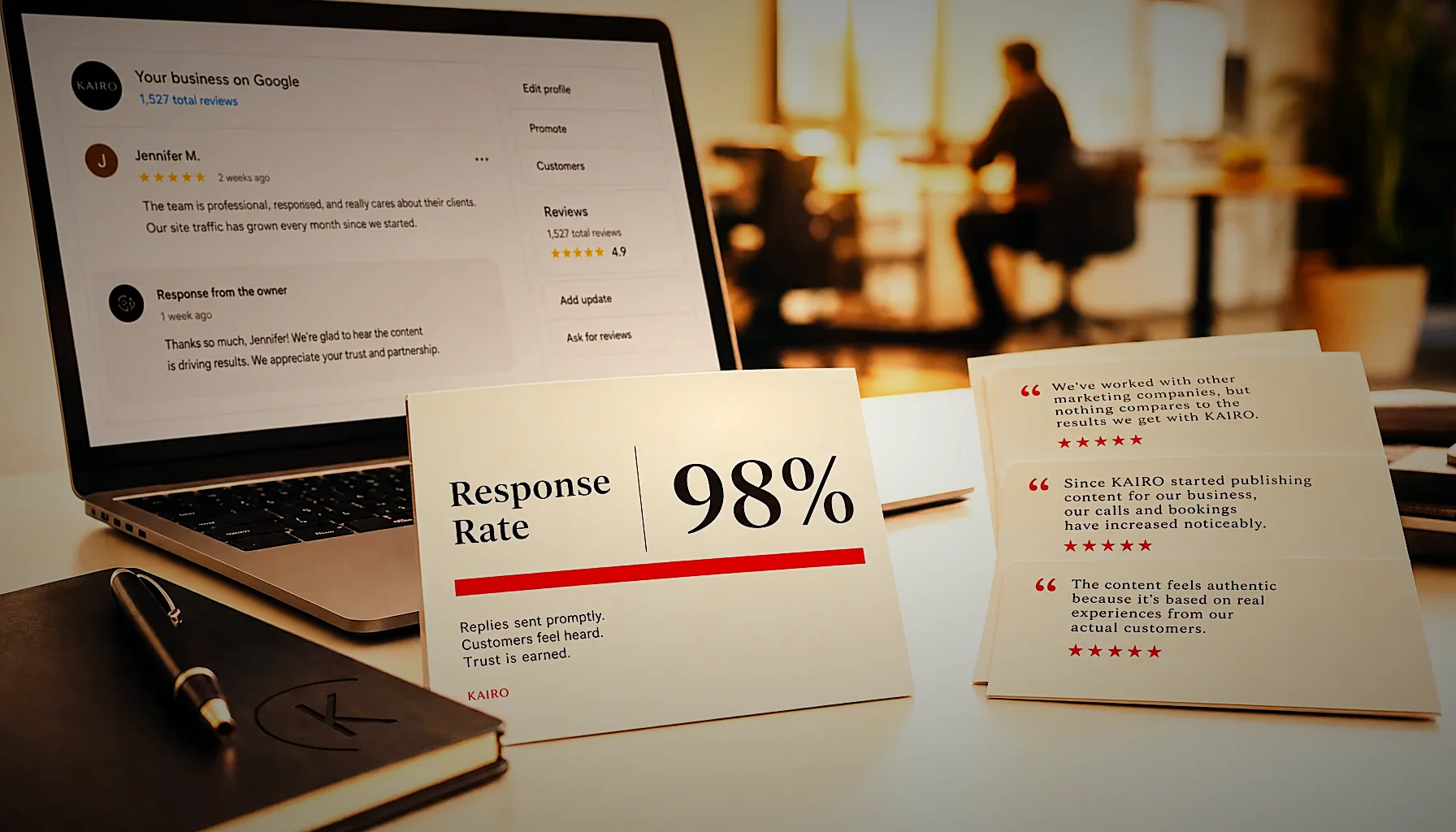
A Google review response helps your SEO when it repeats the service, the city and the specific detail the customer mentioned, in plain language, within a few days of the review. Google reads reply text as part of your Business Profile, so every reply adds fresh, keyword-relevant content to a page you don’t control otherwise.
That’s the short version. The longer version matters because most businesses either skip replies entirely or paste the same “Thank you for your feedback!” under 200 reviews, which adds no information for Google and no reassurance for the next person reading.
Below is how review replies actually connect to local ranking in 2025, what to write, what to avoid, and how to turn the same reviews into content that keeps working after the reply is buried.
Does replying to Google reviews actually affect your ranking?
Yes, indirectly and measurably. Google’s own Business Profile guidance states that responding to reviews can improve your local visibility, and reply text is indexed alongside the review. The ranking effect comes from three things: engagement signals, keyword-rich text on your profile, and the behavior of people who read the replies.
Google’s local ranking system weighs relevance, distance and prominence. Replies feed relevance (your reply says what you do) and prominence (an active, responsive profile looks like a live business).
The behavioral part is the one owners underestimate. When someone reads a thoughtful reply to a 3-star review, they’re more likely to click through to your site or tap “Directions” — and click-through and action rates on your profile are signals Google can see.
There’s also a filtering effect. A profile with 80 reviews and 80 replies reads as a business that pays attention; a profile with 80 reviews and 2 replies reads as abandoned. Both are the same business, but the second one loses the comparison every time a customer has two tabs open.
One caveat worth stating plainly: a single reply doesn’t move rankings. What moves things is a consistent pattern of replies over months, combined with review volume, accurate categories and real content on your site. If you want the volume side of the equation, see our guide on how many Google reviews a business needs to rank well.
What should you actually say in a Google review response?
Name the service, name the location, repeat the specific detail, and keep it under 60 words. A good reply reads like a human who remembers the job, not a template. The structure that works almost every time has four parts and takes under two minutes to write.
1. Thank them by name. “Thanks, Marcus” beats “Dear valued customer.” Use the name Google shows, nothing more.
2. Repeat the service and the place. If they wrote about a brake job, say “brake replacement.” If they drove in from a neighboring suburb, mention it. This is where the SEO value sits — natural keywords in context, not stuffed.
3. Add one specific detail. The Saturday appointment, the dog that came along, the fact that you had the part in stock. Specificity is what proves the reply wasn’t automated.
4. Close with a soft, concrete next step. “We’ll see you for the 10,000-mile check” is better than “We look forward to serving you again.”
Here’s a general example for a dental clinic replying to a 5-star review about teeth whitening: “Thanks, Dana. Glad the whitening session fit into your lunch break — that’s exactly why we keep the midday slots open at our downtown clinic. See you at your cleaning in six months.”
That reply contains the service (“whitening session”), the location type (“downtown clinic”), a specific detail (“lunch break,” “midday slots”) and a next step. It’s 38 words and it reads like a person wrote it.
For a restaurant, the same structure: “Thanks, Paul. The short rib is on a four-week rotation, so it’ll be back in March — I’ll flag it when the new menu goes up. Glad the corner table worked for the eight of you.”
Your reviews already contain your next article
KAIRO reads your public Google reviews and turns the themes customers keep raising into monthly articles for your site. You keep writing the replies; we handle the content side.
How do you reply to a negative Google review without making it worse?
Acknowledge the specific problem, state what you did about it, and move the conversation offline — in that order, in three sentences. Never argue facts in public, never mention the reviewer’s tone, and never explain company policy at length. The audience for a negative reply is not the reviewer; it’s the next 200 people who read it.
A workable pattern: “You’re right that the wait was 40 minutes on Saturday — we were short two servers and we’ve since added a third weekend shift. I’d like to make it up to you; you can reach me directly at [email]. Sorry we got it wrong.”
Three things that reply does. It confirms the complaint is real, which builds more trust than a denial. It shows a fix, which tells future customers the problem is dated. And it hands the reviewer a private channel instead of a public fight.
What to avoid: the phrase “we have no record of your visit,” any sentence starting with “Actually,” and the passive apology (“we apologize for any inconvenience experienced”). All three read as defensive, and defensive replies get screenshotted.
On timing — reply within 48 to 72 hours for negative reviews. Fast replies to complaints read as competence. Replies three months later read as damage control after someone complained about the complaint.
One more practical note: if a review is fake or violates Google’s policies, flag it through the Business Profile interface, then still write a short, calm, factual reply. Removal takes days or weeks and may not happen at all, so the reply is your only reliable cover in the meantime.
Which keywords belong in a review reply, and which don’t?
Use the words a customer would type into Google — service plus city, service plus problem, service plus qualifier. Skip anything you wouldn’t say out loud. Google’s spam systems and human readers both notice keyword stuffing, and a stuffed reply damages trust faster than it helps ranking.
Keywords that belong in replies:
- Service terms — “emergency drain cleaning,” “sports massage,” “winter tire swap.” Specific beats generic.
- Neighborhood and landmark names — “our Northside shop,” “two blocks from the station.” These support local relevance without sounding forced.
- Problem language — “the slab leak,” “the cracked molar,” “the seized caliper.” This is how customers actually search.
- Seasonal or situational context — “before the holiday rush,” “same-day on a Sunday.”
Keywords that don’t belong:
- Your full legal business name in every reply. Once in a while is fine. In all 60 replies it reads as automated.
- Competitive superlatives. Claims like “top-rated in the state” add nothing Google can verify and make the reply sound like an ad.
- Service lists. A reply that ends with “we also offer HVAC, plumbing, electrical and roofing” is a keyword dump, and customers can tell.
- Repeated city stuffing. “Thanks for choosing our Austin plumbing company in Austin, TX” is the exact pattern Google’s guidelines warn about.
A rough rule: one service keyword and one location signal per reply, both appearing naturally in a sentence you’d say to the person’s face. Across 50 replies, that gives Google 50 clean, varied signals about what you do and where — which is far more useful than 50 copies of the same phrase.
Varying your language matters too. If every reply says “auto repair,” you’ve told Google one thing. If your replies mention brakes, timing belts, diagnostics, state inspections and A/C recharge across a year, you’ve mapped your whole service list in the words customers use.
What’s the fastest workflow for replying to reviews consistently?
Block 20 minutes once a week, sort by newest, and work the queue — negative first, then detailed positives, then short ones. Consistency beats volume. A business that replies to every review within a week for a year outperforms one that replies to 200 in a single afternoon and then stops.
A workable weekly routine:
- Negative and 3-star reviews first. These carry the most risk and the most reputational upside. Spend your real attention here.
- Detailed 5-star reviews second. Long reviews give you specifics to echo, which makes keyword-rich replies effortless.
- One-line 5-star reviews last. “Great service!” deserves a one-line reply. Don’t write 60 words about a six-word review.
- Log what keeps coming up. Every month, note the three themes that repeat. Those themes are your content calendar.
Step 4 is where most of the long-term value lives. Replies disappear below the fold; articles don’t. If 11 reviews mention your parking, a page about where to park near your location will out-earn 11 replies for years, because it ranks, it gets cited by AI assistants, and it answers the question before someone has to ask.
That’s the connection between review replies and real content. The reviews tell you exactly which questions your customers ask in their own words — the same words they type into Google and into ChatGPT. Our guide on what your Google reviews say about what customers really want walks through how to pull those themes out systematically.
If you’d rather not do the extraction yourself, that’s the job KAIRO does. We read every Google review a business has received, then publish 4 SEO/AEO articles a month to your WordPress site, plus Google Business Profile posts and a monthly proof report you can check. No contract, cancel anytime.
How do review replies fit into the rest of your local SEO in 2025?
Review replies are one input among five, and they’re the cheapest. The full local picture in 2025 is: an accurate Business Profile, review volume and replies, consistent citations, structured data on your site, and published content that answers real customer questions. Replies alone won’t rank you; replies plus content will.
Here’s roughly how the pieces compare in effort and payoff:
- Business Profile accuracy — one afternoon of work, permanent effect. Categories, hours, services, photos. Do this first.
- Review replies — 20 minutes a week, compounding effect on trust and relevance. Highest return per minute spent.
- Citations — a few hours, slow and steady effect. Consistency of your name, address and phone across directories. See what local citations are and whether they still matter.
- Schema markup — a one-time technical setup that helps both Google and AI assistants read your pages. Our guide to schema markup for local businesses covers the basics.
- Published content — ongoing, and the only input that keeps producing new rankings and new AI citations month after month.
The AI side is newer and it changes the math. When someone asks ChatGPT or Google’s AI Overviews for a recommendation, those systems pull from indexed pages and from what the open web says about you. Review replies contribute a little; published articles that answer specific questions contribute a lot more.
That’s why the review-to-content loop is worth building. Replies handle the people already looking at your profile. Articles built from the same reviews reach the people who haven’t found you yet — the ones typing “who does same-day repairs near me” into a search bar or an AI chat.
Track it so you know what’s working. A monthly report should show profile actions, which pages bring search traffic, and where you’re being mentioned, not a wall of vanity metrics.
Replies fade, articles keep ranking
A reply gets buried after 20 new reviews, but an article on the same question keeps showing up in search and gets quoted by AI assistants. KAIRO writes those articles for local businesses every month.
Frequently asked questions
Does responding to Google reviews help SEO?
Yes. Google states that responding to reviews can improve your local visibility, because reply text is indexed with your Business Profile and signals an active business. The effect is indirect but consistent: replies add natural service and location keywords, raise trust for people comparing you to competitors, and increase profile clicks and direction requests, which Google can measure.
What is the 80/20 rule in SEO?
The 80/20 rule in SEO means roughly 80% of your results come from 20% of your actions. For a local business, that 20% is usually an accurate Google Business Profile, a steady flow of reviews with replies, and content that answers the questions customers actually ask. Fixing those three before touching anything technical is where most of the gain sits.
What to say in response to a Google review?
Thank the reviewer by name, repeat the service and the location, add one specific detail from their visit, and close with a soft next step. Keep it under 60 words and write it the way you’d speak. For example: “Thanks, Dana — glad the whitening session fit into your lunch break. See you at your cleaning in six months.”
Is SEO still relevant in 2026?
Yes, and the reason is AI search. ChatGPT, Gemini and Google AI Overviews build answers from indexed web pages, so the pages that rank are the pages that get cited and recommended. The work has shifted from chasing keywords to publishing clear, specific answers, but the underlying need — being findable and quotable — is stronger in 2026 than it was five years ago.
How quickly should you reply to a Google review?
Reply within 48 to 72 hours for negative reviews and within a week for positive ones. Fast replies to complaints read as competence and often stop the situation from escalating. A weekly 20-minute block is enough for most local businesses to stay current without it becoming a chore.
Can you use AI to write Google review replies?
You can, but only if a human adds the specifics and checks the tone before it posts. AI-written replies fail when they’re generic, because the whole value of a reply is proving someone read the review. A reasonable approach is to use AI for the first draft and the service keyword, then edit in the detail only you know.
This article was produced by the Kairo engine.
The same system can write for your business — starting from what your customers already say.
Get your free review report