How do I get my local business to show up on Google? A complete guide
October 4, 2026 · 11 min read
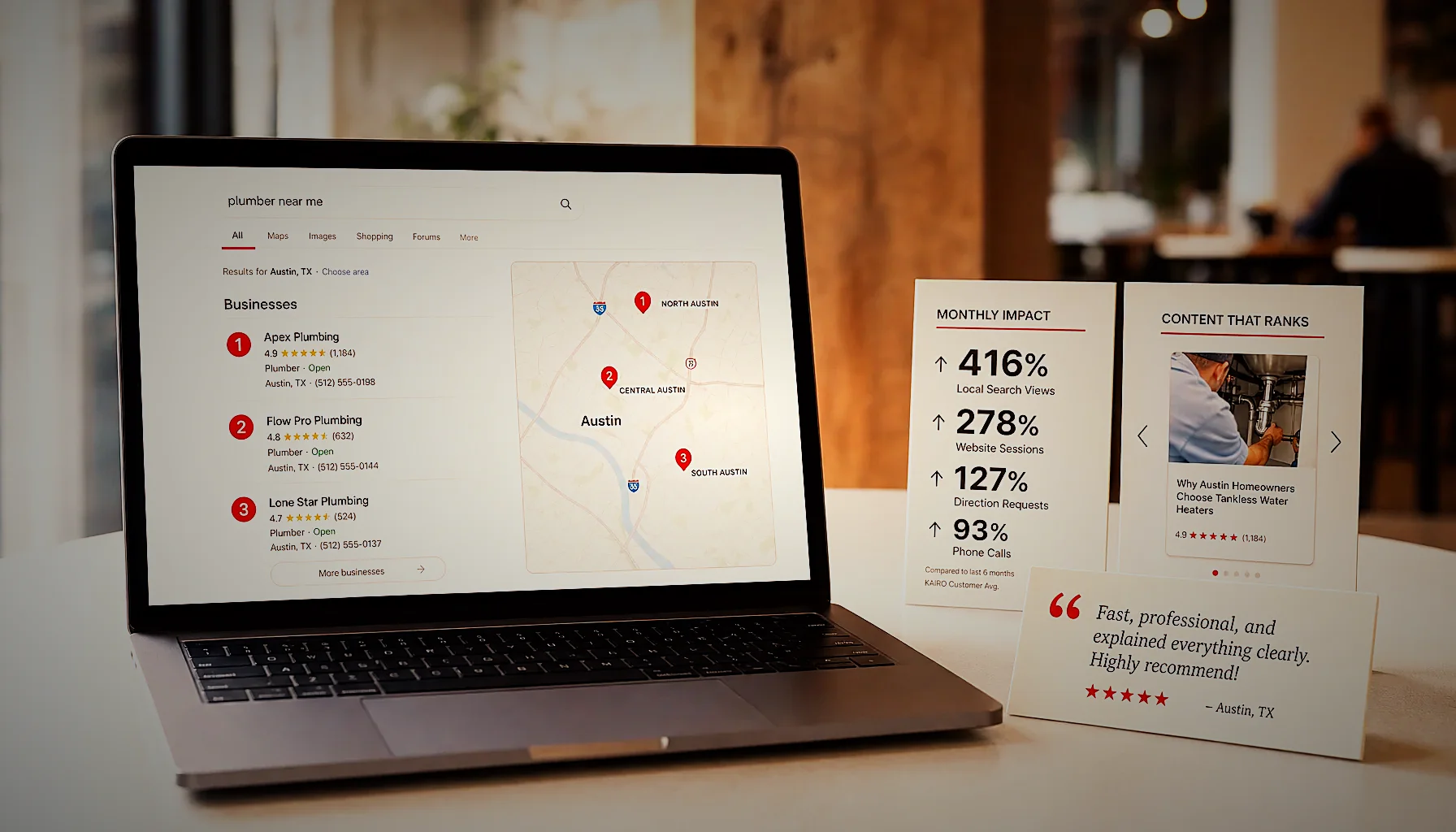
To get your local business to show up on Google, do three things: claim and fully complete your Google Business Profile, collect reviews consistently, and publish pages on your own website that answer the exact questions customers type. Google needs a verified profile to show you in the map pack, review signals to rank you above competitors, and real content to match you to a search. Miss any one of the three and you stay invisible.
That is the short answer. The rest of this guide shows you how each piece works, how long it takes, and what to do first if you are starting from zero in 2025.
Why isn’t my business showing up on Google right now?
Nine times out of ten the cause is one of four things: your Google Business Profile is unverified, your category is wrong, your website has no pages that match what people search, or a competitor simply has more reviews and more content than you.
Google does not hide businesses out of spite. It shows the result it has the most confidence in, and confidence is built from signals it can read: a verified address, a primary category, opening hours, photos, reviews with recent dates, and web pages that mention the service and the city.
Check the obvious first. Search your exact business name plus your city in an incognito window. If nothing appears, your profile is either unverified, suspended, or duplicated — three different problems with three different fixes.
If your profile does appear for your business name but not for the service you sell, that is a ranking problem, not a listing problem. You exist in Google’s index; you are just sitting on page three for “dentist near me” because five other practices have 200 reviews and you have 11.
Distance matters more than most owners expect. Google shows local results based on relevance, distance, and prominence, and you cannot change your physical address to win searches three towns over. What you can change is relevance and prominence, and both respond to work you do every month.
One more common cause: your website is thin. A homepage, a contact page, and a one-line services list give Google almost nothing to match against. A business with 40 pages answering 40 real customer questions has 40 chances to appear; a four-page site has four.
How do I get my business page to show up on Google?
Create and verify a Google Business Profile at google.com/business, then fill in every field — primary category, secondary categories, service areas, hours, phone, website, services, and at least 10 photos. Verification usually takes a few days by postcard, video, or phone, and nothing ranks until it is done.
Pick your primary category with care. It is the single strongest ranking factor in the map pack. A bakery that sells coffee should test “Bakery” versus “Coffee Shop” and keep whichever brings more calls, not whichever sounds nicer.
Write the business description like a person explaining the business to a neighbor. Name the city, name the services, and skip the adjectives. Google reads it, and so do the people deciding whether to call you.
Add your services and products as structured entries inside the profile, each with a short description. Most owners skip this section entirely, which is exactly why filling it in moves you up while competitors sit still.
Photos are not decoration. Profiles with recent, real photos get more clicks and more direction requests, and Google rewards engagement. Upload a few every month — the storefront, the team, the work you actually did last week.
Then post. Google Business Profile posts let you publish short updates that appear directly on your listing, and a profile that gets fresh posts looks active to both Google and the person reading it. Posting once and then going quiet for eight months tells the opposite story.
Your reviews already hold the answers
KAIRO reads your public Google reviews and turns the questions your customers actually ask into articles on your own site. You keep serving customers; the pages keep showing up.
How do I get my business to show up first on Google?
Showing up first in local results comes down to prominence: more reviews than the businesses near you, higher average rating, consistent citations across directories, and more indexed pages on your site that match the search. There is no switch and no payment that moves you to the top of the organic map pack.
Reviews are the clearest lever. A business with 150 reviews at 4.7 stars outranks a business with 20 reviews at 4.9 in most competitive local searches, because volume and recency both count. Ask every satisfied customer, every week, by text message with a direct link.
Reply to every review, good and bad. Replies are indexed text, they often contain the service and city naturally, and they show future customers how you handle a complaint. A thoughtful reply to a two-star review converts more readers than a wall of five-star praise.
Keep your name, address, and phone number identical everywhere — your website, Yelp, Apple Maps, Facebook, industry directories. Inconsistent data makes Google less certain you are one real business, and uncertainty costs positions.
Then there is the part most local businesses never do: publish content. Google ranks pages, not businesses. If someone searches “how much does a bathroom remodel cost in Austin” and you have a page answering it honestly with ranges, you can appear even when your map pack position is middling.
This is also how you reach the searches that never touch the map pack at all. Informational queries — “do I need a permit for a deck,” “how long does a crown last” — pull in organic pages, and those pages bring the customer to you before they ever compare three companies.
Expect months, not weeks. A new profile with steady reviews and 8 to 12 new pages typically starts moving in 90 days and compounds from there. Anyone promising a top spot in two weeks is selling you something that does not exist.
What role does content on my own website play in local search visibility?
Your website is the only asset in local search you fully control, and it is what Google uses to decide what you are actually relevant for. A Google Business Profile tells Google you exist; your pages tell Google what you know. Businesses that publish consistently build local search visibility that a profile alone cannot deliver.
Each page should answer one question completely. “What does a water heater replacement cost in 2025” is a page. “Services” is not. The narrower the question, the easier it is to rank and the more qualified the person who lands there.
Mention the city and the service naturally in the title, the first paragraph, and at least one subheading. That is not keyword stuffing — it is telling Google plainly what the page is about, the same way a signpost works.
Frequency beats length over time. Four solid articles a month gives you roughly 48 new entry points a year; one 5,000-word essay gives you one. Google rewards sites that keep adding useful pages because it reads that as an active, maintained business.
The most overlooked source of topics is sitting in your own account: your reviews. Customers write, in their own words, what worried them, what they compared, and what convinced them. Those sentences are your content calendar, and they match real search language far better than a keyword tool guess.
If writing four articles a month is not realistic alongside running the business, the honest options are a freelancer, an agency, an in-house hire, or an automated engine. We broke down the costs and trade-offs of each in our comparison of who can write monthly SEO articles for my small business, including what each route realistically produces per month.
Whichever route you choose, publish on your own domain. Content posted only to social media disappears from search within days; content on your site keeps earning traffic for years.
How do I get my business recommended by ChatGPT and AI answers?
AI assistants recommend businesses they can read clearly: a complete Google Business Profile, consistent information across the web, recent reviews, and web pages that answer questions in short, quotable blocks. ChatGPT, Gemini, and Google AI Overviews pull from indexed sources, so if your answers are not written down anywhere, you cannot be cited.
The format matters as much as the facts. AI systems extract self-contained passages — a clear question as a heading, then a 2-to-3-sentence answer directly underneath. Pages built as one long unbroken argument rarely get quoted.
Be specific. “Affordable pricing” is unquotable; “most repairs run $180 to $400 depending on the part” is exactly the kind of sentence an assistant repeats to a user. Numbers, ranges, and timelines get cited; adjectives get skipped.
Reviews feed AI answers too. When someone asks ChatGPT for “a reliable plumber in Denver,” the model leans on aggregated sentiment and the text people wrote about you. A hundred reviews mentioning “showed up on time” becomes the reason you get named.
This shift has a name, and it runs alongside traditional search rather than replacing it. If the distinction is new to you, our guide to what is AEO explains how answer engine optimization differs from classic SEO and what changes on the page.
Check your current standing yourself. Ask ChatGPT and Gemini for the top providers of your service in your city and see whether you appear, who does, and what the model says about them. That five-minute test tells you more than most audits.
Then close the gaps. If the assistant names three competitors and describes their pricing, hours, and specialties, those details exist in readable form online and yours do not. Writing them down is the whole fix.
What’s a realistic monthly routine to stay visible on Google?
A workable monthly routine takes about four to six hours: ask for reviews weekly, reply to every review within 48 hours, publish 2 to 4 pages on your site, post 2 to 4 updates to your Google Business Profile, add fresh photos, and check your rankings once. Consistency over 12 months beats a burst of effort in month one.
Week one: review your Google Business Profile insights. Look at calls, direction requests, and which searches brought people to you. Those search terms are free topic research.
Week two: publish. Pick the question customers asked most this month and answer it properly on your site, with real numbers and a clear structure.
Week three: reviews. Send a short request to every customer served in the last 30 days, with a direct link to your profile. A one-line text outperforms a polished email almost every time.
Week four: housekeeping. Check that your hours are right for upcoming holidays, add photos, post an update, and confirm your name, address, and phone number still match across the main directories.
Track two numbers only: calls from the profile and organic sessions to your site. Position tracking is interesting; revenue-adjacent numbers are what tell you whether the work pays.
Most owners can do this. Most owners do not, because month three is when other things get urgent and the routine quietly stops. That is the real reason competitors with worse service outrank good businesses — they kept publishing.
If the publishing half is the part that keeps slipping, that is the piece KAIRO automates. We read every Google review a business has received, turn what customers actually said into 4 SEO/AEO articles a month, publish them to your WordPress site, post to your Google Business Profile, and send a monthly proof report you can check line by line. No contract, cancel anytime — ask us for a personalized quote.
The content part, handled every month
Most owners never get past the profile because writing 8 to 12 pages takes time they do not have. KAIRO publishes them for you, month after month, so Google and ChatGPT have something to cite.
Frequently asked questions
Why isn’t my business showing up on Google?
The most common reasons are an unverified or suspended Google Business Profile, a wrong primary category, duplicate listings, or a website with too few pages matching what people search. Google only shows businesses it can confirm exist and understand. Start by searching your business name and city in an incognito window — if nothing appears, verification is your first fix.
How do I get my business page to show up on Google?
Create a free Google Business Profile, verify it by postcard, video, or phone, then complete every field including primary category, services, hours, and at least 10 photos. Verification typically takes a few days, and nothing ranks until it finishes. After verification, add posts and photos monthly so the profile reads as active.
How do I get my business to show up first on Google?
Ranking first in local results depends on prominence: more recent reviews than nearby competitors, a strong average rating, consistent business information across directories, and more indexed pages on your website. There is no paid shortcut to the top of the organic map pack. Most businesses that commit to weekly review requests and 2 to 4 new pages a month see movement within about 90 days.
Why is business not showing up on Google Search but showing on Maps?
That usually means your Google Business Profile is healthy but your website is too thin or too new to rank in organic results. Maps and Search use overlapping but different signals, and Search depends heavily on the pages you publish. Adding pages that answer specific customer questions, each with your city and service named clearly, is the fix.
How long does it take to show up on Google?
A verified Google Business Profile can appear in Maps within a few days of verification, while organic search visibility for competitive terms generally takes 3 to 6 months of consistent work. The timeline depends on how many competitors you have and how much content they already publish. Expect early movement on low-competition, long-tail questions first.
How do I get my business recommended by ChatGPT?
AI assistants recommend businesses whose information is complete, consistent, and written in short, quotable answers across indexed web pages and review platforms. Publish pages with clear question headings, specific numbers, and direct 2-to-3-sentence answers. Then test it yourself: ask ChatGPT or Gemini for the best providers of your service in your city and see whether you are named.
This article was produced by the Kairo engine.
The same system can write for your business — starting from what your customers already say.
Get your free review report