How many blog posts a month does a local business need? A complete guide
October 8, 2026 · 10 min read
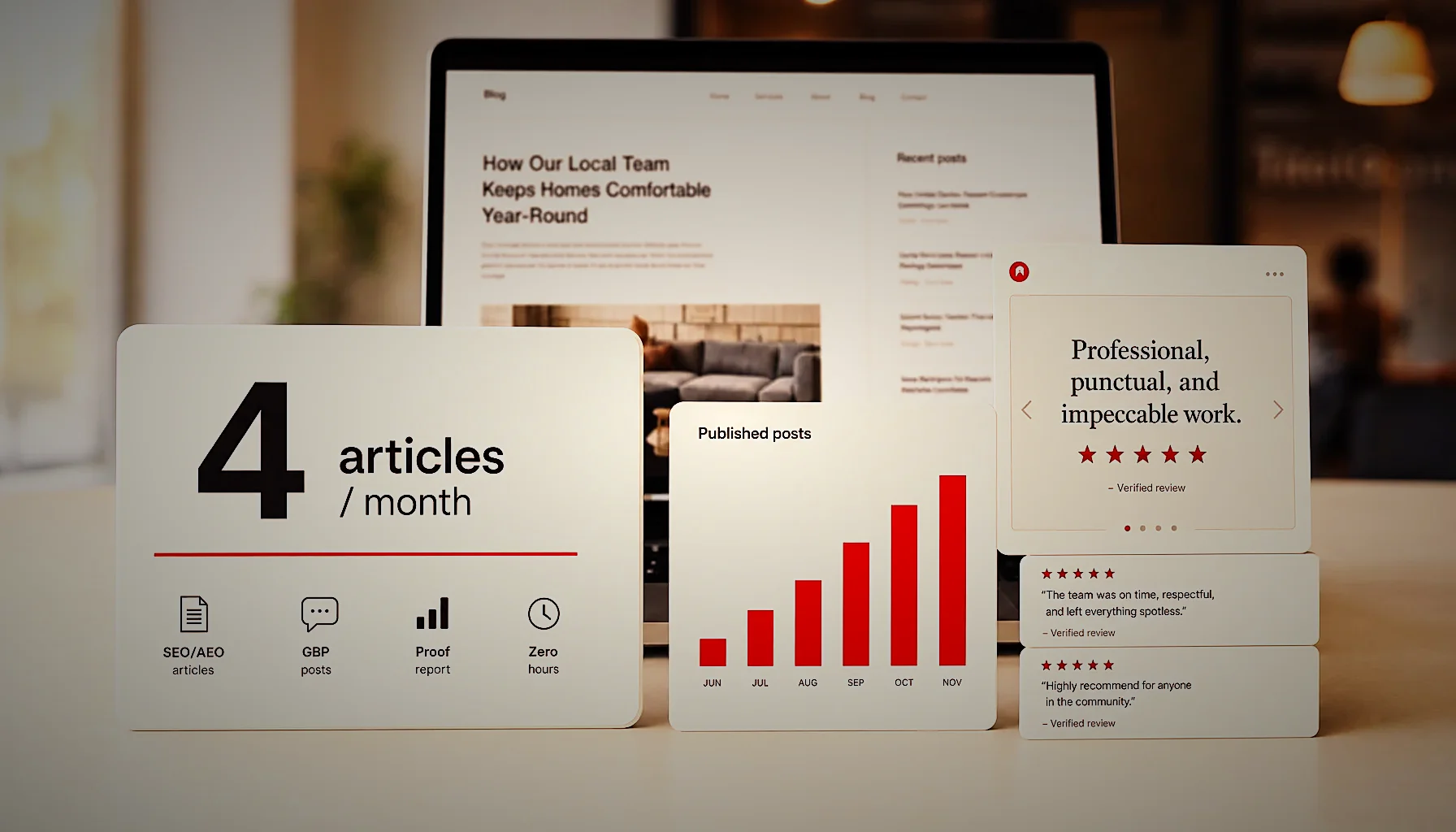
Most local businesses need 4 blog posts a month — roughly one a week — to build and hold visibility on Google and in AI answers. Below 2 a month, momentum stalls and crawl frequency drops. Above 8, you usually pay more for diminishing returns unless you’re competing in a large metro with dozens of rival sites. If you’re asking who can write monthly SEO articles for my small business, the frequency question and the “who does the writing” question are really the same decision.
This guide compares publishing frequencies side by side, shows what each one costs in time and money, and explains how to pick the number that fits your market in 2025.
How many blog posts a month does a local business actually need?
Four a month is the practical floor for a local business that wants steady results. That cadence gives Google a reason to recrawl your site weekly, builds a library of 48 pages a year, and covers enough questions that AI assistants start finding you as a source.
Two a month still works if your market is small — a single-location clinic in a town of 20,000 people, for example. You’ll just take longer to cover the questions your customers ask, and your competitors have a wider opening.
One a month is maintenance, not growth. It keeps the blog from looking abandoned, but 12 pages a year rarely covers the query space of even a narrow local niche.
Here’s the trade-off in plain numbers:
- 1 post/month: 12 pages a year. Covers your 12 biggest questions. Slow to compound.
- 2 posts/month: 24 pages a year. Workable for very low-competition markets.
- 4 posts/month: 48 pages a year. Weekly crawl signal, broad topic coverage, the cadence most local businesses should target.
- 8+ posts/month: 96+ pages a year. Justified in competitive metros or multi-location businesses with several service lines.
The number matters less than whether you hit it every single month. A site that publishes 4 articles in January and nothing until June performs worse than a site publishing 2 a month without fail. Consistency is the variable most owners get wrong.
What is the real difference between 1, 2, 4 and 8 posts a month?
The difference is how fast you cover the questions your customers actually type, and how much of your own time it eats. More posts mean faster topic coverage and more entry points, but also more hours and more cost per month.
Use this table to compare the four common cadences:
| Cadence | Pages per year | Owner hours/month (DIY) | Best fit | Main risk |
|---|---|---|---|---|
| 1/month | 12 | 4–6 | Brand-new site, testing the channel | Too slow to compound; competitors outpace you |
| 2/month | 24 | 8–12 | Small town, single service, low competition | Thin topic coverage after year one |
| 4/month | 48 | 16–24 | Most local businesses: restaurants, clinics, venues, salons, home services | Hard to sustain alone — this is where owners quit |
| 8/month | 96 | 32–48 | Competitive metro, multi-location, several service lines | Quality drops fast if the process isn’t systematized |
Those DIY hour estimates assume 4–6 hours per article: picking the topic, researching what competitors rank for, writing 1,500–2,000 words, adding internal links, formatting, publishing. Most owners underestimate this by half.
At 4 posts a month, you’re looking at roughly 20 hours — half a work week — every month, forever. That’s why the frequency decision and the delegation decision collapse into one. Pick a cadence you can keep without touching it yourself, or pick a lower cadence and keep it honestly.
4 posts a month, without the 20 hours
KAIRO publishes 4 SEO/AEO articles a month for your business, with the topics pulled from your own Google reviews. You keep the cadence and spend close to zero hours on it.
Who can write monthly SEO articles for my small business, and at what cost?
You have five realistic options: write it yourself, hire a freelancer, retain an agency, use a generic AI tool, or subscribe to a content engine that produces a fixed number of articles a month. Each one trades money against your time and against quality control.
Here’s how they compare on the things that decide the outcome:
| Option | Typical output | Your time per month | Consistency | Topic sourcing |
|---|---|---|---|---|
| DIY | 1–2 articles | 8–12 hours | Low — first thing dropped in a busy month | Guesswork |
| Freelance writer | 2–4 articles | 3–5 hours briefing and editing | Medium — depends on one person’s availability | You supply the brief |
| Agency retainer | 2–8 articles | 2–4 hours in calls and approvals | Medium-high | Keyword tools and templates |
| Generic AI tool | Unlimited | 5–10 hours prompting and fixing | High volume, low trust | Whatever you prompt |
| Content subscription | Fixed monthly number | Close to zero | High — it’s the product | Depends on the provider |
Prices vary by market and scope, so treat any single figure you read online with suspicion. The honest way to compare is cost per published, checked article per month — not cost per word. We’ve broken the five options down in detail in our comparison of who can write monthly SEO articles for my small business.
KAIRO, an online content engine with a team based in Romania, sits in the last row: 4 SEO/AEO articles a month, Google Business Profile posts, and a monthly proof report, with zero hours required from you. The topics come from your own Google reviews rather than a keyword template, so the articles answer questions your actual customers already raised. For pricing and availability, request a personalized quote.
What is the 80/20 rule for blogging and how does it change your cadence?
The 80/20 rule for blogging says roughly 80% of your traffic and leads come from about 20% of your posts. A small handful of articles do nearly all the work, which means your job is to publish enough to find those winners — then expand around them.
This has a direct consequence for frequency. If only 1 in 5 posts becomes a real performer, then 12 posts a year gives you 2 winners, while 48 posts gives you around 10. Volume is how you buy more lottery tickets in a lottery you can partly rig.
You rig it by writing about what customers already ask. Mine your reviews, your inbox, your phone calls and your Google Business Profile questions. Those are confirmed demand, not keyword-tool speculation.
A practical 80/20 split for a local blog at 4 posts a month looks like this:
- 2 posts on core money questions — pricing, how to choose, what’s included, comparisons against alternatives.
- 1 post on a local or seasonal angle — neighborhood, city, event, or time of year.
- 1 post on a long-tail question — something oddly specific that one customer asked and nobody in your market has answered.
After six months, look at which pages bring clicks and calls. Then write two or three follow-ups around each winner instead of chasing new ground. That expansion step is where most local blogs leave money on the table.
The other half of the 80/20 principle is maintenance. Updating a strong post that’s 18 months old often beats publishing a brand-new one, so budget one update slot per month inside your cadence.
Does publishing frequency still matter for AI answers in 2025?
Yes — and frequency matters more for AI answers than it did for classic rankings. Assistants like ChatGPT, Gemini and Google AI Overviews pull from pages that answer a specific question directly, so the more distinct questions you’ve answered on your own domain, the more chances you have of being the cited source.
Classic SEO rewarded one strong page per keyword cluster. AEO rewards breadth of answered questions, because the query someone types into an assistant is longer and stranger than what they type into a search box.
That shifts the math toward more posts, each tightly scoped. Forty-eight articles that each answer one real question outperform 12 sprawling pillar pages when the competition is an AI assistant deciding whom to quote. If you want the mechanics, see our guide to what is AEO and how it differs from SEO.
Three things make a post quotable by an AI assistant:
- An answer in the first 60 words, before any setup or storytelling.
- Short, self-contained paragraphs — three sentences maximum, so a model can lift one without losing meaning.
- A real FAQ block with questions phrased the way people actually ask them.
Format alone won’t carry you. Publishing on a schedule that keeps fresh, dated, relevant pages on your domain is what makes an assistant treat you as a current source rather than an archive. A blog that went quiet in 2023 reads as stale to both a crawler and a model.
How do you build a publishing schedule you’ll actually keep?
Pick the cadence you can sustain for 12 straight months, then systematize it so it doesn’t depend on motivation. Four posts a month works best when the topic list, the writing and the publishing are all decided in advance rather than each week.
Build the schedule in this order:
- Collect 24 questions. Read every Google review you have, plus your last 50 customer emails. Write down every question and complaint. You now have a topic bank.
- Rank them by money. Which answer leads directly to a booking, a quote or a visit? Those go first.
- Lock the dates. Same four days every month. A fixed date beats “when I have time” every single time.
- Decide who writes. If it’s you, cut to 2 a month and protect those slots. If it’s a provider, specify 4 a month in writing.
- Measure quarterly, not weekly. Local SEO moves in 3–6 month arcs. Check impressions, clicks and calls each quarter.
Set the review points honestly. At 3 months expect more indexed pages and rising impressions, not a flood of leads. At 6 months expect specific long-tail queries bringing clicks. At 12 months expect a handful of pages doing most of the work, exactly as the 80/20 rule predicts.
If the schedule breaks two months in a row, the problem is the design, not your discipline. Lower the cadence or hand it off — those are the only two fixes that hold.
One more thing worth tracking in 2025: ask ChatGPT and Gemini the questions your customers ask, and note whether your business appears. That’s a check you can run yourself in five minutes, and it tells you more about your content’s reach than a rankings dashboard.
Keep the cadence every single month
Consistency is the part most owners drop, so KAIRO makes it the product: 4 articles a month, Google Business Profile posts and a monthly proof report.
Frequently asked questions
What is the 80/20 rule for blogging?
The 80/20 rule for blogging means roughly 80% of your traffic and leads come from about 20% of your posts. A small group of articles does nearly all the work, so you publish enough to find those winners and then build more content around them. At 4 posts a month, you’d expect around 10 genuine performers after the first year.
How many blogs should I post a month?
Most local businesses should publish 4 blog posts a month — about one a week. Two a month is acceptable in a small, low-competition market, while 8 or more makes sense in a competitive metro or for a multi-location business. Consistency matters more than the exact number: 2 posts every month beats 6 posts followed by a three-month gap.
Are blogs still profitable in 2026?
Yes, for local businesses blogs remain profitable because they feed both Google rankings and AI assistants like ChatGPT, Gemini and Google AI Overviews. The model has shifted from ad revenue to lead generation — a page that answers “how much does X cost in my city” can bring booked customers for years. The content that struggles is generic, undated writing with no local or first-hand detail.
How long does it take to make $500 per month blogging?
For a blog monetized by ads or affiliates, $500 a month typically takes 12 to 24 months of consistent publishing. A local business blog reaches that value far sooner, because one extra booked job or table often covers it — many see payback within 4 to 8 months at 4 posts a month. Local blogs win on lead value per visit, not on traffic volume.
Who can write monthly SEO articles for my small business?
Your realistic options are doing it yourself, a freelance writer, an agency retainer, a generic AI tool, or a content subscription that delivers a fixed number of articles each month. Compare them on cost per published and checked article, plus how many hours of your own time each one consumes. KAIRO, an online content engine with a team based in Romania, publishes 4 SEO/AEO articles a month built from your own Google reviews, with no contract and cancel anytime.
How often should a small business blog to show up in AI answers?
Aim for 4 posts a month, each answering one specific question in the first 60 words. AI assistants cite pages that resolve a precise query, so breadth of answered questions matters more than a few long pillar pages. A fresh publishing date also signals to models that your site is a current source rather than an archive.
This article was produced by the Kairo engine.
The same system can write for your business — starting from what your customers already say.
Get your free review report