Do Google Business Profile posts help SEO? A complete guide for local businesses
October 7, 2026 · 11 min read
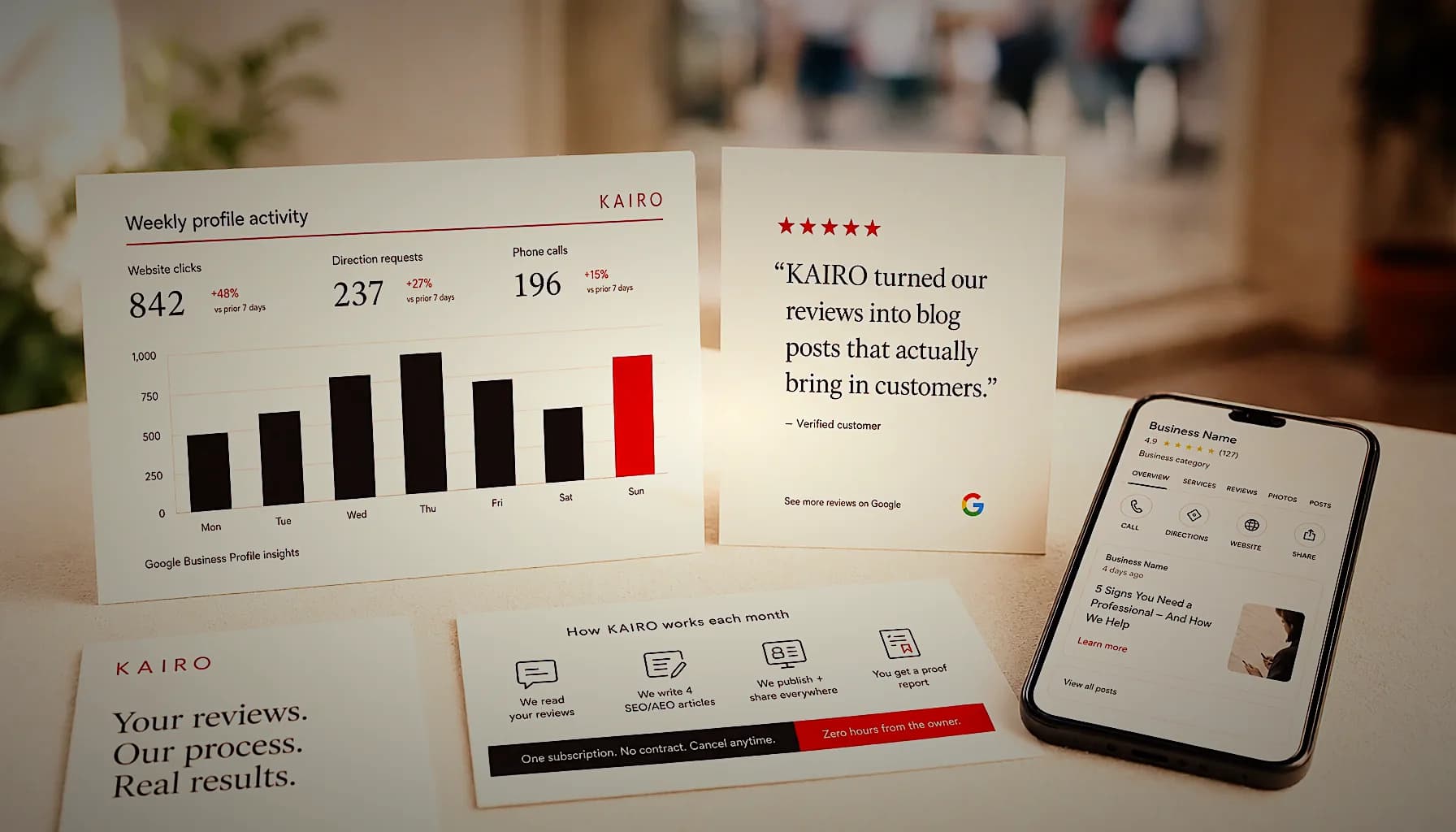
Google Business Profile posts do not directly change your position in the local pack, but they influence the signals that do: engagement on your profile, the keywords Google associates with your business, and how complete and active your listing looks. If you keep asking “how do I get my local business to show up on Google,” posts are one working part of the answer — not the whole engine.
Google has never listed posts as a ranking factor. What Google has said is that relevance, distance and prominence decide local results. Posts touch relevance and prominence, which is why consistent posting tends to correlate with better visibility, even when it is not the cause on its own.
This guide covers what posts actually do in 2026, how often to publish, what to write, how posts interact with articles on your website, and how AI assistants like ChatGPT and Gemini read your profile when someone asks for a local recommendation.
Do Google Business Profile posts help SEO, or do they just sit there?
Posts help indirectly. They add fresh, keyword-rich text to a property Google already trusts — your own profile — and they give searchers something to click, which produces measurable engagement on your listing.
Think of a Google Business Profile as a landing page you do not control the design of. Every element you fill in — categories, services, attributes, photos, Q&A, reviews, posts — tells Google what you do and whether the listing is being maintained. An abandoned profile and an active one send different signals.
Posts show up in three places: the “Updates” or “From the owner” section of your Business Profile panel, sometimes in the Maps app under your listing, and occasionally as a result for branded searches. They are not indexed like blog pages, so a post will rarely rank on its own in organic results.
Where posts earn their keep is the decision moment. Someone searches “dentist near me,” sees five listings, taps yours, and the first thing under your photos is a post from three days ago explaining same-week appointments. That reduces hesitation and increases the chance they call.
Those calls, direction requests and website clicks are tracked by Google. A listing that consistently converts the people who see it is a listing Google has reason to keep showing. That is the realistic chain of cause and effect — no magic, just behavior Google can measure.
One more practical benefit: posts let you use natural language your category field cannot hold. “Gluten-free tasting menu,” “emergency boiler repair on Sundays,” “Invisalign consultation” — these phrases enter your profile through posts and help Google match you to longer, more specific searches.
How do I get my local business to show up on Google if posts alone are not enough?
You need four things working together: a complete and correct Google Business Profile, a steady stream of reviews, pages on your own website that answer the questions people actually search, and consistent activity on the profile itself — including posts.
Start with the profile data. Primary category is the single heaviest lever most owners get wrong: pick the most specific category that describes your main service, then add secondary categories for everything else you do. Fill in services with real descriptions, not one-word labels.
Then reviews. Volume, recency, rating and the words inside the reviews all matter. A review that says “best sourdough in the neighborhood” plants a keyword in your profile that you could never write yourself, and Google reads it.
Your website carries the weight that posts cannot. Articles that answer real questions — pricing, process, comparisons, “what to expect” — are what gets indexed, linked and quoted. We cover the full checklist in our guide on how to get your local business to show up on Google.
Posts then act as the connective tissue. Each post can link to one of those articles, which means the profile keeps feeding traffic into pages that are built to convert and to be cited.
The common failure is doing one of the four and expecting results. A perfect profile with no website content caps out quickly. Great articles with a half-filled profile lose the map pack. The four reinforce each other, and the only one that needs weekly attention is posting.
Let your reviews write the articles
KAIRO turns your Google reviews into monthly articles that answer the questions your customers already ask — the pages your weekly posts can link to. Have a look at how it works.
How often should you post on Google Business Profile?
Post at least once a week. Weekly is the frequency where the profile always has a recent update visible, without burning hours you do not have. Many Google Business Profile post types stay visible for roughly seven days before being pushed down, which is where the weekly rhythm comes from.
Posting daily does not multiply the effect. There is no evidence that five posts a week outperforms one good post a week, and the quality drops fast when you are scraping for something to say every morning.
Posting once a quarter is the real problem. A profile whose last update is dated four months ago looks neglected to a searcher, and the keyword freshness benefit disappears entirely.
Here is a GBP post frequency plan that holds up over a year:
- Week 1: a service explainer — one thing you do, who it is for, what it costs to start
- Week 2: a question your customers actually ask, answered in 80 words, linking to the full article on your site
- Week 3: proof — a review quote, a before/after, a photo of real work
- Week 4: something time-bound — availability, a new item, opening hours around a holiday
That is 48 to 52 posts a year from four repeating slots. You never start from a blank page, and the mix keeps the profile from reading like an ad feed.
Keep each post between 150 and 300 words of useful text, add one real photo, and use a button — “Call now,” “Learn more,” “Book” — so the post has somewhere to send people. Posts without a destination waste the attention they earn.
One warning on offers and events: those post types have start and end dates, and an expired event sitting on your profile does more harm than no post at all. Set a reminder to clear them.
What should you actually write in a Google Business Profile post?
Write the answer to a question a customer asked you out loud this month. That single rule produces better posts than any content calendar, because it guarantees the topic has real demand and uses the words your customers use.
Your reviews are the cheapest source of these questions. Read the last 50 reviews end to end and you will find the same five themes repeating: parking, wait times, price surprises, a specific staff member, one dish or one treatment people keep naming.
Each theme is a post. If four reviews mention that you handled a nervous patient well, write a post about how the first visit works for anxious patients. That post is factual, specific, and impossible for a competitor to copy, because it came from your customers.
Strong post formats, in rough order of usefulness:
- The question-and-answer post. Headline is the question, body is the direct answer, button goes to the article that covers it in depth.
- The proof post. One review quote, one sentence of context, one photo.
- The process post. What happens in step one, two and three when someone books with you.
- The specific offer post. A named service with a starting point for price or timing, not a vague “great deals.”
- The news post. New hours, new equipment, a new location — anything that is genuinely new.
Avoid three things: stock photos, copy that could belong to any business in your category, and posts with no link. Google’s content policies also rule out posts that are purely promotional spam, so keep the useful-to-salesy ratio comfortably on the useful side.
If you want these posts to compound rather than evaporate, each one should point at a page on your site. That is why posts and articles work as a pair — and why an outside writer is often the practical answer. We compared the options in our breakdown of who can write monthly SEO articles for a small business.
What are the real local pack ranking factors in 2026?
Google ranks local results on three stated factors — relevance, distance and prominence — and everything you can control feeds one of them. Posts feed relevance and prominence. Nothing you do changes distance.
Relevance is how well your profile and website match the search. Primary category, service descriptions, the words in your reviews, the topics your site covers in depth, and yes, the language in your posts.
Distance is the gap between the searcher and your address or service area. You cannot move the business, but you can make sure your service area and address data are exact, and you can build dedicated pages for the neighborhoods you actually serve.
Prominence is how well known you are: review count and rating, mentions and citations across the web, links to your site, organic ranking of your own pages, and overall profile activity. This is the slow-moving one, and it is where consistent monthly content does the real work.
A practical ranking of what moves Google Maps ranking for most local businesses:
- Primary category and service accuracy — highest impact, takes 20 minutes
- Review volume and recency — high impact, requires a steady asking habit
- Website content depth on your core topics — high impact, compounds over months
- NAP consistency (name, address, phone identical everywhere) — medium impact, one-time cleanup
- Photos and profile completeness — medium impact, ongoing
- Posts and Q&A activity — supporting impact, weekly
Treat posts as the maintenance layer, not the foundation. A business that posts weekly and has 12 reviews will lose to a business that posts monthly and has 180 reviews, every time.
How do posts affect whether ChatGPT and Gemini recommend you?
AI assistants answer local questions by pulling from indexed web content, map data and reviews. Your Google Business Profile is part of that picture, and the specific, factual language in your posts and reviews is exactly the kind of text these systems extract when someone asks for a recommendation.
When a user types “best place for a vegan birthday dinner in my area” into ChatGPT or Gemini, the model is matching the request against text it can find. Businesses described in concrete terms — “vegan tasting menu for groups up to 20, private room, 48 hours’ notice” — get matched. Businesses described as “a warm atmosphere and passion for food” do not.
Posts help here in two ways. They put plain, specific statements about your services into a source AI systems can read, and they drive clicks to the articles on your site that answer the same questions in 1,500 words instead of 200.
The articles do the heavier lifting for AI answers, because they can be cited with a link. A page structured around a real question, with a direct answer in the first 50 words and an FAQ section at the bottom, is far more quotable than a homepage. That difference between ranking and being quoted is the subject of our guide on what AEO is and how it differs from SEO.
At KAIRO — an online content engine with a team based in Romania — this is the exact workflow we run for local businesses: read every Google review the business has, pull the recurring questions, publish 4 SEO/AEO articles a month on the client’s own site, and push Google Business Profile posts that point back to them. Every month you get a proof report showing what was published and what moved.
No contract, cancel anytime, and no hours from you. If you want to see what your own reviews would produce, contact us for details and we will put together a personalized quote.
Weekly posts are yours, articles are ours
You keep the four-slot posting rhythm going; KAIRO writes the website articles behind it, built from what your customers say in their reviews.
Frequently asked questions
Is it worth posting on Google Business Profile?
Yes, posting is worth it if you do it weekly and link each post to a useful page on your site. Posts are not a direct ranking factor, but they add keyword-rich text to your profile, keep the listing looking active, and increase calls and clicks from people already viewing you. One post a week with a real photo and a button is enough to see a difference in profile engagement.
How to improve SEO on Google Business Profile?
Start with your primary category, then fill in every services field with real descriptions, add real photos monthly, answer the Q&A section yourself, and build a steady flow of reviews. Keep your name, address and phone number identical across every directory, and post at least once a week. These basics outperform any trick, and most of them take under an hour to fix once.
Is SEO still worth it in 2026?
Yes, because the content that ranks on Google is the same content AI assistants quote when someone asks for a recommendation. Search behavior has split across Google, ChatGPT, Gemini and AI Overviews, but all of them read indexed web pages and reviews. A business with 40 well-structured articles answering real customer questions shows up in all four; a business with a five-page brochure site shows up in none.
What is the 80/20 rule in SEO?
The 80/20 rule in SEO means roughly 20% of your actions produce about 80% of your results. For a local business, that 20% is usually your Google Business Profile categories, your review flow, and a handful of pages that answer your highest-intent customer questions. Fix those three before touching anything technical.
How long does it take for Google Business Profile posts to show results?
Profile engagement changes — views, clicks, calls — typically show up within 2 to 4 weeks of consistent weekly posting. Movement in local pack position takes longer, usually 3 to 6 months, and depends far more on reviews and website content than on posts alone. Track calls and direction requests in your profile insights rather than watching rankings daily.
Do Google Business Profile posts expire?
Standard update posts stay on your profile but get pushed down over time, with most losing prominence after about seven days. Offer and event posts have explicit start and end dates and disappear from view once the end date passes. Clear out expired offers regularly, since an outdated promotion visible on your listing costs you more trust than posting nothing.
This article was produced by the Kairo engine.
The same system can write for your business — starting from what your customers already say.
Get your free review report