How do I get my business recommended by ChatGPT? A complete guide
October 13, 2026 · 11 min read
To get your business recommended by ChatGPT, you need three things in place: a complete, consistent profile across the web (Google Business Profile, directories, your own site), plenty of recent customer reviews that mention what you actually do, and published pages that answer the exact questions people ask the chatbot. ChatGPT recommends businesses it can find, verify and quote — so give it something to quote.
That is the short version. The longer version matters, because “how do I get my business recommended by ChatGPT” is a question with a real mechanism behind it, not a trick. Below is how the recommendation actually happens in 2026, and what you can control.
How does ChatGPT decide which local businesses to recommend?
ChatGPT recommends a business when it finds enough consistent, retrievable evidence about that business to answer a user’s question with confidence. For local queries, it searches the live web, pulls a handful of sources, and summarizes them. Your job is to be in that handful.
There are two paths into an answer. The first is the model’s training data — broad, slow to update, and not something you influence directly. The second is live retrieval: ChatGPT runs a search, reads the top results, and builds the answer from what it reads.
Live retrieval is where local businesses win. If someone asks “best family-friendly Italian restaurant in Austin with outdoor seating,” ChatGPT needs a page that says, in plain words, that a restaurant in Austin is family-friendly, Italian, and has outdoor seating. If no page says it, no AI can say it either.
This is also why ChatGPT often recommends the same few businesses in a city. Those businesses tend to have the same facts repeated in many places: their own website, their Google Business Profile, review sites, local blogs, a few news mentions. Repetition across independent sources reads as verification.
One more thing to understand: AI answers are assembled from sentences, not from rankings. Google gives you position 4; ChatGPT gives you a mention or nothing. A page that ranks tenth but contains the one clean, quotable sentence that answers the question can still get cited. That changes what good content looks like — which is the core of the difference between AEO and traditional SEO.
What do I need in place before ChatGPT can recommend my business?
Before any content strategy, you need a verifiable identity on the web. ChatGPT will not recommend a business it cannot confirm exists, operates in a specific place, and offers specific things. Five foundations cover almost all of it.
A complete Google Business Profile. Category, full address, phone number, hours, service area, attributes, photos, and a description written in normal sentences. AI tools read this data directly or through aggregators that do.
Name, address and phone that match everywhere. “Ste 4” on one site and “Suite #4” on another is a small inconsistency that weakens confidence. Pick one format and use it on your site, your profile, and every directory listing.
A website that states the obvious in text. Many local sites hide their key facts in images, sliders or PDF menus. Write them as text: what you do, where, for whom, price ranges, hours, who you serve. If it is not crawlable text, it is invisible to retrieval.
Reviews, recent and specific. A steady stream of reviews signals that the business is open and active. Reviews that mention services, neighborhoods and situations (“they fixed our heat pump in Round Rock on a Sunday”) give AI the exact language it needs to match a query.
Mentions you do not control. Local press, association listings, supplier pages, community blogs. Third-party corroboration is what turns “this business claims” into “this business is.”
None of this is glamorous and all of it compounds. Most local businesses we analyze are missing two or three of these five, and the gap shows up fast in AI answers — the competitor with a tidier footprint gets named instead.
Your reviews already say what AI needs
KAIRO reads your public Google reviews and turns the exact words your customers use into pages ChatGPT can quote. Have a look at how it works.
How do I get my business recommended by ChatGPT through content?
Publish pages that answer the specific questions your customers ask, in the words they use, and keep publishing them. That is the content mechanism behind every AI recommendation: a chatbot cites the source that most directly answers the prompt, and the most direct answer is usually a page built around that exact question.
Start with the questions, not with topics. “Our services” is a topic. “How much does a dog teeth cleaning cost in Denver?” is a question someone types into ChatGPT at 10pm. The second one earns citations; the first one does not.
Structure each page so an answer is easy to lift. Put the direct answer in the first 50 words. Use headings phrased as questions. Keep paragraphs to two or three sentences. Add a short FAQ block at the end with complete, standalone answers.
Be specific with numbers, places and conditions. “Affordable pricing” cannot be quoted. “Most repairs run $180 to $450, and we cover the 78704 and 78745 ZIP codes” can be quoted, and it tells the model exactly when to recommend you.
Cover the long tail, not just the headline keyword. A clinic should have pages on first-visit expectations, insurance questions, parking, what to bring, how long a procedure takes, and how it compares to the alternative. Each page is another door into an AI answer.
Then keep going. One burst of ten articles fades; consistent monthly publishing builds a footprint that search engines recrawl and AI tools keep finding. This is also the honest reason most local businesses stall — writing four solid question-led articles a month is real work, which is why it helps to know who can write monthly SEO articles for your small business before you commit to a plan.
Why are my customer reviews the best source for AI-ready content?
Your reviews are a transcript of what customers actually care about, written in their own language — and that language is almost identical to the prompts people type into ChatGPT. Mining reviews gives you a topic list you could not invent and phrasing you could not guess.
Read 200 reviews of a hotel and patterns appear: people keep mentioning late check-in, the walk to the train station, whether the breakfast is included, how quiet the rooms facing the street are. Those are five articles, and every one of them matches a real query.
Reviews also hand you the vocabulary. Customers do not say “HVAC remediation services.” They say “the AC died in July and someone came out the same day.” When your page uses the customer’s words, it matches the prompt far better than a page written in industry language.
There is a credibility layer too. Quoting a real review inside an article — attributed, unedited — gives the page something a template cannot fake: evidence. AI systems favor pages with specifics that can be cross-checked against other sources, and your public reviews are exactly that.
At KAIRO, an online content engine run by a team based in Romania, this is the starting point rather than an afterthought. We read every Google review a business has received, pull the recurring questions and complaints out of them, and turn those into the month’s articles. Nothing magic: your own reviews, read end to end, then written up as content that keeps working.
The practical takeaway works even if you do it yourself. Export your reviews, group them into themes, count how often each theme appears, and write the three most frequent themes first. You will have better topics in an hour than a keyword tool gives you in a week.
Does ranking on Google still matter for ChatGPT recommendations?
Yes — heavily. ChatGPT’s browsing and the AI answers inside Google both pull from live search results, so pages that rank well are the pages most likely to be read and cited. Google visibility and AI visibility are not separate projects; the second mostly rides on the first.
The overlap is large but not total. Classic SEO rewards pages that satisfy a click: depth, internal links, authority, speed. AEO rewards pages that satisfy an extraction: a clean answer in the opening lines, question-shaped headings, facts stated as complete sentences.
Here is the difference in practice. A 3,000-word “ultimate guide” with the answer buried in section six can rank and still never get quoted. A 900-word page that answers one question in its first paragraph may rank lower and get cited constantly.
So build for both. Solid technical basics, a well-structured site, local relevance, and reviews handle the Google half — the fundamentals covered in our guide on how to get your local business to show up on Google. Answer-first writing handles the AI half.
Watch both, too. Track your Google positions as usual, and separately test prompts in ChatGPT, Gemini and Google AI Overviews — “best [your service] in [your city],” “who does [service] near [neighborhood],” “is [your business] good for [specific need].” Log who gets named and how the answer changes over the months. That log is the only honest scoreboard for AI visibility in 2026.
How long does it take to show up in AI answers, and how do I measure it?
Expect first signs in 4 to 8 weeks and a stable presence in 4 to 6 months, assuming you publish consistently and your profile data is clean. New pages need to be crawled and indexed before any AI tool can retrieve them, and that indexing is the main bottleneck.
A realistic timeline looks like this. Weeks 1 to 2: fix your profile, your NAP consistency and your on-site facts. Weeks 3 to 8: publish the first batch of question-led pages and request indexing. Months 3 to 6: keep the cadence, add pages around the queries where competitors still get named instead of you.
Measurement needs a method, because AI answers vary between users and sessions. Pick 15 to 25 prompts that a real customer would type. Run them monthly in the same tools, in a clean session, and record three things: were you mentioned, were you cited as a source link, and which competitors appeared.
Add the supporting numbers you can actually verify: indexed pages, Google Business Profile views and calls, impressions and clicks in Search Console, new reviews per month. Together these tell you whether the footprint is growing even in months when a specific prompt swings the other way.
Do not expect a straight line. One model update can reshuffle which sources get quoted, and a single answer tells you very little. A six-month trend across 20 prompts tells you a lot.
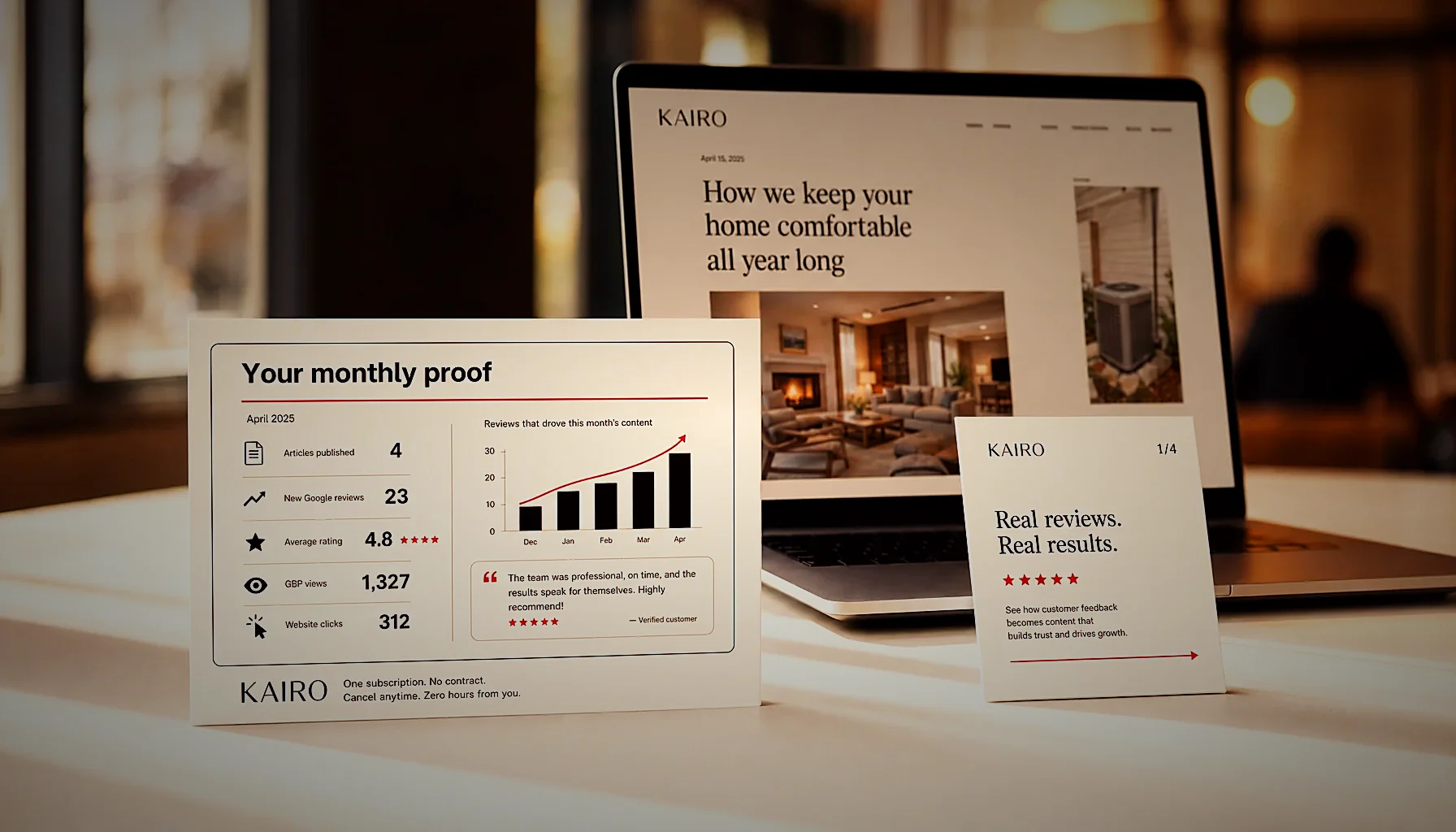
If you would rather not run this yourself, that reporting is part of what we do: 4 SEO/AEO articles a month published to your WordPress site, Google Business Profile posts, 1:1 carousels for social media, and a monthly proof report you can check line by line. One subscription, no contract, cancel anytime — and for pricing and availability, request a personalized quote.
Four question-led articles a month, handled
Consistent publishing is what builds AI visibility over 4 to 6 months, and it is also the part most local businesses never get to. KAIRO writes those articles for you, every month.
Frequently asked questions
How to make ChatGPT suggest your business?
Make your business easy to verify and easy to quote: complete your Google Business Profile, keep your name, address and phone identical everywhere, and publish pages that answer the exact questions customers ask. ChatGPT builds local recommendations from live search results, so it suggests businesses whose facts it can find and repeat. A page that states your services, city, price range and hours in plain text is far more likely to be used than a design-heavy site with no readable detail.
How do I get ChatGPT to promote my business?
You cannot pay for or buy placement in ChatGPT answers — there is no ad slot, so the only route is earning citations. That means consistent publishing of question-led content, steady recent reviews, and third-party mentions that corroborate what your own site claims. Businesses that publish a few focused answer pages every month usually start appearing in AI answers within 2 to 6 months.
How do I get my business ranked on ChatGPT?
ChatGPT has no ranking list; it either names your business in an answer or it does not. Instead of chasing a position, track mentions: pick 15 to 25 prompts a real customer would type, run them monthly, and record whether you are named and cited. Improve the prompts where a competitor appears instead of you by publishing a page that answers that specific question better.
How can I get AI to recommend my business?
Give every AI assistant the same clear, consistent evidence: accurate listings, recent reviews that mention specific services and locations, and content written answer-first so a model can lift a sentence directly. The same groundwork works across ChatGPT, Gemini, Perplexity and Google AI Overviews, because they all retrieve from the live web. Start by writing one page for each of your five most-asked customer questions.
Do customer reviews affect whether ChatGPT recommends my business?
Yes — reviews act as third-party evidence and as a source of the exact language customers use. A business with 300 recent reviews mentioning specific services, neighborhoods and situations gives AI tools much more to work with than one with 12 generic five-star ratings. Ask for reviews consistently, and reply to them so the text on your profile keeps growing.
How much content do I need to show up in AI answers?
Think cadence rather than volume: 4 well-structured answer pages a month beats 40 published once and abandoned. Each page should target one real question, open with a 30 to 60 word answer, and include specific numbers, locations and conditions. Most local businesses need 20 to 30 such pages before they appear reliably across a range of prompts.
This article was produced by the Kairo engine.
The same system can write for your business — starting from what your customers already say.
Get your free review report