How do you know if AI is mentioning your business? A complete guide
October 8, 2026 · 12 min read
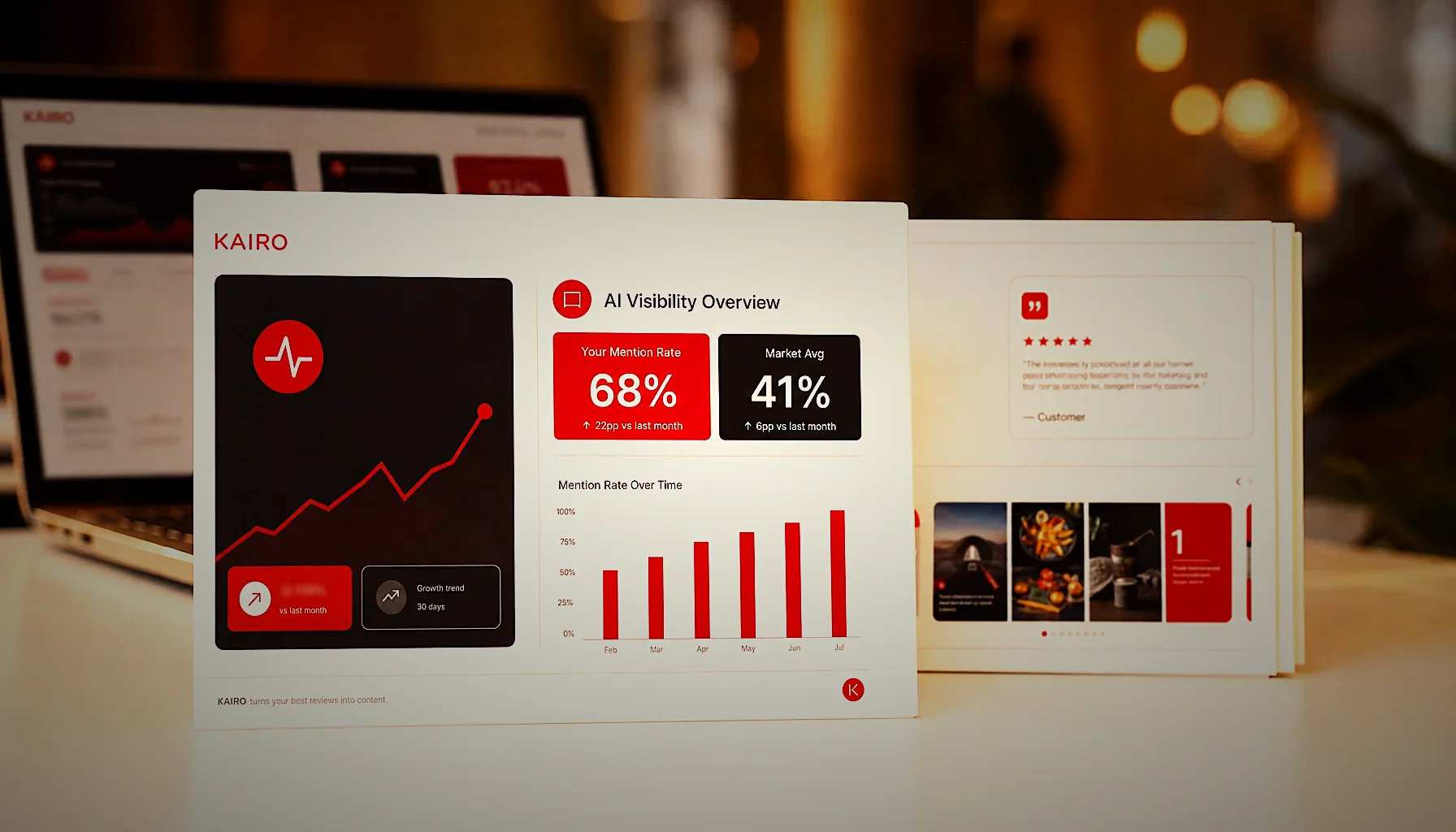
To check if AI mentions your business, ask ChatGPT, Gemini, Perplexity and Google AI Overviews the same questions your customers ask — “best pizza near [your city]”, “affordable dentist in [your city]” — then record whether your name appears, in what position, and what source the AI cites. Run the same prompt list every month and you have a real AI visibility report. If you’re wondering how do I get my business recommended by ChatGPT, this test is where you start: you can’t fix a gap you haven’t measured.
There is no official dashboard for this yet. Google Search Console doesn’t break out AI Overviews mentions, and no AI assistant sends you a report when it names you. So the job comes down to structured manual checks plus a few tools that automate parts of it.
This guide walks through the exact prompts to run, how to compare the available tracking methods in 2025, what each one costs, and what to do when the answer is “no, AI is not mentioning you.”
How do you check if AI mentions your business right now?
Open four tabs — ChatGPT, Google (logged out, AI Overviews on), Gemini and Perplexity — and run 10 to 15 customer-style questions about your category and city. Log the results in a spreadsheet: prompt, assistant, were you mentioned yes/no, position in the list, and which websites the AI cited. That spreadsheet is your baseline.
The prompts matter more than the tools. Nobody types “SEO content agency Romania reviews schema” into ChatGPT. They type “who should I hire to write blog posts for my restaurant?”
Use five prompt types for a clean read on your visibility:
- Category + location: “best family dentist in Austin”
- Problem-first: “my AC is leaking water, who do I call in Phoenix?”
- Comparison: “compare [your business] and [competitor]”
- Branded: “what do people say about [your business name]?”
- Recommendation: “recommend three wedding venues near Denver under $8,000”
Run each prompt in a fresh chat with memory and personalization turned off. ChatGPT’s memory will happily feed your own business back to you if you’ve discussed it before, which produces a flattering and completely useless result.
Pay close attention to the branded prompt. If you ask “what do people say about [your business]?” and the assistant invents services you don’t offer, lists the wrong hours, or says it has no information, that’s a content gap, not a technology failure. The AI is summarizing whatever text about you exists on the open web — and if that’s only a thin Google Business Profile and three directory listings, you get a thin answer.
Record the citations too. When AI Overviews or Perplexity names a source, that’s the page you need to either own or get mentioned on. In most local categories the cited sources are a mix of Google Maps, Yelp, Reddit threads, local news and the businesses’ own blog posts.
No mentions yet? Fill the content gap
If the assistants say they have no information about you, there simply isn't enough written about your business online. KAIRO turns your Google reviews into monthly articles that give AI something to quote.
Which AI visibility tracking methods should you compare?
You have four realistic options in 2025: manual prompt testing, a dedicated AI visibility tool, your existing analytics and search data, or a content service that reports on mentions for you. Each one answers a slightly different question, and most businesses end up using two of them together.
Here’s how they compare on what actually matters — effort, cost and what you learn:
| Method | What it tells you | Time per month | Typical cost | Best for |
|---|---|---|---|---|
| Manual prompt testing | Exact wording of AI answers, position, cited sources | 2–4 hours | $0 (plus any paid AI subscriptions) | Owners who want ground truth and have 20 prompts to track |
| Dedicated AI visibility tool | Share of voice across assistants, competitor comparison, trend over time | 30 minutes | Roughly $50–$500/month depending on prompt volume | Multi-location brands and agencies |
| Analytics + Search Console | Referral traffic from ChatGPT and Perplexity, impression shifts on informational queries | 1 hour | $0 | Confirming whether mentions turn into clicks |
| Content service with reporting | Mentions plus the content that caused them, published for you | 0 hours from you | Subscription — request a personalized quote | Owners who want the measurement and the fix in one place |
Manual testing is the most honest and the least scalable. It’s also the only method that shows you the full sentence the AI wrote about you, which is often the single most useful piece of information you’ll get all month.
Dedicated tools automate the prompt runs and chart your share of voice against named competitors. The trade-off is that they sample a fixed prompt set on a schedule, so they smooth over the variance that makes AI answers so unpredictable in the first place.
Analytics closes the loop. In Google Analytics 4, filter your traffic sources for referrals containing chatgpt.com, perplexity.ai, gemini.google.com and copilot.microsoft.com. The volume is usually small — low single-digit percentages of total sessions for most local businesses — but these visitors arrive already pre-sold, because an assistant just recommended you.
The fourth option exists because measurement alone changes nothing. Knowing you’re absent from ChatGPT answers for 14 of your 20 core prompts is useful only if something then gets written and published. That’s the gap a monthly content service is built to close.
How do you track brand mentions in ChatGPT specifically?
Track ChatGPT mentions by running a fixed list of 10 to 20 prompts in temporary chats on the first business day of every month, logging mention yes/no and position, then comparing month over month. Keep the prompts identical. Changing the wording changes the answer, and then you’re measuring your prompts instead of your visibility.
Three settings make the difference between a real test and a vanity test. Turn off memory in your ChatGPT settings. Use a temporary chat. And run at least one check from a logged-out browser or a different device, because personalization skews results toward whatever you’ve asked before.
Test both modes, too. ChatGPT answering from its training data gives you one picture — slower to update, heavily weighted toward well-established sources. ChatGPT with web search enabled gives you another, and that one responds to content you published last month.
That difference is strategically important. If you appear in search-enabled answers but not in training-data answers, your content is fresh but not yet widely referenced. If you appear in neither, you have a volume problem: there isn’t enough text about your business on the web for a model to have an opinion.
Log the sources ChatGPT cites in search mode. Build a simple list of the domains that keep appearing for your category — a local magazine, a Reddit subreddit, a comparison site, two competitor blogs. Those domains are your target list for mentions, guest contributions and review activity.
Watch for the three failure modes that show up repeatedly in local categories. One: total absence, where competitors are named and you aren’t. Two: hallucinated details, where you’re named but the services, prices or hours are wrong. Three: outdated identity, where the AI describes a version of your business from three years ago. Each one has a different fix, and only the first is about publishing more.
For the hallucination problem, the fix is making the correct facts easy to find in plain text on your own site: services, service area, hours, who you serve, what you don’t do. Models extract from clear sentences, not from carousels and image-only pages.
How do I get my business recommended by ChatGPT after you’ve measured the gap?
You get recommended by ChatGPT by publishing clear, specific answers to the questions your customers ask, on your own site, consistently — and by making sure third-party signals like Google reviews and local directories say the same thing. Assistants recommend businesses they can describe confidently. Confidence comes from repeated, consistent, extractable information.
Start with the questions. Take the 15 prompts from your baseline test and write a page or a blog post that answers each one directly, in the first 50 words, with the specifics an assistant can lift: prices or ranges, timelines, capacities, neighborhoods, what’s included. Vague copy gets skipped.
Then fix the structure. One question per H2, written the way a person would say it out loud. Short paragraphs. An FAQ section with 2 to 3 sentence answers. This is the practical core of answer engine optimization, and it’s the part most local sites never do.
Your reviews are the most underused raw material you own. Customers already tell you, in their own words, what they searched for, what worried them, and what won them over. Turning those reviews into articles produces content that matches real queries, because the phrasing comes from real customers instead of a keyword tool.
Keep the off-site signals aligned. Your name, address, phone number, hours and service list should match across your website, Google Business Profile, Apple Business Connect, Bing Places and the two or three directories that dominate your category. Contradictions make an assistant hedge, and a hedged answer names someone else.
Publishing cadence matters more than any single post. Four articles a month across a year gives an assistant 48 distinct, specific documents about your business to draw from. One post a quarter gives it four, and three of them are stale.
How often should you run an AI visibility report?
Run a full AI visibility report monthly, on the same date, with the same prompt list. Monthly matches how fast AI answers actually change, gives you enough signal to spot a trend, and keeps the work to a couple of hours. Weekly checks mostly measure noise; quarterly checks miss the window to react.
A report worth reading has five parts. Mention rate — how many of your prompts produced a mention, as a percentage. Average position when you are mentioned. Which assistants mention you and which don’t. The cited sources. And the diff: what changed since last month, and what you published in between.
That last column is what turns a report into a decision. If you published three articles about wedding catering packages in March and your mention rate on catering prompts moved from 1 in 5 to 3 in 5 by May, you know what to do more of.
Expect lag. Content typically needs 4 to 12 weeks to start showing up in search-enabled AI answers, and considerably longer to influence answers drawn from training data. Judging a content program after three weeks tells you nothing.
Don’t measure AI visibility in isolation either. Track it next to your Google rankings, your Google Business Profile insights and your organic traffic, because the same content usually moves all of them. Google Business Profile posts are a good example: they feed the local panel that assistants frequently read when answering “near me” style questions.
At KAIRO, our online team based in Romania sends every client a monthly proof report alongside the four articles we publish — mentions, what went live, what moved. No contract, cancel anytime, and the numbers are ones you can verify yourself by running the same prompts we ran.
What are the trade-offs between doing this yourself and outsourcing it?
Doing it yourself costs 2 to 4 hours a month for measurement and 6 to 15 hours for the content that fixes what you find. Outsourcing costs a subscription and roughly zero hours of your time. The real variable isn’t money — it’s whether the work survives your busy season.
Here’s the honest comparison across the three paths most local businesses consider:
| Criterion | DIY | Freelance writer | Content subscription |
|---|---|---|---|
| Your time per month | 8–19 hours | 3–5 hours (briefing, edits, publishing) | Close to zero |
| Consistency | Drops first when work gets busy | Depends on one person’s availability | Fixed monthly output |
| AEO structure | Needs learning | Varies widely by writer | Built into the process |
| Measurement included | Only if you build it | Rarely | Monthly proof report |
| Source material | Your own knowledge | Briefs and keyword tools | Your own Google reviews, read end to end |
DIY works genuinely well for one type of owner: someone who enjoys writing, knows the business cold, and protects two half-days a month on the calendar. That person often outperforms an agency, because the specifics in their writing are real.
A freelance writer suits businesses with a clear editorial plan and someone internally who can brief and approve. The common failure isn’t quality, it’s cadence — a good writer takes on a bigger client and your pipeline stalls for six weeks.
A subscription makes sense when the content keeps not happening. The output is fixed, the publishing is automatic, and nothing depends on you finding a free Tuesday. That’s the model we run at KAIRO: review analysis, four SEO/AEO articles a month published straight to your WordPress site, Google Business Profile posts, 1:1 carousels for social, and a monthly proof report.
Every article passes our own quality gates before it goes anywhere.
Whichever route you pick, keep the measurement separate from the person doing the work where you can. Running your own 15-prompt check once a month takes 30 minutes and means you’re never relying on someone else’s screenshot. It also sharpens the brief: you’ll know exactly which questions you’re losing.
Measuring is step one, publishing is step two
Your spreadsheet shows the gaps; articles close them. KAIRO writes and publishes monthly SEO and AEO content for local businesses, built from your own public reviews.
Frequently asked questions
How to get AI to mention your business?
Publish clear, specific answers on your own website to the exact questions customers ask, and keep your business details consistent across Google Business Profile and major directories. AI assistants recommend businesses they can describe confidently, which requires repeated, extractable information rather than vague marketing copy. Start by writing one page per customer question, with the direct answer in the first 50 words.
How to track brand mentions in ChatGPT?
Run a fixed list of 10 to 20 customer-style prompts in temporary ChatGPT chats with memory turned off, on the same date each month, and log whether your business is mentioned and in what position. Test both the default mode and web search mode, because they produce different answers. Keep the prompt wording identical month to month, or you’ll be measuring your prompts instead of your visibility.
How can I check the AI visibility of my website?
Ask ChatGPT, Gemini, Perplexity and Google AI Overviews 10 to 15 questions your customers would actually type, then record your mention rate, your position and the sources each assistant cites. Cross-check the results against your Google Analytics 4 referral data, filtering for chatgpt.com and perplexity.ai. A dedicated AI visibility tool can automate this for roughly $50 to $500 a month if you want trend charts and competitor comparisons.
Is there a 100% accurate AI detector?
No — no AI detector is 100% accurate, and the major vendors say so themselves, since detectors produce both false positives on human writing and false negatives on edited AI text. That’s a separate question from AI visibility tracking, which measures whether assistants mention your business rather than how text was written. For visibility, the reliable method is running the same prompts yourself and recording what the assistants say.
Does being mentioned in AI answers bring real traffic?
Yes, though the volume is modest for most local businesses — AI referrals typically show up as low single-digit percentages of total sessions in 2025. The visitors tend to convert better than average because an assistant effectively pre-recommended you. Check it yourself in Google Analytics 4 by filtering session sources for chatgpt.com, perplexity.ai and gemini.google.com.
How long before new content shows up in AI answers?
Content usually starts appearing in search-enabled AI answers within 4 to 12 weeks of publishing, and takes considerably longer to influence answers drawn from a model’s training data. Consistency beats volume in any single month, because assistants favor sources that keep publishing. A year of four articles a month gives an assistant 48 specific documents about your business to draw from.
This article was produced by the Kairo engine.
The same system can write for your business — starting from what your customers already say.
Get your free review report