Who can write monthly SEO articles for my small business? A complete guide
November 12, 2026 · 11 min read
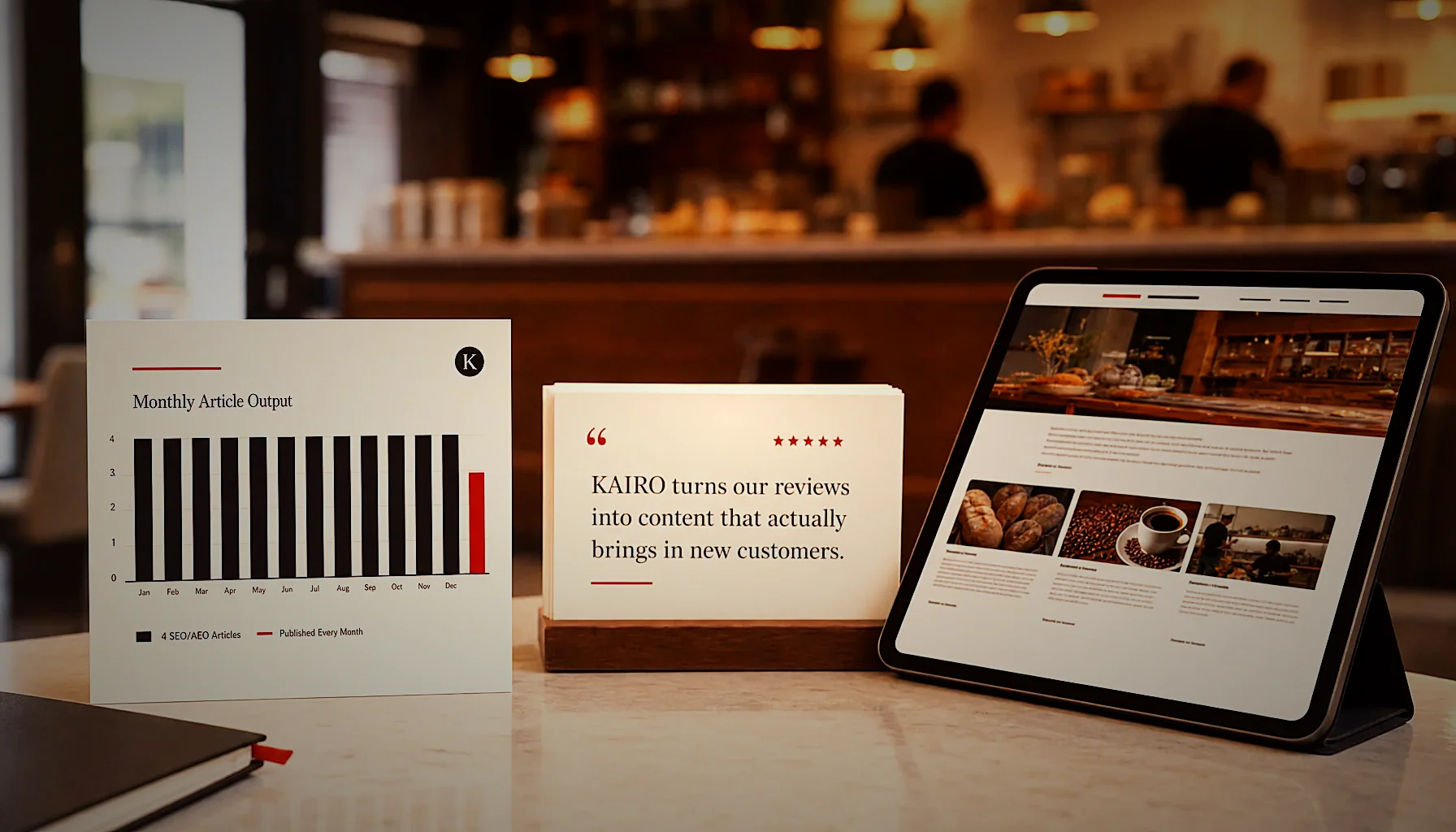
You run a six-table restaurant, and at 11pm you’re staring at a blank blog page you promised yourself you’d fill. If you’re asking who can write monthly SEO articles for my small business, you have four realistic options: a freelance writer, an agency retainer, an in-house hire, or a content subscription that runs on autopilot. Each one differs in price, speed, and how many hours it takes from you.
Who can write monthly SEO articles for my small business, option by option?
Four types of provider write monthly SEO articles for small businesses: freelance writers (roughly $100–$500 per article), full-service SEO agencies ($1,500–$7,000 a month), an in-house marketing hire (a full salary), and productized content subscriptions that publish a fixed number of articles every month for one flat fee.
The differences that matter are not writing quality alone. They are consistency, how much of your own time gets eaten, and whether anyone is accountable for publishing, not just drafting.
Freelance SEO writer. You get a human who can learn your voice and write genuinely well. You also get the management overhead: briefs, keyword research, revisions, invoices, and the month they go on vacation or raise their rate.
SEO agency retainer. Broad scope — technical audits, link building, reporting, sometimes ads. Strong if you have budget and a real marketing problem to solve. Content is often one line item among many, and the junior writer assigned to your account may never have set foot in a business like yours.
In-house hire. Makes sense once content drives a meaningful share of revenue and you need someone on-site every day. For a single-location salon or auto shop, a full salary for blog posts rarely adds up.
Content subscription. A fixed output, a fixed price, no contract. You trade bespoke creative direction for reliability: articles land every month whether or not you had time to think about marketing. KAIRO, an online content engine with a team based in Romania, sits in this category — four SEO/AEO articles a month, Google Business Profile posts, and a monthly proof report, built from your own Google reviews.
Most owners move through these options in order. They start writing themselves, hire a freelancer, drift into a stop-start pattern, then look for something that just keeps running.
Freelance SEO writer vs subscription — which one fits a local business?
A freelance SEO writer fits businesses with a marketing person to manage them and a clear topic plan. A subscription fits owners who have neither. The deciding factor is who does the thinking: with a freelancer, you brief; with a subscription, the brief is part of the service.
Here’s the honest comparison on the criteria that actually change outcomes.
- Cost predictability. Freelancers bill per article or per hour, so costs swing with scope. A subscription is one monthly figure you can budget around.
- Consistency. Freelance output depends on one person’s calendar. A subscription is built around a fixed monthly volume — four articles, every month, regardless of how busy your season is.
- Strategy. Good freelancers will push back on bad topic ideas. Cheap ones will write whatever you send. A productized service should bring the topic plan with it.
- Your hours. A freelance relationship typically costs you 3–6 hours a month in briefing, review, and publishing. A subscription with automatic publishing to WordPress should cost you close to zero.
- Voice. A long-term freelancer who visits your venue will nail your tone better than anything automated. That’s a real advantage if you have the time to cultivate it.
Neither option is better in the abstract. If you enjoy marketing and have a spare afternoon each month, a freelancer gives you more control. If every spare afternoon already belongs to staffing, suppliers, or customers, control is not what you need — output is.
One more practical point: ask any provider who publishes. Plenty of writers hand over a Google Doc and consider the job done. The doc sits in your drive for five weeks, and the content never ranks because it was never live.
Four articles a month, written for you
If briefing a writer is the part that never happens, KAIRO builds the topics from your own Google reviews and publishes straight to your site. No contract, one flat monthly fee.
How much should a small business pay for monthly SEO content in 2026?
In 2026, small businesses typically pay $500–$2,500 a month for a content-focused SEO program, and $1,500–$7,000 a month for full-service SEO that includes technical work and link building. Individual articles from freelancers run $100–$500 depending on length and research depth.
Those ranges are wide for a reason. A 700-word post stitched together from other blogs costs very little. A 2,000-word article researched against real customer questions, with schema markup and internal links, costs considerably more because it takes longer and lasts longer.
Before you compare prices, normalize what you’re buying. Ask every provider the same five questions:
- How many articles per month, and what word count?
- Who chooses the topics, and based on what data?
- Does publishing to my site count as included work?
- What do I receive each month that shows whether it worked?
- Is there a contract, and what happens if I cancel in month three?
Cheap content has a specific failure pattern. It reads fine, publishes fine, and never gets cited anywhere because it answers no question a real customer ever asked. You pay less per article and get nothing per article.
The other trap is the 12-month contract. SEO does take months to compound, but a contract protects the agency, not you. KAIRO works with no contract — cancel anytime — because the monthly proof report is supposed to be the reason you stay. For pricing on your specific situation, request a personalized quote.
Budget this way instead of by article price: decide what one new customer is worth to you. If a new patient at a clinic is worth $400 over a year, a $900 monthly content program needs roughly three extra patients a month to make sense. That math is far more useful than comparing per-word rates.
Can ChatGPT write the SEO articles instead?
ChatGPT can write a readable draft in two minutes, but it cannot do the parts that make content rank: knowing what your customers actually ask, verifying facts about your business, publishing on a schedule, and checking quality before the post goes live. Used alone, it produces generic pages that look like everyone else’s.
Google does not ban AI-assisted content. It ranks helpful, original content and demotes mass-produced pages with no added value. The distinction is input, not tooling.
Three things an off-the-shelf chatbot can’t supply on its own:
- Your real customer language. A generic model guesses what people ask. Your Google reviews tell you exactly — which dish gets named, which fear comes up before booking, which staff member gets thanked. Our full breakdown of what customers say in Google reviews shows how much signal sits in that pile of text.
- Factual discipline. Language models invent prices, capacities, and opening hours. That’s a reputation problem, not a style problem. Every claim needs a verified source.
- Follow-through. Drafting is the easy 20%. Topic planning, internal linking, schema markup for local business pages, publishing, and measurement are the other 80%.
The realistic answer in 2026 is a system where AI handles volume and humans or automated quality gates handle accuracy. That’s how KAIRO’s content engine works: it researches, writes, and checks every article against quality gates before it goes anywhere, with your own reviews as the raw material.
If you want to test this yourself, ask ChatGPT to write a blog post about your business and read it carefully. It will be grammatical, plausible, and completely interchangeable with your competitor’s version. That’s the ceiling of prompt-only content.
How do I get my local business to show up on Google and in AI answers?
You show up by giving search engines and AI assistants specific, structured answers to the questions your customers ask, published consistently on your own site. One post a quarter does nothing. A steady monthly cadence of question-led articles, plus an accurate Google Business Profile, is what builds the pattern.
AI answers work differently from classic rankings. ChatGPT, Gemini, and Google AI Overviews pull short, extractable passages from sources they consider reliable, then cite or paraphrase them. If your site has no page that answers “is there parking at X” or “do you do gluten-free,” there is nothing to pull.
Four things move the needle for a local business:
- Question-shaped pages. Each article should answer one real query in its first 50 words, with the rest supporting it. That format is what gets quoted.
- Consistent cadence. Four articles a month builds 48 in a year, covering nearly every question a customer might type. A content plan for local business keeps those topics from overlapping.
- Clean technical signals. Schema markup, fast pages, and correct business details so machines can parse who and where you are.
- Reviews and profile activity. Google Business Profile posts, fresh reviews, and consistent name-address-phone data across directories.
Getting recommended by ChatGPT follows the same logic as ranking, with one addition: specificity. “We offer excellent service” is unquotable. “We seat 40 indoors, 24 on the terrace, and take walk-ins until 9pm” is a fact an assistant can repeat to someone asking for a table tonight.
Whoever writes your monthly articles should understand this. If a provider’s samples are all vague lifestyle prose with no numbers, no questions as headings, and no concrete detail, they’re writing for 2015.
How do you know whether the content is working?
You know it’s working when you can see three things move month over month: impressions and clicks for question-based queries in Google Search Console, the number of queries your site ranks for at all, and calls or form fills that start from organic search. Anything else is decoration.
Most content providers send a traffic graph with an upward arrow and call it a report. That graph tells you almost nothing about which article earned what, or whether the work should continue.
A useful monthly report answers plain questions:
- What got published, and on which queries did each piece start appearing?
- Which keywords moved from page two into the top ten?
- How many total queries does the site now show up for, compared with last month?
- Are AI assistants mentioning the business when asked about this category locally?
- What’s the plan for next month, based on what just happened?
Our guide to what a monthly SEO report for small business should contain goes deeper into the specific metrics worth tracking and the ones safe to ignore.
Be realistic about timing. New articles typically begin collecting impressions within 2–8 weeks, and meaningful ranking movement on competitive local queries takes 3–6 months of consistent publishing. Any provider promising faster than that is selling you something else.
KAIRO sends a monthly proof report plus an AI visibility report for exactly this reason: so the decision to keep going or stop is yours, based on numbers you can check in your own Search Console. No contract means the report has to earn the next month.
Content that keeps running without you
Four SEO/AEO articles, Google Business Profile posts and a monthly proof report, all built from what your customers already wrote about you. Cancel anytime.
Frequently asked questions
How much does SEO cost for a small business?
Small businesses typically spend $500–$2,500 a month on content-led SEO and $1,500–$7,000 a month on full-service SEO that adds technical work and link building. Individual articles from freelance writers run $100–$500 each depending on length and research. Decide your budget by what one new customer is worth: if a customer brings $400 in a year, a $900 monthly program needs about three extra customers to pay for itself.
Can ChatGPT write SEO content?
ChatGPT can write a competent draft, but it cannot choose the right topics, verify facts about your business, publish on schedule, or check quality before the post goes live. Used alone it produces generic pages that read like every competitor’s. The workable approach in 2026 pairs AI drafting with real customer data — your own Google reviews — and quality checks before anything publishes.
Is SEO worth it for small businesses?
Yes, for businesses whose customers search before buying — restaurants, clinics, salons, venues, home services, and auto shops. Organic search traffic keeps arriving after you stop paying, unlike ads, which stop the day the budget does. The honest caveat is timeline: expect 3–6 months of consistent publishing before you see meaningful movement on local queries.
Is SEO still relevant in 2026?
SEO is still relevant in 2026, but the target has widened from blue links to AI answers. ChatGPT, Gemini, and Google AI Overviews pull their responses from indexed web content, so the pages that rank are also the pages that get cited. Clear, question-led content with specific facts now serves both audiences at once.
Should I hire a blog writer for my small business or use a subscription?
Hire a freelance blog writer if you have someone to brief them and a topic plan ready; choose a subscription if you want articles to appear without your involvement. A freelance relationship usually costs you 3–6 hours a month in briefs, reviews, and publishing. A subscription with automatic publishing to your WordPress site removes nearly all of that time.
How many blog articles a month does a small business need?
Four articles a month is a practical baseline for a local business, building to 48 pieces in a year — enough to cover almost every question a customer might ask. Fewer than two a month rarely builds the topical depth search engines and AI assistants reward. Quality still matters more than raw volume: each article should answer one real query clearly in its opening lines.
This article was produced by the Kairo engine.
The same system can write for your business — starting from what your customers already say.
Get your free review report