Complete guide to building a content plan for a local business next year
October 31, 2026 · 11 min read
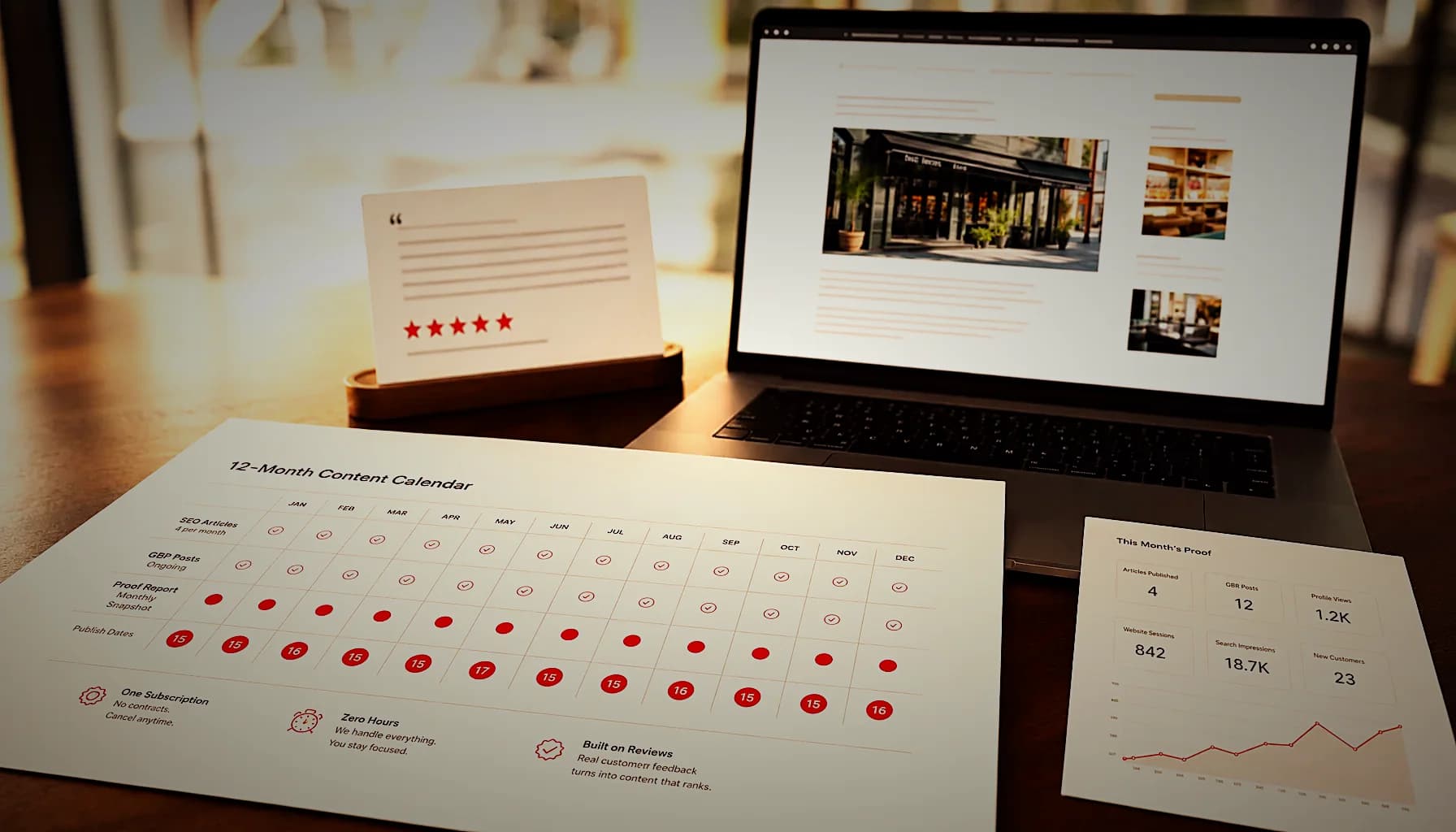
Start a content plan for a local business by listing the questions your customers already ask, then assign one article to each question across 12 months. Pull the questions from your Google reviews, your inbox and your phone calls. Four articles a month covers 48 topics a year — enough to own the searches that bring you paying customers.
What is a content plan for a local business, exactly?
A content plan for a local business is a written list of what you publish, when you publish it, and which customer question each piece answers. It covers blog articles on your site, Google Business Profile posts, and the social posts that point back to both.
It is not a strategy document nobody reads. A usable plan fits on one page: month, topic, primary keyword, format, and where it gets published.
The difference between a plan and random posting is repetition. Google and AI assistants need to see consistent, topic-focused publishing before they treat your site as a reliable source on “best brunch in [your city]” or “emergency plumber near me.”
Most local businesses already have the raw material. A restaurant with 300 reviews has hundreds of sentences about parking, noise levels, gluten-free options, high chairs, and whether the terrace is heated. Those sentences are search queries in disguise.
A plan turns that pile into a schedule. Instead of wondering what to write in March, you look at row 9 of your calendar and it says “Is there parking near [venue]? — 1,100 words, publish March 12, link to contact page.”
The plan also decides what you will not do. A dental clinic does not need TikTok trends; it needs 20 articles answering what a root canal costs, how long an implant lasts, and whether you can book an appointment on a Saturday.
How do you plan blog topics for a whole year without running dry?
Collect questions from four sources: your Google reviews, the questions customers ask in person or by phone, Google’s “People also ask” boxes for your main services, and what competitors in your city already rank for. Sort them by how close they sit to a purchase. That list will exceed 48 topics on the first pass.
Reviews are the richest source because they use your customers’ own words, not industry vocabulary. A guest writes “we waited 40 minutes but the staff kept us topped up” — that is an article about reservation policy and peak hours.
Read every review, not the last 20. Patterns only show up at volume, and the fifth mention of “hard to find the entrance” is the signal that you need a “how to find us” page with landmarks and parking details. We go deeper into this in our guide on which review insights should go straight into your website content.
Next, write down every question you answer on the phone in one week. Most owners are shocked at the repetition: opening hours on holidays, whether you take walk-ins, whether the price includes VAT, how far in advance to book.
Then check Google. Type your main service plus your city, scroll to “People also ask,” and expand three levels deep. Each expansion generates more questions, and each question is a potential H2 or a standalone article.
Finally, group the questions into 5 or 6 topic clusters — for a hotel that might be rooms, breakfast, location and transport, events, and pets. Clusters keep the calendar coherent and help search engines understand what your site is actually about.
A practical ratio: 60% of your topics should answer buying questions (“how much does X cost in [city]”), 30% should answer practical logistics (“is there parking”, “do you take dogs”), and 10% can be seasonal or news-driven.
Your reviews already hold the topics
KAIRO reads your public Google reviews and turns the questions hiding in them into a monthly plan of articles. You get the topics and the finished pieces without writing the list yourself.
How much should a local business publish each month?
Four articles a month is the practical minimum for a local business that wants to compete in search and in AI answers. That gives you 48 pieces a year, enough to cover a full service list plus the logistics questions, while staying slow enough to keep quality high.
One article a month does not build a pattern. By the time the fourth piece goes live, the first is nine months old and the site still has no depth on any single topic.
Ten articles a month usually breaks on quality. Thin, repetitive pages compete with each other for the same keyword and dilute the signal instead of strengthening it.
Pair each article with Google Business Profile posts. The article does the long-tail ranking work on your own domain; the profile post feeds the map pack and keeps your listing active, which matters if you have seen your Google Business Profile ranking drop after a quiet period.
Length matters less than completeness. An article that fully answers “how much does a wedding cost at a venue in Austin” in 1,400 words beats a 3,000-word piece that circles the question.
Expect the compounding effect to show between month 3 and month 6. Early articles start picking up long-tail impressions first, then clicks, then assisted bookings — the order is almost always the same. Our breakdown of what a restaurant gains from four blog articles a month walks through the pattern.
Set the volume once and protect it. Publishing cadence is the single easiest variable to control and the first one that collapses when the business gets busy — which is exactly when you need the content working for you.
How do you structure a 12-month content calendar?
Lay the year out in four quarters, assign one topic cluster per quarter as the anchor, then fill each month with 3 evergreen articles and 1 timely piece. Evergreen content carries the traffic; timely content captures the seasonal spikes.
Start with your revenue calendar, not the marketing calendar. A ski rental shop plans backwards from November; a wedding venue plans backwards from January, when couples start searching.
Publish seasonal content 6 to 8 weeks before the season starts. An article about Christmas party bookings that goes live on December 10 has missed the people who booked in October — our holiday content plan for local business covers the full Q4 timeline.
A workable monthly template for 2026 looks like this: week 1 a money-keyword article (service plus city plus price), week 2 a logistics or FAQ article, week 3 a comparison article (“X vs Y”), week 4 a seasonal or local-event piece.
Comparison articles earn more AI citations than any other format, because assistants need structured criteria to answer “which is better” questions. Give them tables of criteria, clear verdicts, and specific numbers.
Leave two slots per quarter empty. A new competitor opens, a review mentions something unexpected, a local event gets announced — you want room to react without blowing up the schedule.
Write the calendar in a spreadsheet with six columns: publish date, working title, primary keyword, format, internal links to add, and status. Anything more elaborate becomes admin work nobody does.
Review the calendar quarterly, not monthly. Search data needs 90 days to say anything useful, and reshuffling every four weeks just hides whether the plan is working.
What should a yearly marketing plan include besides blog articles?
A yearly marketing plan for a local business needs five moving parts: website articles, Google Business Profile posts, review generation, social distribution, and a monthly measurement report. Content without distribution and measurement is just writing.
Google Business Profile is the highest-leverage surface for a local business, and it is free. Post weekly, keep hours and services accurate, and add photos — the profile is what most people see before your website.
Build review generation into the plan as a recurring task, not a campaign. A steady flow of fresh reviews feeds both your map ranking and your content pipeline, since each new review brings new customer language.
Distribution means repurposing each article into formats people actually see: a carousel for Instagram, a short profile post, a line in your email newsletter. One article should produce at least three downstream assets.
Then there is technical readiness. If AI crawlers cannot read your pages, none of the content gets cited in ChatGPT, Gemini or Google AI Overviews — check whether your website is readable by AI crawlers before you scale publishing.
Measurement should be a short monthly report, not a dashboard you log into twice a year. Three numbers are enough: organic impressions, which queries you now appear for, and which pages brought calls or bookings.
Budget realistically. Decide whether you write in-house, hire a freelancer per article, or run a content subscription — our comparison of an SEO agency vs a content subscription lays out what each model actually delivers for a local business.
How do you get your content cited by ChatGPT and AI assistants?
AI assistants cite content that answers a question directly in the first two sentences, uses specific numbers, and lives on a crawlable page with clear structure. Write the answer first, then the explanation — the opposite of how most blog posts are built.
Assistants extract passages, not whole pages. A paragraph that reads “A christening reception in Dublin typically costs €45 to €75 per guest” gets pulled; a paragraph that builds up to the price over 200 words does not.
Use question-shaped headings that match how people actually type. “How much does a family photo session cost?” beats “Pricing information” every time, for both Google and AI answers.
Add an FAQ section to every article with 4 to 6 questions and answers of 2 to 3 sentences. This is the single easiest format for an assistant to quote verbatim, and it maps directly to Google’s People Also Ask results.
Specificity is what separates cited content from ignored content. Names of neighborhoods, exact capacities, real price ranges, opening hours, travel times from the airport — these are the details an assistant has nowhere else to find.
Keep your facts consistent across your website, your Google Business Profile and your social accounts. Conflicting hours or phone numbers make an assistant less likely to trust any single source.
In 2026, the practical goal is to be the most complete local source on your own specialty. No one guarantees a citation, but a site with 48 well-structured answers has far more surfaces to be found on than a site with a homepage and a contact form.
Who should actually write the content, and how do you keep it running?
Pick the model you can sustain for 12 months, not the one that looks best in month one. Owners who write it themselves usually stop by month three; the plan only survives if someone else owns the calendar and the publishing.
Writing in-house works when one person has 6 to 8 hours a month protected on the calendar and knows the business well. It fails when that person is also doing payroll and service recovery.
Freelancers per article work for one-off pieces but rarely build topical depth. Each writer starts from scratch, so the internal linking and keyword mapping tend to drift.
A content subscription keeps the cadence fixed, which is what search and AI visibility actually reward. KAIRO, an online content engine with a team based in Romania, publishes 4 SEO/AEO articles a month to your own WordPress site, plus Google Business Profile posts and a monthly proof report.
Our process starts with your reviews, not a template. Every Google review you have received gets read and analyzed, and the questions inside those reviews become the article calendar.
Every article passes our own quality gates before it goes anywhere, and the same engine renders 1:1 carousels for social and publishes automatically to your site and your social accounts. No contract, cancel anytime, and no writing hours from you.
Whichever model you choose, keep the plan boring and repeatable: one spreadsheet, four articles a month, weekly profile posts, one report. For pricing on a plan built from your own reviews, request a personalized quote — we will show you the review analysis first, so you can check the logic before you commit.
Four articles a month, written for you
If protecting the cadence is the hard part, KAIRO keeps it running: new articles every month, built from what your customers actually say about you.
Frequently asked questions
What is the 70/20/10 rule for content?
The 70/20/10 rule allocates 70% of your content to proven, evergreen topics, 20% to adapting formats that work for others in your industry, and 10% to experiments. For a local business, that means roughly 34 of your 48 annual articles answer core customer questions, 10 adapt a competitor’s winning format, and 4 test something new. The split keeps output reliable while leaving room to find what performs.
What is the 3-3-3 rule for social media?
The 3-3-3 rule suggests a balanced posting mix: 3 posts about your business, 3 posts that share useful or educational content, and 3 posts that engage your community or amplify others. It is a simple way to avoid an account that only sells. For a local business, the practical version is 3 posts a week — one offer, one tip, one piece of customer proof such as a review quote.
What are the 7 contents of a business plan?
A standard business plan contains seven sections: executive summary, company description, market analysis, organization and management, products or services, marketing and sales strategy, and financial projections. Your content plan sits inside the marketing and sales section. Keeping it there matters, because content topics should be chosen against revenue goals, not posting habits.
How to structure a content plan?
Structure a content plan in four steps: collect customer questions, group them into 5 or 6 topic clusters, assign one article to each question across 12 months, and set a fixed publishing cadence. Record it in a single spreadsheet with columns for date, title, keyword, format and status. Four articles a month plus weekly Google Business Profile posts is a realistic baseline for a local business.
How do I get my local business to show up on Google?
You show up on Google by combining a complete, actively posted Google Business Profile with a website that answers the searches your customers actually type. Consistent publishing is what builds that second half — service pages, price questions, and local logistics articles. Most local businesses see long-tail impressions start to move within 3 to 6 months of steady monthly publishing.
Who can write monthly SEO articles for my small business?
Your options are an in-house writer, a freelancer paid per article, an SEO agency on retainer, or a content subscription that publishes a fixed number of articles each month. Subscriptions suit small businesses because the cadence stays fixed and the owner spends no writing hours. KAIRO, for example, publishes 4 SEO/AEO articles a month built from your own Google reviews, with no contract and cancel anytime.
This article was produced by the Kairo engine.
The same system can write for your business — starting from what your customers already say.
Get your free review report