Why is my competitor outranking me on Google Maps? A complete guide
November 14, 2026 · 10 min read
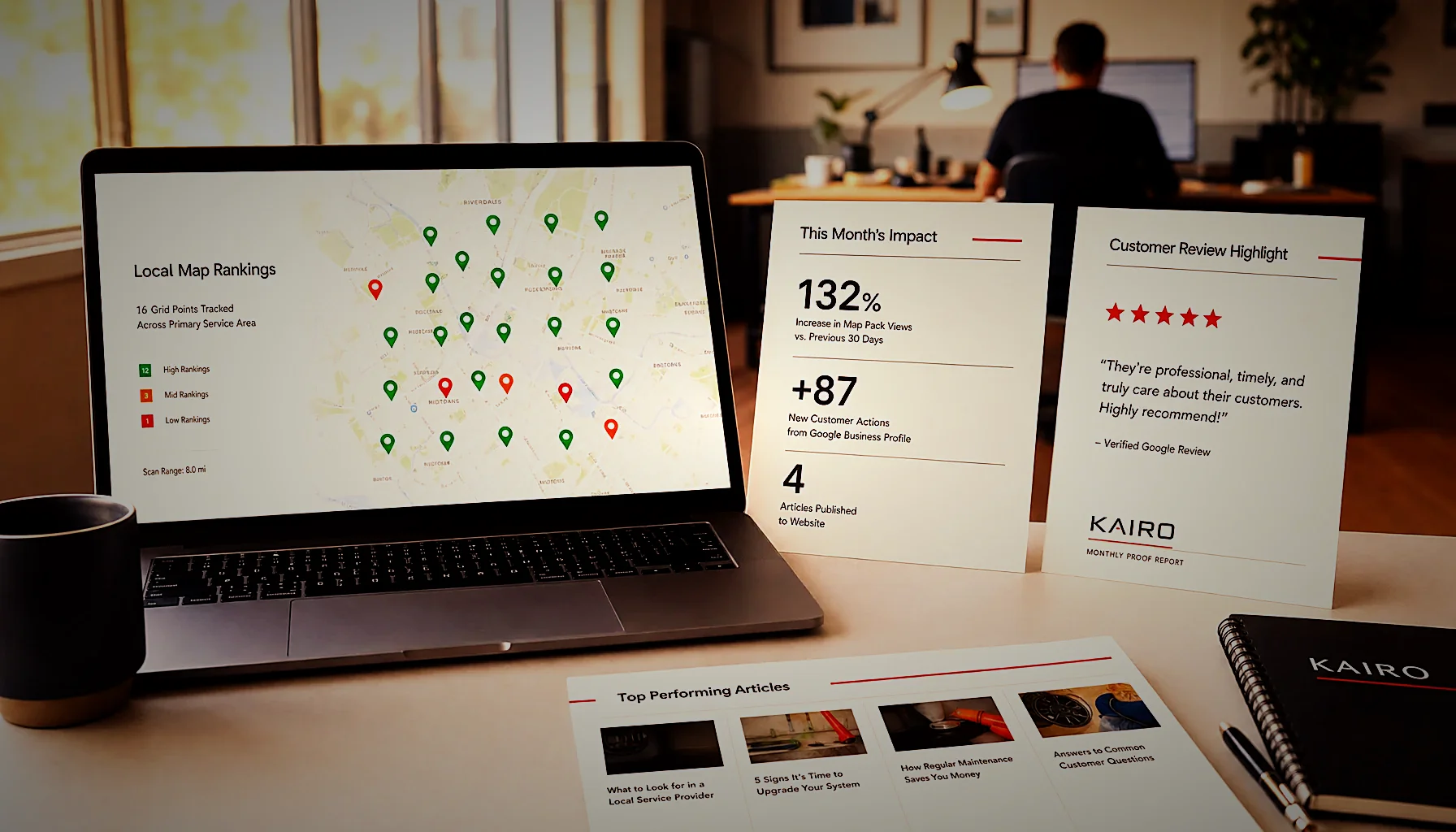
You search your own service in your own town, and the shop three streets over sits at the top of the map while you are nowhere. A competitor outranking you on Google Maps almost always comes down to three things: they are physically closer to the searcher, they have more and fresher reviews, and their profile and website send Google more signals about what they actually do.
What actually decides who ranks in the Google Maps local pack?
Google ranks local results on three factors it states publicly: relevance, distance, and prominence. Relevance is how well your profile and website match the search. Distance is how far you are from the searcher. Prominence is how well known you are, measured partly through reviews, links, citations, and web mentions.
Distance is the one you cannot change, and it explains a large share of the “why them, not me” cases. If the searcher is standing next to your competitor, that competitor wins that search — and still loses the search happening on the other side of town.
Relevance is the factor most owners underuse. A profile set to “Restaurant” with no services listed, no menu, no description and four photos tells Google very little. A profile with the right primary category, six services spelled out, 40 photos and a weekly post tells Google a lot.
Prominence is cumulative. Reviews, consistent business listings across the web, press mentions, and pages on your own site that talk about what you do in your city all stack up over months. There is no switch for it, which is exactly why competitors who started earlier look unbeatable.
One more thing worth knowing in 2025: the same signals increasingly drive AI answers. When someone asks ChatGPT or Google AI Overviews for “a good hair salon in Portland,” the model leans on the same reviews, profiles and web pages Google uses. Ranking work now pays twice.
How do I check whether my competitor is really outranking me?
Run the search from the places your customers actually search from, not from your desk. Google Maps results shift block by block, so a single check from your office tells you almost nothing. Use a grid of 5 to 10 points across your service area and record who appears in the top three at each one.
The simplest free method: open Google Maps on your phone, search your main keyword, and screenshot the top three results. Do it from home, from the other side of town, and from the neighborhood you most want customers from. Three different pictures usually appear.
Repeat the same search in an incognito browser window on desktop. Logged-in results are personalized by your own history — including the fact that you keep clicking your own listing. Incognito gets you closer to what a stranger sees.
Then write down the actual keywords. “Dentist” and “emergency dentist near me” and “teeth whitening Austin” are three different competitions with three different winners. Owners often lose one of them and assume they are losing all of them.
Track it monthly, not daily. Local rankings wobble naturally, and a single bad day is noise. A trend across three months is information, which is the whole reason a monthly SEO report for a small business is worth reading in the first place.
Keep the screenshots. When you make changes to your profile or publish new content, the before-and-after is the only proof that the work moved anything.
Turn your reviews into pages that rank
KAIRO reads your public Google reviews each month and writes articles about what your customers actually say. It's the content side of the audit you just ran.
What should a local SEO competitor audit look at?
A useful local SEO competitor audit compares six things side by side: primary category, review count, average rating, review recency, photo count, and the depth of the website behind the profile. Put your top three competitors and yourself in one list and the gap usually becomes obvious in 20 minutes.
Start with the primary category, because it is the single highest-leverage field on a Google Business Profile. If your competitor is “Italian restaurant” and you are “Restaurant,” they win Italian searches by default. Check what the top-ranked profiles chose and match the specificity.
Count reviews and look at dates. A competitor with 180 reviews where the newest is from 14 months ago is weaker than it looks. A competitor with 60 reviews and four new ones this month is building momentum you can feel in the rankings.
Read what the reviews say, not just how many there are. Review text feeds relevance — when customers write “best gluten-free pizza in town,” that phrase becomes associated with the business. This is also why what customers say in Google reviews is a content goldmine, not just a reputation score.
Compare photos and posts. Top-ranking profiles in competitive categories often carry 50 to 200 photos and post something most weeks. An abandoned profile with eight photos from 2021 signals a business Google is less confident recommending.
Finish with the website. Count how many pages each competitor has that actually target a service plus a location. A plumber with 12 service pages and a blog beats a plumber with a one-page site, every time, on the searches that are not decided purely by distance.
Why do competitors rank higher locally even with fewer reviews?
Because reviews are one signal among many, and three others regularly outweigh them: proximity to the searcher, category and service accuracy, and the amount of relevant content on the website. A competitor with 40 reviews and 30 well-written service pages routinely beats a business with 300 reviews and no site to speak of.
Proximity does most of the invisible work. Google splits a city into overlapping pockets, and in each pocket the nearby businesses get a boost. You cannot move your shop, but you can win the pockets where no strong competitor sits.
Category and service accuracy is the cheapest fix available. Filling in every service you offer, with a short description for each, adds dozens of relevance signals in an afternoon. Most owners never touch these fields.
Consistency across the web matters more than people expect. If your name, address and phone number appear three different ways across directories, Google has less confidence in your data. Local citations for SEO are not glamorous, but inconsistent ones actively hold you back.
Structured data is the other quiet advantage. Schema markup for a local business tells search engines in machine-readable form what you are, where you are, what you charge for and what your hours are — and it is the format AI systems read most easily.
Finally, there is time. A competitor who has published something every month for two years has hundreds of pages and mentions working for them. That is not talent, it is accumulation, and accumulation is the one thing you can start today.
How do I beat local competitors on Google — step by step?
Fix the profile first, then build content consistently, then keep reviews flowing. In that order. Profile fixes take an afternoon and can move rankings within weeks; content and reviews compound over three to six months and are what hold a position once you get it.
Step one: complete every field on your Google Business Profile. Primary category, secondary categories, all services with descriptions, business description, hours including holidays, attributes, products, and a booking or contact link. Leave nothing blank.
Step two: add photos and keep adding them. Exterior shots help people recognize you, interior shots help them decide, and team shots build trust. Aim to add a few every month rather than 50 once.
Step three: post to your profile regularly. Google Business Profile posts are a direct, free line to the people already looking at your listing, and an active profile reads as an open, responsive business.
Step four: build pages that answer real questions about your service in your city. One page per service, one page per location you serve, plus articles that answer what customers actually ask. A content plan for a local business keeps this from becoming a one-month burst followed by silence.
Step five: ask every happy customer for a review, by name, at the moment they are happiest. Then reply to all of them. Reply text is indexed, and a reply that names the service adds a relevance signal the review itself may have missed.
Step six: measure monthly. Rank positions at your grid points, calls and direction requests from the profile, and which pages bring organic traffic. If a change did not move one of those, do something else next month.
How does this connect to showing up in AI answers like ChatGPT?
AI assistants recommend local businesses using the same raw material Google uses: your Google Business Profile, your reviews, and the pages on your website. If a model cannot find text that says what you do, where you do it, and why people liked it, it has nothing to recommend you with.
Reviews are the most quotable thing you own. When 30 customers independently describe you as reliable, fast or great with nervous patients, that language becomes the evidence an AI answer leans on. It is specific, it is third-party, and it is already written.
Your own pages fill the gaps reviews leave. Prices, service areas, parking, languages spoken, what to bring to a first appointment — these are the details people ask assistants about, and they only exist if you publish them.
Consistency beats volume here too. A site that publishes a few solid articles every month gives models a steady, current picture of the business. A site frozen in 2022 looks dormant to both crawlers and models.
This is the whole idea behind KAIRO, a content engine for local businesses run by a team based in Romania. We read every Google review a business has received, turn what customers actually say into 4 SEO/AEO articles a month plus Google Business Profile posts, publish them automatically to your WordPress site and social channels, and send you a monthly proof report you can check.
No contract, cancel anytime, and zero hours from you. If you want to know what your own reviews would produce, request a personalized quote and we will show you the analysis first.
Close the content gap on your competitor
If the business outranking you has 30 service pages and you have one, that's the gap KAIRO fills — a new article every month, built from your own reviews, so Google and ChatGPT both have something to recommend.
Frequently asked questions
What does “outranking share” mean in Google Ads?
Outranking share in Google Ads is the percentage of auctions where your ad ranked higher than a specific competitor’s ad, or showed when theirs did not. It is a paid-search metric and has nothing to do with Google Maps or organic local rankings. If you are comparing map positions, look at local rank tracking across a grid of locations instead.
Is there a way to manipulate your location on Google Maps?
No — faking a business location on Google Maps violates Google’s guidelines and gets listings suspended or removed. Virtual offices, fake addresses and keyword-stuffed business names are the most common violations, and competitors can report them. The legitimate route is a real address or a service-area business with an accurate service radius.
Who is Google Maps’ biggest competitor?
Apple Maps is Google Maps’ largest direct competitor, with Waze, Bing Maps and OpenStreetMap-based apps behind it. For local businesses, the more relevant shift in 2025 is toward AI assistants like ChatGPT and Google AI Overviews answering “where should I go” questions directly. Those tools draw on your reviews and website pages, so the same work serves both.
What makes you rank higher on Google?
For local results, Google weighs relevance, distance and prominence: how well your profile matches the search, how close you are, and how well known you are. The parts you control are a fully completed Google Business Profile, a steady flow of recent reviews, consistent listings across the web, and pages on your site that answer real customer questions. Most businesses see movement within four to twelve weeks of fixing the profile and publishing consistently.
Who can write monthly SEO articles for my small business?
You can hire a freelance writer, an agency, or use a content service built for local businesses like KAIRO, which publishes 4 SEO/AEO articles a month based on your own Google reviews. The important part is consistency — one article every month beats ten articles once. Ask any provider for a monthly report showing what was published and what it changed.
How long does it take to outrank a local competitor?
Profile and category fixes can shift map positions within two to six weeks, while content and review growth usually need three to six months to hold a top-three spot. The gap depends on how far ahead the competitor is and how close you both are to the searcher. Track positions from the same grid points every month so you can see the trend rather than guess.
This article was produced by the Kairo engine.
The same system can write for your business — starting from what your customers already say.
Get your free review report