How do you get your business cited in Google AI Overviews? A complete guide
October 15, 2026 · 9 min read
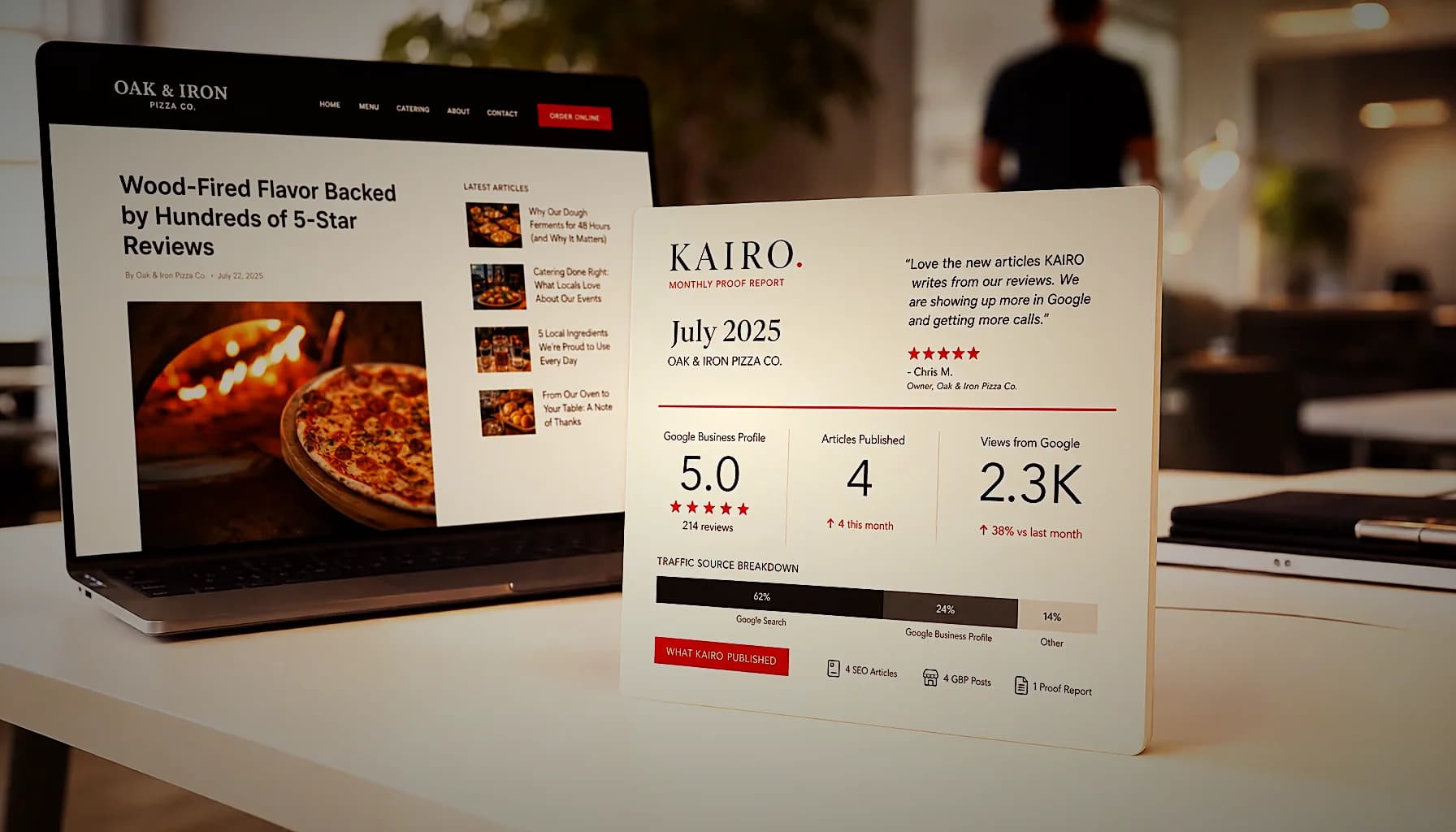
You get cited in Google AI Overviews by publishing pages that answer a specific question in plain language, backed by signals Google already trusts: a complete Google Business Profile, real customer reviews, and consistent topical content. AI Overviews pull from indexed pages that match the query intent closely. Clear answers near the top of a page get quoted most often.
What are Google AI Overviews, and why do citations matter for a local business?
Google AI Overviews are AI-generated summaries that appear above the classic blue links, with 3 to 8 source links attached. Those links are the citations. If your site is one of them, you get visibility and clicks even when the searcher never scrolls.
For a local business, this changes the math on search. A searcher asking “best brunch spot with outdoor seating near me” may read the summary, pick one of the cited names, and call. The cited business wins the customer; the uncited ones on page one never get seen.
Citations also travel. The same content layer that earns an AI Overview citation tends to feed ChatGPT, Gemini, and Perplexity answers, because those systems crawl and retrieve from the same open web. One well-built answer page can show up in several assistants at once.
The practical difference between ranking and being cited is scope. Ranking rewards a whole page’s authority on a topic. A citation rewards a single extractable passage: 40 to 70 words that answer the exact question asked, in the exact words a person would use.
In 2026 this matters more because AI Overviews now trigger on a large share of informational and “near me” style queries. The searches that used to send you traffic through a listicle are increasingly summarized on the results page itself.
How does Google decide which sources to cite in an AI Overview?
Google selects citation sources from pages already in its index that rank well for the query or closely related queries, then favors passages that directly answer the question. Entity clarity, review volume, structured data, and topical depth all raise your odds. There is no submission form and no paid placement.
Four signals do most of the work. First, retrievability: the page must be crawlable, indexed, and fast enough to be fetched. Second, passage-level relevance: a heading that matches the question with the answer immediately underneath.
Third, entity confirmation. Google needs to be confident about who you are, where you are, and what you do. A complete Google Business Profile, consistent name and address across directories, and a steady flow of reviews all confirm the entity.
Fourth, corroboration. AI systems prefer claims they can cross-check. If your page says you serve gluten-free options and 14 Google reviews mention gluten-free, that claim is reinforced by independent text Google already holds.
What does not work: keyword stuffing, thin pages spun from templates, and AI text with no specifics. Those pages get indexed and ignored, because they contain nothing a summarizer can quote that isn’t already said better elsewhere.
One more detail worth knowing. Pages that answer several closely related questions in separate, clearly labeled sections tend to pick up citations across multiple query variants, not just one. Depth beats breadth here.
Answer pages written from your own reviews
KAIRO turns what your customers already wrote on Google into answer pages AI can quote. You keep serving customers while the pages go live each month.
Which approach wins: classic SEO, AEO content, or paid ads?
AEO content wins for AI citations, classic SEO wins for long-term organic rankings, and paid ads win for immediate traffic you stop receiving the moment you stop paying. The three overlap: strong AEO content usually ranks too, because the underlying signals are the same.
Here is how the options compare on the criteria that matter to a local owner.
| Criteria | Classic SEO (pages & links) | AEO content (answer pages) | Google Ads |
|---|---|---|---|
| Gets cited in AI Overviews | Sometimes, indirectly | Yes, this is the target | No |
| Time to first results | 4 to 8 months | 6 to 12 weeks | Days |
| Compounds over time | Yes | Yes | No |
| Owner hours per month | High if done in-house | Near zero if outsourced | Medium, ongoing management |
| Stops when you stop paying | No | No | Yes, same day |
| Feeds ChatGPT and Gemini too | Partly | Yes | No |
The honest trade-off: ads buy you a month, content buys you a year. If you need bookings next week, run ads. If you want to be the name an assistant says in 2026 and 2027, build answer pages now and keep adding them.
Cost structures differ as much as timelines. A freelance writer, an agency retainer, and a subscription engine land at very different monthly numbers for the same output, which we break down in our guide to SEO content cost for a small business.
Most owners end up blending two. Ads for seasonal pushes, answer pages running quietly underneath, so the pipeline doesn’t collapse when the ad budget pauses.
How do you structure a page so AI Overviews can quote it?
Structure every page as a question and a 40 to 70 word answer, repeated. Use the searcher’s exact question as an H2, put the complete answer in the first paragraph underneath, then add detail below. AI systems extract that first paragraph; everything after it builds trust.
Keep paragraphs to three sentences at most. A summarizer needs a self-contained chunk it can lift without losing meaning, and long paragraphs force it to choose between truncating you or skipping you.
Be specific where you can be. “Open until 11 pm on Fridays,” “parking for 30 cars,” “tasting menu with 6 courses” are quotable. “Premium experience tailored to your needs” is not, and never will be.
Add a FAQ section with 4 to 6 real questions, each answered in 2 to 3 sentences. These map almost one-to-one onto People Also Ask and voice queries, and they are the easiest citations to earn on a new page.
Use schema markup where it fits: LocalBusiness on your core pages, FAQPage on article FAQs, Product or Service where relevant. Schema doesn’t force a citation, but it removes ambiguity about who you are and what you sell.
Finally, write the answer before the context. Many business owners open with three sentences of setup before the useful line. Move the useful line to position one and the rest of the page still reads fine.
Why do customer reviews make your content more citable?
Reviews tell you the exact questions real customers ask, in their own words, and they give Google independent text that confirms your claims. Content built from reviews matches search language more closely than content built from keyword tools, because it comes from people who already walked through your door.
Read 200 reviews end to end and patterns appear. The same five concerns repeat: parking, wait times, dietary options, whether it suits kids, how far in advance to book. Each pattern is an answer page waiting to be written.
That is the core of how the KAIRO content engine works. It analyzes every Google review a business has received, finds the recurring questions, and turns them into 4 SEO/AEO articles a month plus Google Business Profile posts.
Reviews also supply proof you can quote on the page. A line like “guests mention the quiet terrace in more than 40 reviews” is a concrete, checkable claim, and checkable claims are what AI systems prefer to repeat.
There is a corroboration effect too. When your page, your Google Business Profile, and your review text all say the same thing, confidence in that fact rises. When they disagree, the system hedges and cites someone clearer.
Keep asking for reviews, and keep responding to them. A business with 12 reviews and a business with 400 reviews are not treated as equally confirmed entities, no matter how good the website copy is.
How often should you publish, and how do you know it’s working?
Publish consistently rather than in bursts: a steady 4 articles a month gives search engines a predictable crawl pattern and builds topical coverage faster than 12 posts dumped once a quarter. Expect the first citations in 6 to 12 weeks for low-competition questions.
Consistency matters more than volume because topical authority accumulates. Twenty answer pages on one subject area make every new page on that subject easier to rank and easier to cite.
If you’re deciding on a cadence for your own site, our breakdown of how many blog posts a month a local business needs compares output levels against competition and business type.
Measurement is where most owners go blind. AI Overviews don’t appear in standard rank trackers, and assistant answers leave no referrer in analytics, so you need to check manually or with a tool built for it.
Track four things monthly: impressions and clicks per article in Google Search Console, which queries now trigger an AI Overview showing your domain, whether ChatGPT and Gemini name you when asked a buying question in your category, and calls or form fills attributed to those pages.
A practical routine: once a month, ask ChatGPT, Gemini, and Google AI Mode the same three questions a customer would ask, and log who gets named. Our guide on how to check if AI mentions your business walks through the exact prompts.
KAIRO sends a monthly proof report for this reason. You should be able to see what was published, what moved, and where you now show up, without taking anyone’s word for it. No contract, cancel anytime.
Be the name the assistant says
If writing answer pages every month isn't realistic for you, KAIRO publishes them for your business, built from your public Google reviews.
Frequently asked questions
How to get cited in AI Overviews?
To get cited in AI Overviews, publish pages that answer a specific question in the first 40 to 70 words under a heading that matches how people actually search. Google pulls citations from indexed pages it already trusts, so a complete Google Business Profile, steady reviews, and consistent topical content all raise your odds. Start with the five questions your customers ask most and write one answer page for each.
How to cite Google’s AI mode?
Google AI Mode shows its own source links beside each generated answer, so you cite it by clicking through to the original source and referencing that page, not the AI summary itself. For academic or editorial work, cite the underlying publisher with its URL and access date. If you must reference the AI output, name the tool, the date, and the prompt you used.
How to appear in Google AI Overviews?
You appear in Google AI Overviews when your page is indexed, ranks for a related query, and contains a passage that answers the question better than the alternatives. Make the page crawlable, lead with the answer, add FAQPage and LocalBusiness schema, and keep your entity details consistent everywhere. Most local businesses see their first citations within 6 to 12 weeks of publishing focused answer pages.
How to generate citations for AI?
You generate AI citations by producing content that is easy to retrieve and easy to quote: short self-contained paragraphs, specific numbers, clear headings, and claims that other sources corroborate. Reviews, directory listings, and local press all reinforce the same facts, which makes AI systems more confident repeating them. Publishing on a steady monthly schedule compounds this effect across more queries.
Do AI Overviews reduce clicks to my website?
AI Overviews reduce clicks on queries where the summary fully answers the question, but they increase visibility for the cited sources. The practical response is to target questions with a commercial next step, like booking, pricing, or availability, where the searcher still needs to reach you. Being the cited business on those queries is worth more than ranking fourth on an informational one.
Can a small local business get cited alongside big national sites?
Yes, and local questions are where small businesses win most often, because national sites rarely cover specifics like your neighborhood, your hours, or your menu. For “near me” and city-level queries, a well-structured page from a single-location business regularly outranks a large aggregator. Depth on a narrow topic beats broad coverage from a bigger domain.
This article was produced by the Kairo engine.
The same system can write for your business — starting from what your customers already say.
Get your free review report