Local business blog ideas for the slow season: a complete guide
October 8, 2026 · 11 min read
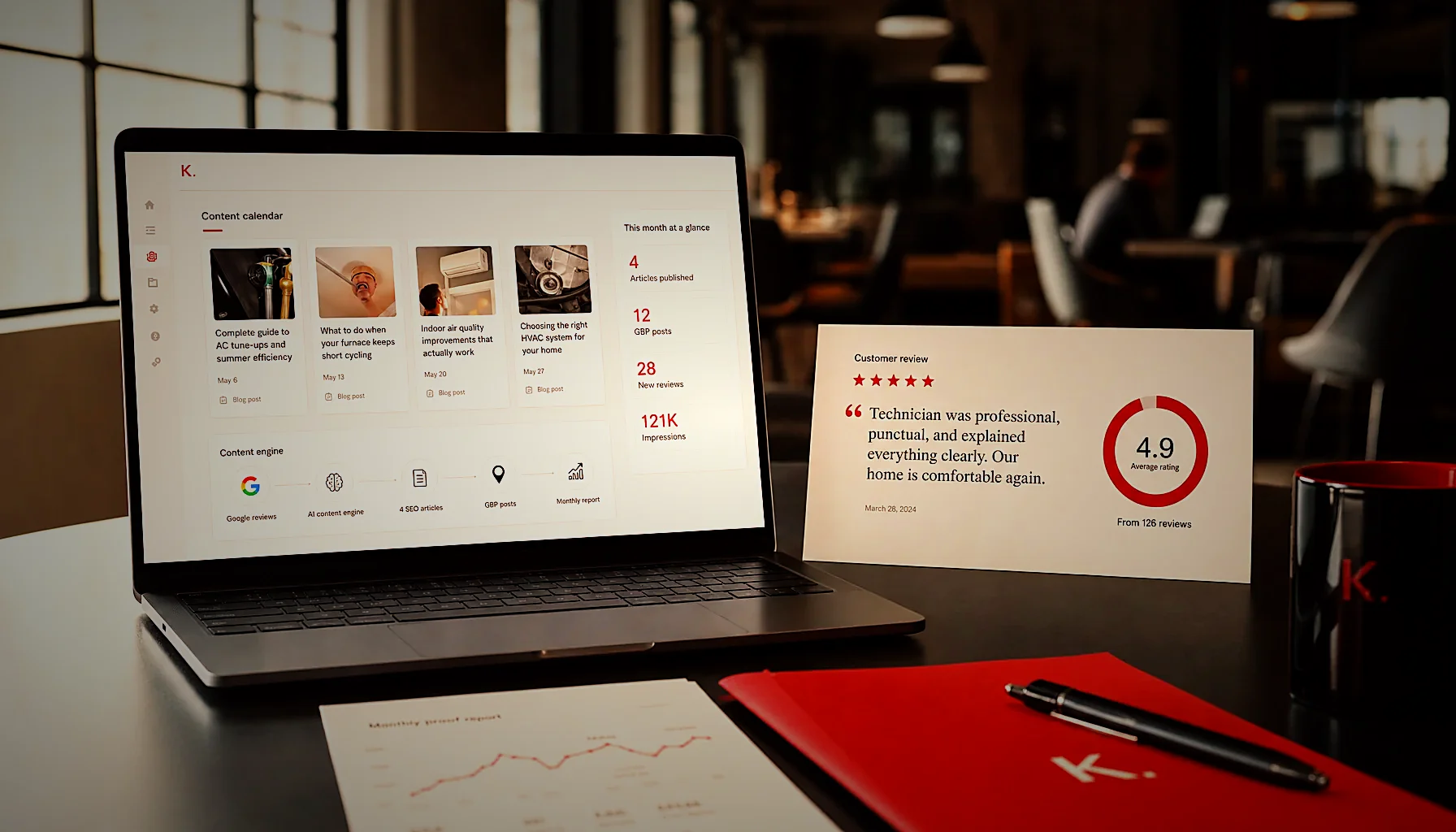
In the slow season, a local business should write about the questions customers ask before they buy: pricing, planning timelines, comparisons, and “how do I choose” guides. Those articles get indexed while you have time, then do the selling when demand returns. If you’re asking who can write monthly SEO articles for my small business while you’re busy again in peak season, that’s exactly the gap a consistent content system fills.
Quiet months look like a marketing problem. They’re actually the only window you get to build search visibility without rushing it. Below: what to publish, what to skip, and how the options compare on cost, effort, and how long the results last.
Why is the slow season the best time to publish local business content?
Because search content has a lag. A new article typically needs 4 to 12 weeks to settle into stable rankings, so anything you publish in a quiet month is working for you by the time demand picks up again.
The mistake most owners make is publishing when they’re busy and stopping when they’re not. That’s backwards. Publishing in a slow month costs you nothing in lost operational attention, and it front-loads the ranking window.
There’s a second reason: your head is clearer. In a quiet month you actually remember the questions customers asked last season — the price objection, the “can you do it by Friday” panic, the comparison they kept bringing up. Those are article topics.
And there’s a third, newer reason. AI assistants — ChatGPT, Gemini, Google AI Overviews — pull from pages that answer questions directly. In 2026, a business with 20 published answers on its own site has far more surface area to be quoted from than a business with a homepage and a contact form.
Think of the slow season as the build phase. You’re not trying to generate bookings this week from a blog post. You’re stocking the shelf so the shelf is full when people start shopping.
What should a local business write about in the slow season?
Write the answers to the five questions you get asked most on the phone. That’s the entire list. Price, timeline, process, comparison, and “is this right for my situation” — those five categories cover almost every commercial search a local customer makes.
Here’s how that breaks down in practice:
- Pricing and cost guides. “How much does X cost in [your city]?” People search this constantly and most local businesses refuse to write it. If you can’t publish exact numbers, publish ranges and the factors that move the price.
- Timeline and planning articles. “How far in advance should I book?” “How long does it take?” These rank well because they’re specific and few competitors bother.
- Comparisons. Option A vs option B, DIY vs hiring someone, your service vs the cheaper alternative. Comparison pages attract people who are close to deciding.
- Process explainers. What happens on day one, what you need from the customer, what the handover looks like. This kills anxiety, which is what actually blocks a booking.
- Off-season and seasonal topics. “Best time of year to book”, “what to do in the off-season”, “autumn maintenance checklist”. These get searched when demand is low and also build authority for the peak-season terms.
The best source for all five? Your own Google reviews. Customers write down exactly what worried them, what surprised them, and what finally convinced them. Read 50 reviews end to end and you’ll have a 12-month content calendar — we walk through the method in our guide on how to turn Google reviews into blog content.
What to skip: industry news, holiday greetings, “we’re excited to announce”, and anything that only makes sense the week you publish it. Those posts have a shelf life of three days and generate no search traffic in month six.
Your reviews already hold the topics
KAIRO reads your public Google reviews and turns the questions customers actually asked into monthly SEO articles on your own site. You stay busy running the business.
What is the 80/20 rule for blogging, and how does it apply to a slow month?
The 80/20 rule for blogging means spending 20% of your effort creating a post and 80% promoting and maintaining it. For a local business in a slow season, the more useful version is this: 20% of your topics will bring 80% of your traffic, so write those 20% properly instead of writing 10 shallow posts.
In practice, that means a quiet month is better spent on four substantial, genuinely useful articles than on twelve 300-word updates. Depth wins on search, and depth is what AI assistants quote.
The promotion half matters too. Every article should get pushed out through the channels you already own: a Google Business Profile post pointing to it, a social post, an email if you have a list. One article, four distribution points.
Maintenance is the forgotten part. An article you wrote 18 months ago with outdated pricing is costing you credibility. Pick two older posts per quarter, update the numbers and the year, and republish.
And apply 80/20 to keywords as well. Ignore the broad, national terms you’ll never rank for. Target the specific, local, long questions — “how much does a wedding venue in [city] cost for 100 guests” beats “wedding venue” every time, because the person typing it is 10 minutes from deciding.
Who can write monthly SEO articles for my small business? A comparison of the options
You have five realistic options: write it yourself, hire a freelancer, use an agency, use a raw AI tool, or use a managed content system. They differ enormously in cost, in how many hours they take from you, and in whether the output is consistent enough to actually rank.
| Option | Your time per month | Consistency | Typical trade-off |
|---|---|---|---|
| Do it yourself | 8-15 hours | Low — stops in peak season | Free in cash, expensive in hours; usually abandoned by month three |
| Freelance writer | 3-6 hours (briefing, edits) | Medium | Quality varies by writer; you own the strategy and the briefing |
| Marketing agency | 2-4 hours (calls, approvals) | Medium to high | Highest cost; often bundled into a retainer with a contract |
| Raw AI tool (ChatGPT alone) | 4-8 hours | Low | Cheap and fast, but generic output and no research, publishing, or checks |
| Managed content engine | Close to zero | High — fixed monthly output | Less hands-on control over each individual post |
The honest read: if you have time and enjoy writing, do it yourself. Most owners don’t, and the pattern is predictable — four good months, then silence through the busy season, then starting over.
That’s the gap KAIRO was built for. KAIRO is an online content engine (our team is based in Romania) that reads every Google review your business has received, then produces 4 SEO/AEO articles a month, publishes them to your WordPress site and your social channels, adds Google Business Profile posts, and sends a monthly proof report you can check line by line.
No contract, cancel anytime, and zero hours from you. Every article passes our own quality gates before it goes anywhere. If you want the longer breakdown of each option, see our full comparison of who can write monthly SEO articles for a small business.
How do you increase sales during the slow season with content?
You increase slow-season sales by publishing content that captures people planning ahead, then giving them an easy reason to commit early. Off-season buyers are researchers, not impulse buyers — so the content that converts them answers questions, not slogans.
Three concrete plays that work in a quiet month:
- Publish the “book early” case. An article explaining why booking in the off-season gets better availability, more attention, and sometimes better pricing does two jobs: it ranks, and it justifies an early-booking offer.
- Write for the next season, not this one. In autumn, publish the spring planning guide. By the time spring searches spike, your page has 4 to 6 months of ranking history.
- Turn your best reviews into proof pages. A page built around three real customer stories, with the specific problem and outcome, outperforms a generic services page for people in decision mode.
Pair each article with a Google Business Profile post. GBP posts are seen by people already searching your name or category, and they give your new content a second entry point — we cover the mechanics in our guide on whether Google Business Profile posts help SEO.
Also fix the conversion path while you have the time. One clear next step per article — call, book, request a quote — placed where someone finishes reading. A ranking article with no obvious action is a missed sale.
Track it simply. Note how many calls and form fills you get in the slow month, publish consistently for 90 days, then compare. You won’t see a jump in week two, and anyone promising that is selling you something.
Are blogs still profitable in 2026, and how does AEO change the answer?
Yes — but the mechanism changed. In 2026 a local business blog earns its keep less through raw click volume and more by being the source AI assistants and Google AI Overviews quote when someone asks a question in your category.
That shift has a name: AEO, or answer engine optimization. Instead of writing to rank a page and win a click, you write so a machine can extract a clean, correct answer and attribute it to you. Short answer-first paragraphs, specific numbers, clear headings phrased as questions.
The practical difference is structural, not stylistic. An article that buries its answer in paragraph six still gets indexed, but it rarely gets quoted. One that answers in the first 40 words gets pulled into AI responses and featured snippets.
This is also why consistency beats brilliance. AI systems favor sites with topical depth — many pages covering the same subject area from different angles. Four articles a month compounds into 48 a year, and that volume is what makes your site a reliable source rather than a one-off.
If you want the full distinction between writing for search engines and writing for answer engines, start with what AEO is and how it differs from SEO.
One caution: blogs are not profitable if you publish three posts and stop. The return comes from accumulation. A slow season is the cheapest time to start accumulating, which is the whole argument of this guide.
What does a realistic slow-season content plan look like?
A realistic plan is four articles a month, each answering one real customer question, each 1,500 words or more, each published with a Google Business Profile post and a social post. That’s it. No content calendar spreadsheet with 40 tabs.
Here’s a four-week structure you can copy:
- Week 1 — the money question. Your pricing or cost guide. The one you’ve been avoiding.
- Week 2 — the comparison. You versus the obvious alternative, written fairly. Fairness is what makes it credible.
- Week 3 — the planning guide. Timelines, lead times, what to prepare. Written for the next season.
- Week 4 — the proof piece. Real reviews, real situations, what you actually did.
Repeat that pattern with different services or different customer types and you have a year of content without inventing a single topic.
Before you publish anything, make sure the basics are in place: accurate Google Business Profile, consistent name and address everywhere, working phone number. Content amplifies a solid local presence; it doesn’t replace one. If that foundation needs work, our guide on how to get your local business to show up on Google covers it.
Decide now who does it in the busy season. That’s the real test. If the honest answer is “nobody”, pick a setup that runs without you — because the 90-day gap you leave in March is what undoes the work you did in January.
And measure in quarters, not weeks. Three months of consistent publishing gives you something real to judge: impressions, queries you now appear for, calls attributed to search. KAIRO sends a monthly proof report for exactly that reason — you should be able to check the work, not trust it.
Publish every month without the hours
If the four-week plan looks good but you'd rather not write it yourself, KAIRO handles the writing and publishing each month, built around the questions your customers keep asking.
Frequently asked questions
What is the 80/20 rule for blogging?
The 80/20 rule for blogging means spending 20% of your effort creating a post and 80% promoting and maintaining it. For local businesses it also means roughly 20% of your topics will produce 80% of your search traffic, so depth on a few commercial questions beats volume on filler. In practice, four substantial articles a month outperform twelve short updates.
Are blogs still profitable in 2026?
Yes, blogs are still profitable in 2026, but the return now comes as much from AI citations as from clicks. Articles structured with answer-first paragraphs and specific details get quoted by ChatGPT, Gemini, and Google AI Overviews, which puts your business in front of buyers before they ever reach a results page. The catch is consistency — returns come from accumulating 40 to 50 pages a year, not from publishing three and stopping.
How do you increase sales during the slow season?
You increase slow-season sales by targeting people who are planning ahead rather than buying today, then making early commitment easy. Publish pricing guides, planning timelines, and comparison articles, pair each with a Google Business Profile post, and add one clear next step such as “request a quote”. Expect a 90-day horizon before you can fairly judge the results.
Who can write monthly SEO articles for my small business?
You have five options: do it yourself, hire a freelance writer, use an agency, use a raw AI tool, or use a managed content engine. They differ mostly in how many of your hours they consume and whether output stays consistent through your busy season. KAIRO handles the fourth path — 4 SEO/AEO articles a month built from your own Google reviews, published automatically, with no contract and cancel anytime.
What business has a 90% success rate?
No business category has a verified 90% success rate — that figure circulates online without a credible source behind it. What research does show is that businesses solving an ongoing, essential local need tend to survive longer than trend-driven ones. For marketing, the equivalent principle is that consistent effort over 12 months outperforms short bursts, whatever your industry.
How do I get my business recommended by ChatGPT?
To get recommended by ChatGPT, you need clear, factual answers about your business published on pages the model can read and attribute. That means question-based headings, direct answers in the first 40 words, specific details like service areas and price ranges, and consistent information across your website and Google Business Profile. Volume helps too — more published answers means more chances to be the cited source.
This article was produced by the Kairo engine.
The same system can write for your business — starting from what your customers already say.
Get your free review report