How do you write a Google Business Profile description that ranks?
October 31, 2026 · 10 min read
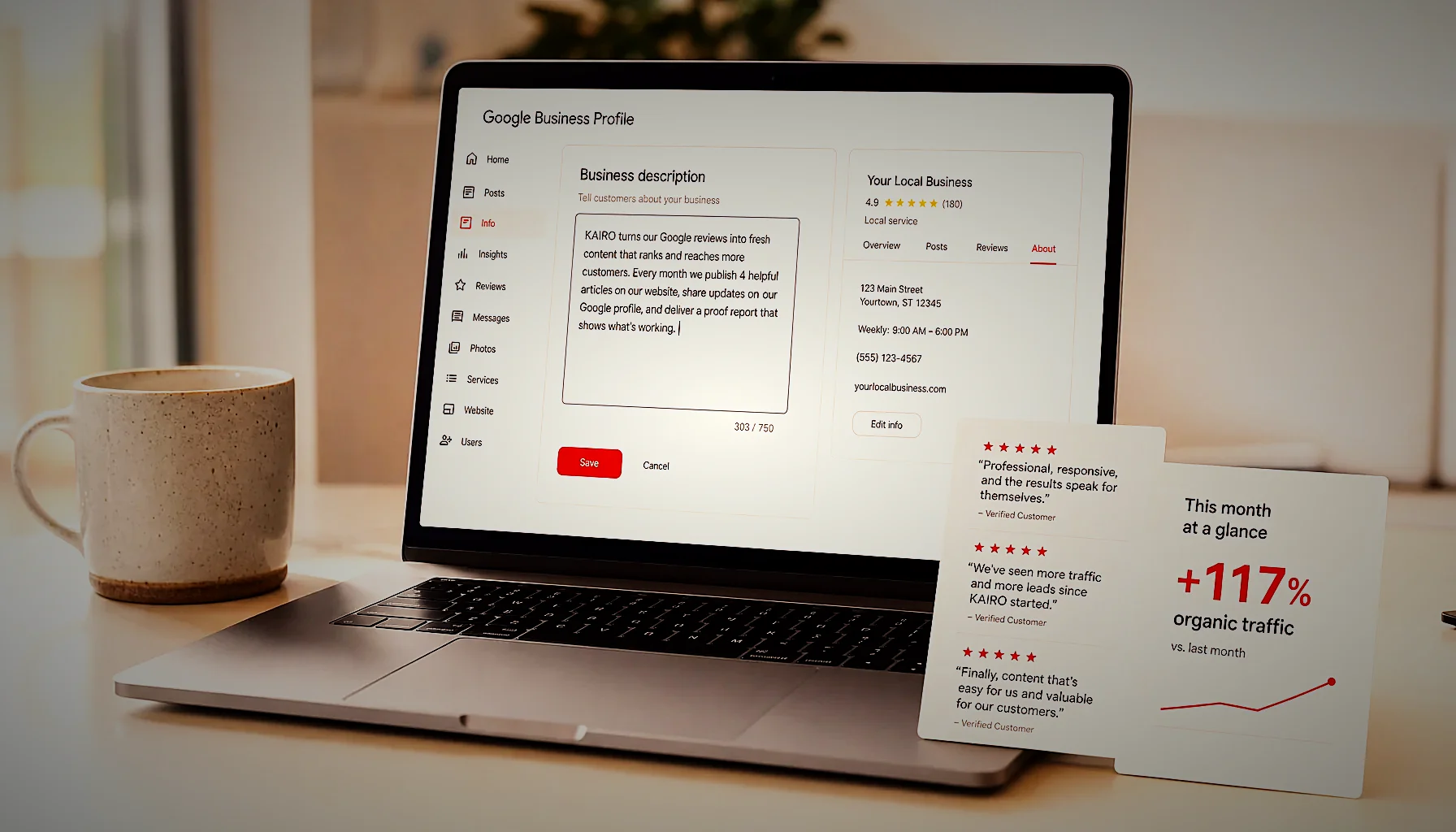
A plumber in a mid-sized city had 180 five-star reviews and a description that read “We are a family-owned company dedicated to excellence.” It ranked for nothing. A Google Business Profile description that ranks names your service, your city, and the specific problems you solve — in plain language, inside the first 250 characters, using the exact words customers type into search.
What is the Google Business Profile description and does it affect ranking?
The Google Business Profile description is a 750-character “from the business” field that appears on your profile in Google Search and Maps. It is not a direct ranking factor in Google’s local algorithm, but it feeds relevance signals, it is read by AI assistants, and it decides whether a searcher clicks you or your competitor.
Google confirms that local ranking comes from three things: relevance, distance, and prominence. Your description contributes to relevance by telling Google what your business actually does, in your own words.
The bigger shift in 2025 is who else reads that text. ChatGPT, Gemini, Perplexity, and Google AI Overviews pull from business profiles when someone asks “who does emergency plumbing near me in Austin.” A vague description gives those systems nothing to quote.
There is also a practical limit worth knowing. Only the first 250 characters show before the “Read more” cut-off on mobile, which is where most people see your profile. Everything that matters has to live in those first two or three sentences.
Treat the field as a 750-character answer to one question: what do you do, for whom, and where. That is the question a searcher asks and the question an AI model needs answered to recommend you.
What should you include in a Google Business Profile description?
Include six things: your primary service, your city or service area, your main differentiators, the specific services you offer, who you serve, and a soft call to action. Write them in that order. The first sentence should contain your main service plus your location, because that is the sentence everyone reads.
Here is the checklist, in priority order:
- Primary service + city in sentence one. “Family dentistry in Portland, Oregon” beats “Your trusted partner in oral health.”
- Concrete differentiators. Same-day appointments, 24-hour callout, 15 years in the same neighborhood, Spanish-speaking staff, free parking for 20 cars.
- A list of actual services, written the way customers name them: “brake replacement,” not “comprehensive automotive maintenance programs.”
- Who you serve. Families, landlords, restaurants, people without insurance, dogs over 40 pounds.
- Practical details that reduce friction: hours, walk-ins welcome, wheelchair access, pickup available.
- A soft close. “Call to check availability” or “Book online.” No exclamation points.
What to leave out matters just as much. Google’s guidelines prohibit URLs, phone numbers, promotional offers, prices, and anything misleading in the description field — profiles that break those rules can have the text rejected or the profile suspended.
Also skip the adjectives that mean nothing. “Leading,” “premier,” “world-class,” and “passionate” appear in thousands of descriptions and tell Google and a searcher exactly the same thing: nothing. Replace each one with a fact.
If you want the fastest source of the right words, read your own reviews. Customers describe your business in the exact language other customers search with, and that overlap is where a description stops being marketing copy and starts being useful. We go into that method in detail in which review insights should go straight into your website content.
Your reviews already hold the right words
KAIRO reads your public Google reviews and turns the phrases your customers actually use into monthly articles for your site. Same method you just used for your description, applied to every page.
How do you find the right keywords for a local business description?
Pull keywords from three places: your own Google reviews, Google’s autocomplete for your service plus your city, and the service names your competitors rank for. Choose two or three phrases you can use naturally, and write them into full sentences — never as a comma-separated list.
Start with reviews because the language is already yours. Open your 30 most recent reviews and write down every noun customers use for what you sell. A bakery might find “sourdough,” “birthday cake,” “gluten-free,” and “last-minute order” appearing over and over.
Then check demand. Type your service into Google and read the autocomplete suggestions, then scroll to “People also search for” and the related searches at the bottom. These are real queries, not estimates.
Map each keyword to intent before you use it. “Emergency electrician Denver” is a buying query and belongs in sentence one. “How electrical panels work” is research and belongs on your blog instead.
Keyword stuffing is the one mistake that actively hurts you. A description that reads “plumber Austin, plumber near me, Austin plumbing services, best plumber Austin” looks like spam to Google’s reviewers and reads like spam to a customer about to call you.
The honest test: read the description out loud to someone who does not work in your business. If they can repeat what you do and where, the keywords are placed correctly. If they wince, rewrite it.
One more source most owners ignore — the search terms already sending you calls. Your Google Business Profile performance report lists the queries people used to find you. Phrases that already convert deserve a place in the first 250 characters.
Can you provide examples of a good business description?
Yes. A good Google Business Profile description example names the service and city in the opening line, lists concrete services in the middle, and closes with one practical instruction. Below are four examples, each under 750 characters, written for different industries.
Restaurant
“Neapolitan pizza and handmade pasta in downtown Asheville, open for dinner Tuesday through Sunday. Our dough ferments 48 hours and the mozzarella arrives twice a week. We seat 60 inside, 24 on the patio, and keep six tables for walk-ins every night. Gluten-free crust and vegan cheese available on every pizza. Groups of eight or more can reserve the back room. Call after 4pm to check tonight’s availability.”
Dental clinic
“Family and cosmetic dentistry in Tempe, Arizona, accepting new patients of all ages. We offer cleanings, fillings, crowns, Invisalign, and same-day emergency appointments for toothache and broken teeth. Most major insurance plans accepted, with payment plans for treatment without coverage. Our hygienists schedule 50-minute cleanings so nothing is rushed. Evening appointments available Tuesdays and Thursdays. Call or book online to reserve a first visit.”
Auto shop
“Independent auto repair in Columbus, Ohio, servicing all makes with a focus on Honda, Toyota, and Subaru. We handle brakes, timing belts, suspension, check-engine diagnostics, and state inspections. Every repair comes with a written estimate before work starts and a 24-month parts warranty. Loaner cars available for jobs over one day. Drop-off opens at 7am for commuters. Call for a same-week appointment.”
Hair salon
“Hair salon in the Mission District, San Francisco, specializing in curly cuts, balayage, and color correction. Our stylists train twice a year in curl-specific cutting and we offer free 15-minute consultations before any color service. Walk-ins welcome Wednesday through Friday before noon. We use ammonia-free color and vegan product lines throughout. Online booking shows live availability for every stylist.”
Notice the pattern in all four: service plus city first, verifiable specifics second, one instruction last. No superlatives, no “passionate team,” no sentence that could belong to any competitor on the same street.
One description done, the rest handled
A sharp profile description gets you found; regular content keeps you there and gives AI assistants something to quote. KAIRO writes those articles for local businesses every month, built from your own reviews.
How does your description help you show up in AI answers?
AI assistants recommend businesses they can describe confidently. When ChatGPT or Google AI Overviews answers “who does curly haircuts in San Francisco,” it needs a source that states the service, the location, and a reason to pick you. A specific description gives it that sentence to quote; a vague one gets skipped.
Large language models work with patterns of co-occurrence. If “curly cuts,” “Mission District,” and your business name appear together across your profile, your website, and your reviews, the model connects them. If your description only says “we love making people feel beautiful,” there is nothing to connect.
Consistency across sources is the second half of the job. Your Google Business Profile description, your website’s homepage, and your service pages should describe the business with the same core words — not identical copy, but the same vocabulary.
That consistency is also why your website has to be machine-readable in the first place. If AI crawlers cannot parse your pages, your profile is doing the work alone. Our guide on whether your website is readable by AI crawlers covers how to check it.
Published content extends the same effect. A description tells an AI what you do; monthly articles about the questions your customers actually ask give it dozens of pages to cite. That is the difference between being listed and being recommended.
At KAIRO, an online content engine run by a team based in Romania, we read every Google review a business has received and turn the patterns into 4 SEO/AEO articles a month plus Google Business Profile posts. The description and the articles pull from the same source: your customers’ own words.
How often should you update your Google Business Profile description?
Review your description every 3 to 6 months, and rewrite it whenever your services, hours, service area, or team change. Profiles that sit untouched for years drift out of sync with what the business actually sells, and that mismatch costs you clicks from people who were ready to call.
Build a short routine instead of waiting for a problem. Twice a year, read your newest 20 reviews, check which search terms your performance report shows, and compare both against your current text.
Edits go live after a Google review process, which can take anywhere from a few minutes to several days. Make your changes in one pass rather than editing the same field four times in a week.
Watch for signals that something is off. A sudden drop in profile views or calls often has nothing to do with the description — it can come from category changes, duplicate listings, or a competitor’s new activity. We cover the usual causes in why your Google Business Profile ranking keeps dropping.
Keep the description aligned with your profile posts too. If your description promises same-day emergency service and your last post is from 14 months ago, the profile reads as abandoned to both Google and a customer.
In 2025, the profiles that hold position are the ones that keep moving: current description, regular posts, fresh reviews, and new pages on the website every month. None of that is dramatic work, but it has to happen consistently rather than once.
If writing it yourself is the bottleneck, that is a scheduling problem more than a skill problem. There is no contract to sign with us and you can cancel anytime — ask for a personalized quote and we will show you what the first month looks like, with a proof report you can check.
Frequently asked questions
What to include in Google Business Profile description?
Include your primary service and city in the first sentence, then your specific services, concrete differentiators, who you serve, and a soft call to action. Google prohibits URLs, phone numbers, prices, and promotional offers in this field. Keep the most important information inside the first 250 characters, because that is all mobile users see before the “Read more” cut-off.
What is a good description for a business profile?
A good business profile description states what you do, where you do it, and why someone should choose you — in plain language a customer would use. It avoids superlatives like “leading” or “world-class” and replaces them with verifiable facts such as opening hours, service area, or years in business. For example: “Independent auto repair in Columbus, Ohio, servicing all makes with a 24-month parts warranty.”
What should I put in my business description?
Put the two or three keywords your customers actually search with, written into natural sentences rather than a list. Pull those words from your own Google reviews and from Google’s autocomplete for your service plus your city. Then add practical details that remove hesitation — walk-ins welcome, evening appointments, insurance accepted, loaner cars available.
Can you provide an example of a business description?
Yes: “Family and cosmetic dentistry in Tempe, Arizona, accepting new patients of all ages. We offer cleanings, fillings, crowns, Invisalign, and same-day emergency appointments. Most major insurance plans accepted, with payment plans for treatment without coverage. Call or book online to reserve a first visit.” It names the service and city first, lists real services, and ends with one clear instruction, all within the 750-character limit.
How long should a Google Business Profile description be?
The field allows up to 750 characters, and you should use 500 to 750 of them. Only the first 250 characters appear before the “Read more” link on mobile, so front-load your service, city, and strongest differentiator. The remaining characters are still indexed and still read by AI assistants, so fill them with specific services rather than filler.
Who can write monthly SEO articles for my small business?
A content subscription service can write and publish monthly SEO articles without taking hours from you. KAIRO, for example, analyzes every Google review a business has received and turns the findings into 4 SEO/AEO articles a month, plus Google Business Profile posts and a monthly proof report, published automatically to your WordPress site. There is no contract and you can cancel anytime.
This article was produced by the Kairo engine.
The same system can write for your business — starting from what your customers already say.
Get your free review report