Why does my Google Business Profile ranking keep dropping?
October 22, 2026 · 11 min read
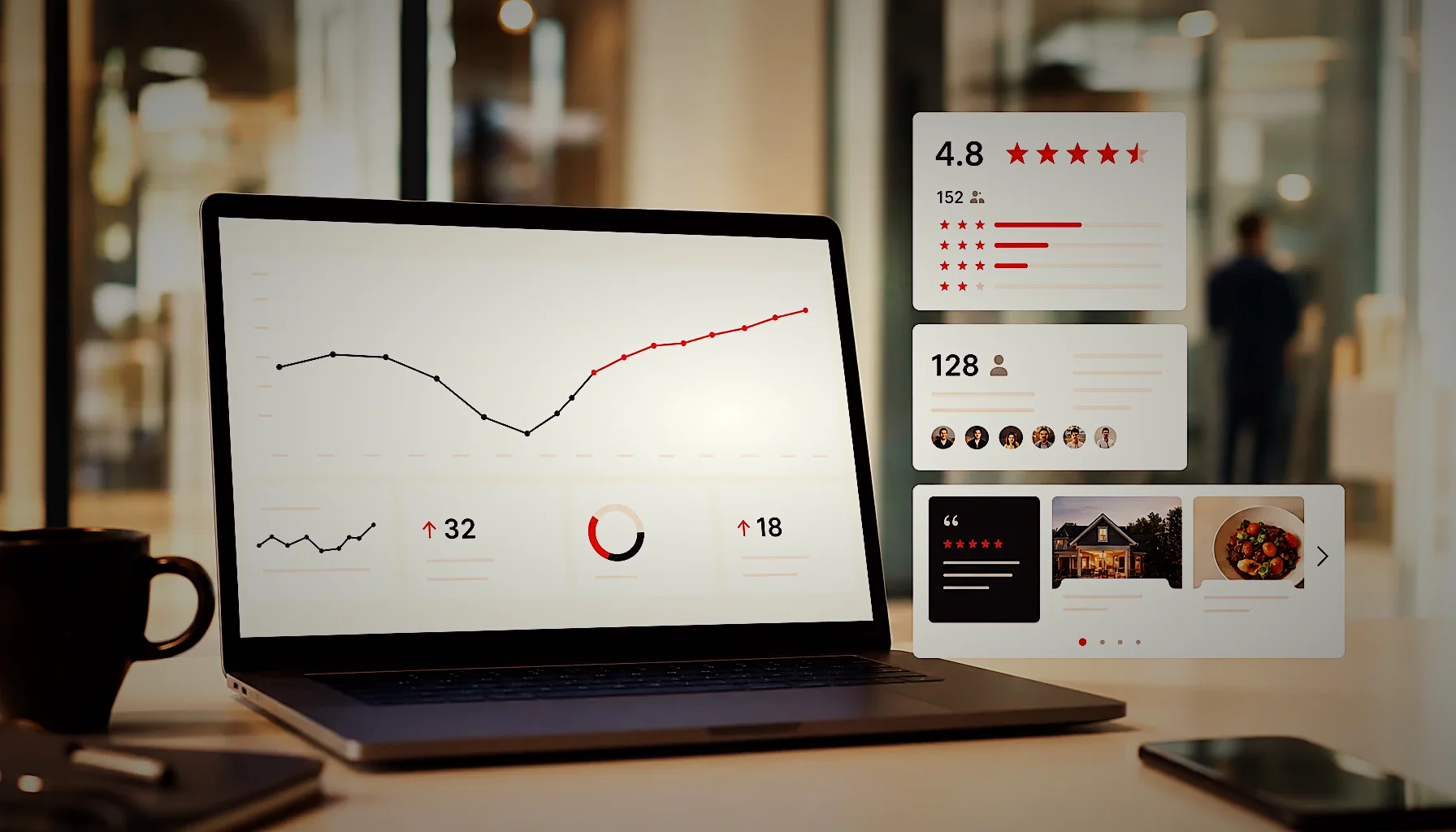
You check your phone on a Tuesday morning, search your own service plus your city, and you’re suddenly on page two. Your Google Business Profile ranking dropped for one of five reasons: a Google algorithm update, a profile edit or suspension, a slowdown in new reviews, a competitor doing more than you, or simple local pack shuffling tied to the searcher’s location.
Why has my Google ranking suddenly dropped?
A sudden drop almost always traces back to a change — either Google changed how it ranks, or something on your profile changed. Local rankings move daily, but a real drop lasts more than a week and shows up across different devices and searchers, not just your own phone.
Start by separating noise from a genuine problem. Google personalizes local results by the searcher’s exact GPS position, so standing 400 meters down the street can move you two spots. If you check from your office every day, you’re measuring one point on a map, not your actual visibility.
The five causes worth investigating, in the order they’re most likely:
- An algorithm update. Google ships core and local updates several times a year. Local pack results often reshuffle for two to three weeks afterward before settling.
- A profile edit. Changing your business name, primary category, address, or hours can reset part of your ranking signals. Third parties can also suggest edits that Google accepts without telling you clearly.
- A suspension or soft suspension. A hard suspension removes your profile from Maps entirely. A soft suspension keeps it visible but strips your ability to manage it.
- Review velocity stalling. If you averaged eight reviews a month and dropped to one, competitors who kept collecting pass you.
- A competitor improving. Someone added 40 photos, filled out every service field, started posting weekly, and published 30 pages about their services. They didn’t beat you; they outworked you.
Write down the date you first noticed the drop. Then check whether anything on your profile, your website, or your review flow changed in the two weeks before that date. In most audits we run in 2026, the owner can name the change once they look at a calendar.
How do I tell the difference between normal fluctuation and a real drop?
A real drop is consistent, measurable from multiple locations, and lasts longer than seven to ten days. Normal fluctuation looks like moving between positions 2 and 5 across a week, then returning. If your average position across a grid of search points hasn’t moved, you don’t have a problem.
Measure properly before you act. Searching your own business name from your own logged-in phone tells you almost nothing — Google knows it’s you, knows where you are, and knows you’ve clicked your own listing a hundred times.
Three checks that give you honest data:
- Use a grid tool or an incognito window with a different location. Check your ranking from several points across your service area, not one address.
- Open Google Business Profile performance data. Look at searches, views, calls, direction requests, and website clicks month over month. If calls are flat but your position moved one spot, nothing meaningful happened.
- Compare 90 days, not 7. Weekly data on local search is mostly weather. Quarter-over-quarter data is climate.
Pay attention to which metric fell first. A drop in impressions usually means a ranking or visibility issue. A drop in calls and direction requests while impressions hold steady means people are seeing you and choosing someone else — that’s a reviews, photos, or offer problem, not a ranking problem.
One more distinction matters: branded versus discovery searches. If people searching your name still find you but people searching “plumber near me” don’t, your profile is fine and your competitive position is weak. Those two problems need completely different fixes.
Turn your reviews into fresh content
While you diagnose the drop, your existing Google reviews can do some of the work. KAIRO writes monthly SEO articles for your business using what your customers already said about you.
What happened to Google’s Business Profile — did the rules change?
Google retired the standalone Google My Business app and moved profile management directly into Search and Maps. The product still exists, now called Google Business Profile, and the ranking factors haven’t fundamentally changed: relevance, distance, and prominence still decide who shows in the local pack.
What did change is enforcement and interface. Google has tightened verification, especially for service-area businesses and anything that looks like a virtual office. Video verification is now common, and reverification can be triggered by edits you thought were routine.
Several platform shifts have real ranking consequences:
- AI Overviews now sit above the local pack for many informational searches. Your position in Maps is unchanged, but fewer people scroll to it.
- Review spam enforcement improved. Fake and incentivized reviews get removed in batches, and if some of your reviews were bought, a cleanup looks exactly like a ranking penalty.
- Attribute and service fields expanded. Profiles that fill them out match more specific queries; empty profiles match fewer.
- Posts and Q&A carry more weight as freshness signals than they did a few years ago.
The practical takeaway: the fundamentals of ranking in the Google Maps local pack are stable, but the surface area you need to cover keeps growing. A profile that was complete in 2021 is incomplete in 2026 simply because Google added fields and formats since then.
If your profile was suspended, appeal through the official reinstatement form with documentation — a utility bill, business license, or signage photo showing your name at the address. Reinstated profiles usually recover their previous rankings within a few weeks, though the gap in posts and reviews during the suspension can leave a dent.
Why isn’t ranking #1 on Google enough anymore?
Ranking #1 only wins the clicks that still happen on the results page. A growing share of searches end inside an AI answer, a map pack preview, or a zero-click snippet, so position alone no longer predicts how many customers call you. You now need to be the business the answer names.
Think about how your customers actually search now. Someone asks ChatGPT for “a good family dentist in Austin that takes new patients.” Someone else reads a Google AI Overview summarizing three options. Neither of them ever sees a ranked list of ten blue links.
Those AI answers pull from a different mix of sources than the local pack: your reviews, your website content, directory listings, and whatever text exists online describing what you actually do. If your website has four pages and no content answering real customer questions, there is nothing for a language model to quote about you.
This is the gap we see most often. A business has 300 glowing Google reviews and a five-page website. The reviews prove the business is good; the website gives AI nothing to repeat. So the AI recommends the competitor who published 40 articles about their services, pricing, and process.
Closing that gap means producing content that answers the questions your customers ask out loud. Our own approach: read every Google review a business has received, find the questions and objections hiding in them, and publish 4 SEO/AEO articles a month built from that material. The same work that helps you get cited in Google AI Overviews also helps you get recommended by ChatGPT.
Visibility in 2026 is plural. You need the map pack, the organic results, and the AI answers — and the content that feeds the third one increasingly feeds the first two as well.
How do I fix my Google Business Profile visibility?
Fix visibility by completing every field on the profile, restarting a steady flow of reviews, publishing content consistently, and then measuring for 90 days. There is no single switch. Local ranking is a weighted sum of signals, and recovery comes from improving several at once.
Work through this in order:
- Audit the profile line by line. Primary category, secondary categories, every service with a description, hours including holidays, attributes, products, service area, phone, and website URL. Incomplete profiles lose to complete ones on specific queries.
- Add photos and keep adding them. Interior, exterior, team, work in progress, finished results. Profiles with regular photo uploads get more direction requests than static ones.
- Restart review velocity. Steady beats bursty — five reviews a month for twelve months outperforms sixty in one week, which can look manipulative. Our guide on asking customers for Google reviews covers the timing and wording that work.
- Reply to every review, good and bad. Replies are indexed text and they show future customers how you handle problems.
- Post weekly. Offers, updates, new services, answers to common questions. Posts are a freshness signal and they occupy space on your profile.
- Build out your website. One page per service, one page per location, and ongoing articles answering customer questions. This is the part most owners skip, and it’s the part AI answers depend on.
Then stop checking daily. Local SEO changes compound slowly; most businesses see measurable movement in three to six months, which we break down in our timeline on how long local SEO takes.
Set a review cadence instead: pull your performance data on the first of each month, note impressions, calls, direction requests, and clicks, and compare against the same month last quarter. That’s the report we send our own clients every month — numbers you can check, not a promise.
Who can handle the content side for a small business?
If you can’t write 4 articles a month yourself, your realistic options are a freelance writer, an agency retainer, or a content subscription. Each trades off cost, consistency, and how much of your time it eats. The deciding factor is usually whether the work still happens during your busiest month.
Here’s how the three compare in practice:
- A freelance writer is flexible and often the cheapest per article. You supply the topics, the review research, the SEO brief, and the publishing. Expect to spend two to four hours per article on your side.
- A full-service agency handles strategy and reporting but usually asks for a contract and a monthly minimum that covers ads, design, and account management you may not need.
- A content subscription covers one job only: consistent monthly publishing. Narrower scope, lower overhead, no contract.
KAIRO, an online content engine with a team based in Romania, sits in that third category. Every month we read the Google reviews your customers already wrote, turn them into 4 SEO/AEO articles published straight to your WordPress site, add Google Business Profile posts and 1:1 carousels for social, and send a proof report you can check. No contract, cancel anytime, and no hours from you.
Whatever you choose, judge it on one thing: did content actually get published every month, and did impressions, calls, and AI mentions move over two quarters? Content marketing fails far more often from inconsistency than from bad writing.
And handle reputation alongside content. A single unanswered one-star review can cost you more conversions than three ranking positions, which is why responding to a bad Google review deserves a place in your monthly routine.
Cover more ground every month
Competitors pass you by publishing more, not by knowing a secret. KAIRO sends your local business a new article each month, built from your public Google reviews.
Frequently asked questions
Why has my Google ranking suddenly dropped?
A sudden Google ranking drop is usually caused by an algorithm update, an edit or suspension on your Google Business Profile, a stall in new reviews, or a competitor improving their profile and website. Local results also shift with the searcher’s exact location, so check from several points before assuming a real drop. If the decline lasts more than seven to ten days across different devices and locations, treat it as genuine and audit what changed in the two weeks beforehand.
Why isn’t ranking #1 on Google enough anymore?
Ranking #1 is no longer enough because many searches now end inside an AI Overview, a map preview, or a zero-click snippet, so the top position gets fewer clicks than it used to. AI assistants like ChatGPT and Gemini recommend businesses based on reviews and published content, not on your position in a list. That’s why businesses with strong reviews but thin websites get skipped — there’s no content for an AI to quote about them.
Is Google declining in popularity?
Google still handles the large majority of searches worldwide, but its share of answers is shrinking as people ask ChatGPT, Gemini, and AI Overviews instead of scrolling results. The behavior change matters more than the market share: fewer searches end in a click to a website. The practical response is to be visible in both places at once — a complete Google Business Profile plus content that AI systems can cite.
What happened to Google’s Business Profile?
Google retired the standalone Google My Business app and moved profile management into Google Search and Maps, renaming the product Google Business Profile. The ranking factors stayed the same — relevance, distance, and prominence — but verification is stricter and review spam enforcement is more aggressive. If your profile became unmanageable, you were likely soft-suspended and need to appeal through Google’s reinstatement form with documentation.
How long does it take to recover a dropped Google Business Profile ranking?
Most profiles recover over three to six months of consistent work on reviews, posts, photos, and website content. A reinstated profile after a suspension often regains its previous position within a few weeks, since the underlying signals never disappeared. Algorithm-driven drops typically settle within two to three weeks of an update finishing its rollout.
Who can write monthly SEO articles for my small business?
Your options are a freelance writer, a full-service agency retainer, or a content subscription that publishes on a fixed monthly schedule. Freelancers cost less per article but need topics, briefs, and publishing from you; subscriptions handle the whole cycle. KAIRO turns your own Google reviews into 4 SEO/AEO articles a month published to your site, with Google Business Profile posts and a monthly proof report — no contract, cancel anytime.
This article was produced by the Kairo engine.
The same system can write for your business — starting from what your customers already say.
Get your free review report