Which review insights should go straight into your website content?
October 27, 2026 · 10 min read
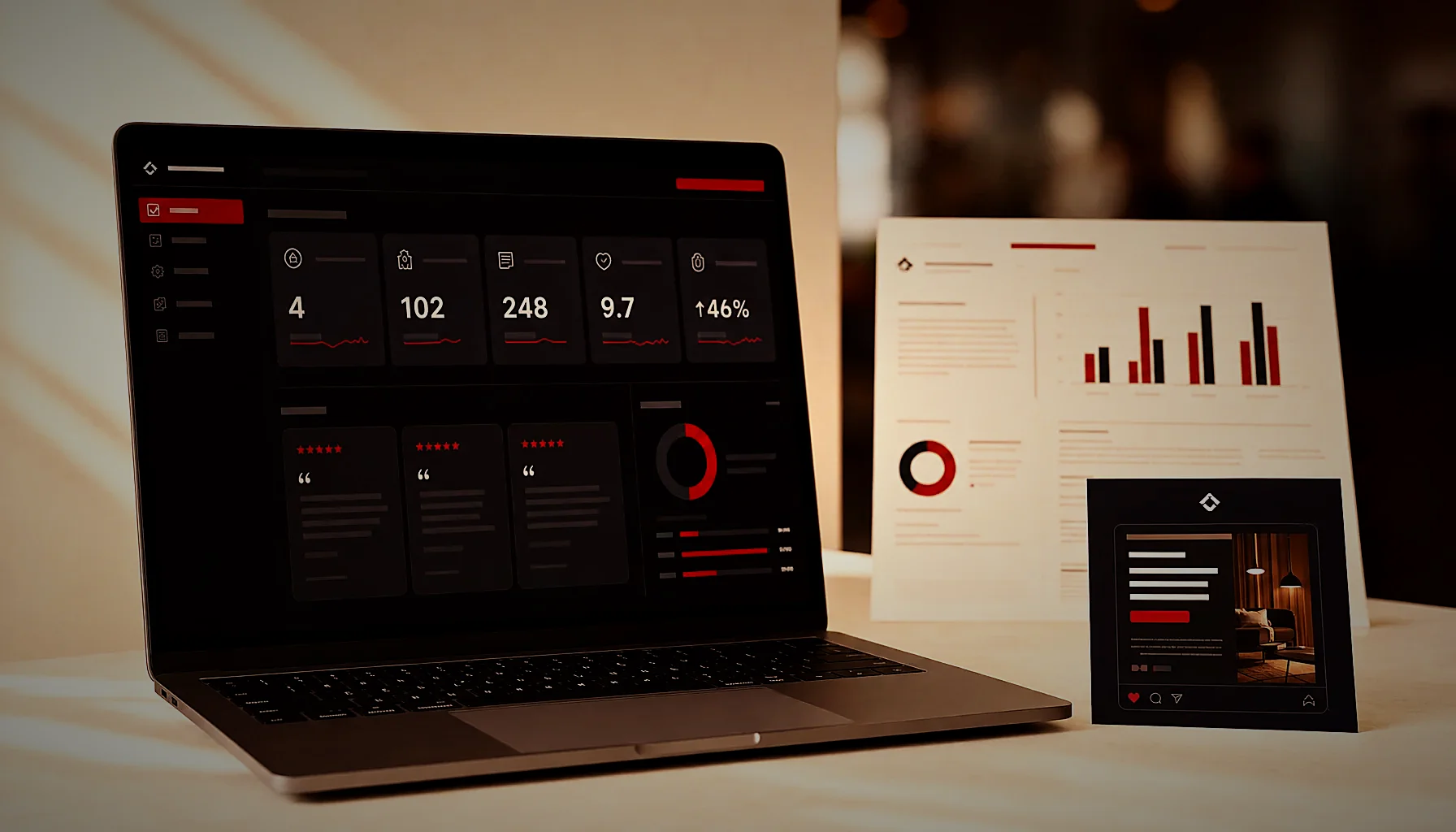
Five kinds of review insight belong on your website immediately: the exact words customers use to describe you, the questions they answer for each other, the objections they raise before buying, the specific services or dishes they name, and the local landmarks they mention. Those five turn into headings, FAQs, service pages and location copy that match real searches.
What is review analysis for marketing, and why does it beat keyword tools?
Review analysis for marketing is the practice of reading every review a business has received, tagging the recurring themes, and converting those themes into content: page headings, FAQ answers, service descriptions and social posts. It starts from language customers already typed, not from a tool’s guess at search volume.
Keyword tools tell you how many people search a phrase. Reviews tell you why they searched it, what they feared, and what finally convinced them. That “why” is the part Google’s AI Overviews and ChatGPT quote back to users.
A keyword tool will hand you “dentist near me.” A review says: “I hadn’t been to a dentist in nine years because of anxiety, and Dr. Pop talked me through every step.” The second one gives you a page title, an FAQ question, and a paragraph that reads like a human wrote it.
Reviews also carry something no tool has: proof. When you write “patients who haven’t seen a dentist in years are our most common first visit,” you are reporting a pattern from your own feedback, not making a claim you cannot back up.
There is a volume argument too. A business with 180 reviews has roughly 12,000 to 20,000 words of customer language sitting unused. That is more raw material than most local sites publish in a year.
At KAIRO, the content engine reads every Google review a business has received before it writes anything. In 2026 that remains the cheapest content research available to a local business, because you already paid for it with good service.
Which five review insights should go straight into your website content?
Prioritize insights in this order: customer vocabulary, repeated questions, pre-purchase objections, named services, and local references. Each one maps to a specific piece of on-page content, so you are never staring at a blank page wondering what to publish.
1. Customer vocabulary (voice of customer keywords)
Write down the nouns and adjectives customers repeat. A salon’s reviews might say “balayage,” “grown-out roots” and “they actually listened” far more often than “hair coloring services.” Use their words in your H2s and your meta titles.
2. Repeated questions
Reviews that start with “I wasn’t sure whether…” are FAQ questions in disguise. If four people mention they were relieved you had parking, parking belongs in your FAQ. Our guide on how to write an FAQ section that wins featured snippets covers the formatting that gets those answers pulled into search results.
3. Objections and hesitations
Price, wait times, parking, “is it worth it,” “I almost went somewhere cheaper.” Each hesitation that shows up three or more times deserves a paragraph that addresses it in plain language. Answering an objection on the page removes the reason someone bounces to a competitor.
4. Named services, dishes and treatments
Customers name specifics: the ribeye, the deep tissue massage, the timing belt replacement. Those names are long-tail keywords with buying intent, and most local sites never publish them as individual headings.
5. Local references
Reviews mention neighborhoods, nearby offices, train stations and events. “We walked over after the match” tells you which landmark to name on your location page, and it is exactly the kind of signal that helps you rank in the Google Maps local pack.
Let your reviews write the pages
KAIRO reads every Google review your business has received, then turns the recurring themes into published articles each month. See how the content engine works.
Review mining vs keyword tools vs competitor research: which should you start with?
Start with review mining if you have 25 or more reviews, because it is free, specific to your business, and produces content no competitor can copy. Use keyword tools second to check demand and spelling variants, and competitor research last to find gaps.
| Method | Cost | Time to first content idea | What it gives you | Main weakness |
|---|---|---|---|---|
| Review mining | Free (your own data) | 1-2 hours of reading | Exact customer wording, objections, proof points | Needs a reasonable review count |
| Keyword tools | $0-$120/month | 15 minutes | Search volume, related queries | No context, no emotion, same data everyone has |
| Competitor research | Free to $99/month | 2-3 hours | Topic gaps, page structures | You copy their mistakes too |
| Customer interviews | Staff time | 1-2 weeks | Deep motivation, rich quotes | Slow, small sample, hard to repeat monthly |
The honest trade-off: review mining wins on specificity and loses on scale. Ten reviews will not tell you what your market searches for, but 100 reviews will tell you what your market cares about, which matters more for AI answers.
Keyword tools still earn their place. They confirm whether people write “AC repair” or “air conditioning repair” in your city, and they catch seasonal swings you would never see in reviews.
Competitor research is the weakest starting point for a local business. Most local competitors publish thin service pages and no FAQ at all, so copying their structure caps your ceiling at their level.
A practical split for 2026: 60% of your content topics from reviews, 25% from keyword data, 15% from competitor gaps. That ratio keeps your site sounding like your business while staying aligned with how people actually search.
How do you turn a review theme into a published page?
Turn a theme into a page in five steps: count how often it appears, write the question it answers, draft an answer-first paragraph, add two or three specifics from reviews, then publish it as an H2 or a standalone article. A theme mentioned five times justifies a section; twenty times justifies its own page.
Step one is counting. Open your Google reviews, create a simple list of themes, and tally mentions. “Staff explained everything” at 34 mentions is a headline; “nice music” at two mentions is noise.
Step two is phrasing the question the way a customer would type it. “Do you explain the treatment before you start?” beats “Our patient communication philosophy” every time, both for search and for a voice assistant reading your page aloud.
Step three is the answer-first paragraph. Lead with the answer in one sentence, then support it. AI systems extract the first 40 to 60 words of a section, so burying the answer in paragraph three costs you the citation.
Step four is adding proof. Quote a review, name the service, give a number: “We book 20-minute consultations before any first treatment.” Specifics are what make a page quotable rather than generic.
Step five is publishing on a schedule instead of in bursts. One strong page a week beats twelve pages in January and silence until June, and it is the difference between a site Google crawls often and one it forgets. If your rankings have slipped lately, this breakdown of why Google Business Profile rankings drop covers the usual causes.
One more habit worth keeping: log which review theme fed which page. Six months later you will know which customer concerns actually brought traffic, and you can mine deeper on those.
Which review insights belong on Google Business Profile instead of your site?
Short, timely insights belong on your Google Business Profile: a single praised dish, a newly added service, an answer to one repeated question, a seasonal note. Long explanations, comparisons and multi-question FAQs belong on your website, where they can rank and be cited.
Think of it as length and lifespan. A GBP post has roughly 1,500 characters and a short shelf life; a web page can run 2,000 words and earn links for years.
Use GBP for the themes that need no setup. “Three reviews this month mentioned our gluten-free menu, so here it is” works perfectly as a post and takes 90 seconds to write.
Use your website for the themes that need explaining. Pricing structure, what happens at a first appointment, how your warranty works, why your lead time is what it is — those need paragraphs and headings.
There is also a crawling difference. Your website feeds Google’s index and the models behind AI answers; your GBP mostly feeds the local pack and the map. You want both, fed from the same review themes, which is why running them on one calendar saves hours.
A workable rhythm: four articles a month on the site, with GBP posts drawn from the same review themes so your messaging matches everywhere. That is the setup KAIRO runs for clients, and it is the same engine we use for our own marketing. For a seasonal version of the same logic, see our holiday content plan for local business.
What does review-driven content do for AI answers and ChatGPT recommendations?
Review-driven content gets you recommended by AI assistants because it answers specific questions in extractable language. ChatGPT, Gemini and Google AI Overviews pull from pages that state a clear answer, name a location, and include concrete details — exactly what review themes produce.
Ask ChatGPT “where can I get a tire change near Cluj on a Sunday” and it needs a page that says those words. A homepage that says “quality automotive services since 2004” gives the model nothing to work with.
Specificity is the ranking factor nobody writes about. Pages that name services, neighborhoods, hours, price ranges and customer scenarios get cited; pages full of adjectives get skipped.
Entity clarity matters as much as wording. State your business name, your city and your services in plain sentences on every important page, so a model has no doubt which business the answer describes.
FAQ blocks do the heaviest lifting. A question-and-answer pair taken from a real review theme is close to the format an AI assistant wants to repeat, which is why we put four to six of them on every article.
None of this is instant. Indexing, crawling and model updates take weeks, and anyone promising a timeline is making it up. What you can check is output and movement: how many pages went live, which queries they show up for, and what your proof report says month over month. If you are weighing who should do this work, our comparison of an SEO agency vs a content subscription lays out the costs on both sides.
Review mining, done every month
Reading 180 reviews once is a good afternoon; doing it every month is a job. KAIRO handles the reading and the writing for local businesses.
Frequently asked questions
What is a review analysis?
A review analysis is a structured read of all the reviews a business has received, where recurring themes, phrases, questions and complaints are tagged and counted. The output is a ranked list of what customers actually care about, in their own words. For marketing, that list becomes page headings, FAQ answers and social posts instead of sitting unread in a dashboard.
What are the 5 C’s of marketing?
The 5 C’s of marketing are company, customers, competitors, collaborators and climate — a framework for sizing up your situation before you build a plan. Reviews feed three of the five directly: they describe your company as customers experience it, they reveal customer priorities, and they often mention competitors by name. That makes review analysis one of the fastest ways to fill in the framework without commissioning research.
What are the four types of market analysis?
The four common types are industry analysis, competitor analysis, customer analysis and market trend analysis. Review mining sits inside customer analysis, and it is the only one of the four you can run entirely on data you already own. Most local businesses skip the other three and still gain ground, simply because their competitors publish nothing specific.
What are some good 5 star review examples?
The most useful 5-star reviews name a specific person, a specific service and a specific outcome: “Andrei replaced the brake pads on my Golf in two hours and showed me the worn parts.” Vague praise like “great service” rates you well but gives you no content. If you want more of the specific kind, our guide on how to ask customers for Google reviews shows how to prompt detail without being pushy.
How do I get my local business to show up on Google?
Publish pages that answer the exact questions your customers ask, keep your Google Business Profile active, and stay consistent month after month. Consistency matters more than volume: a site that adds four useful pages every month gets crawled more often than one that adds forty pages once. Start with your review themes, since those are the questions you already know people ask.
Who can write monthly SEO articles for my small business?
Options include freelance writers, SEO agencies and content subscriptions, and they differ mainly in price, speed and how much of your time they take. KAIRO publishes 4 SEO/AEO articles a month built from your own Google reviews, plus Google Business Profile posts and a monthly proof report, with no contract and the option to cancel anytime. Contact us for details on what that looks like for your business.
This article was produced by the Kairo engine.
The same system can write for your business — starting from what your customers already say.
Get your free review report