How do you ask customers for Google reviews without being pushy?
October 15, 2026 · 11 min read
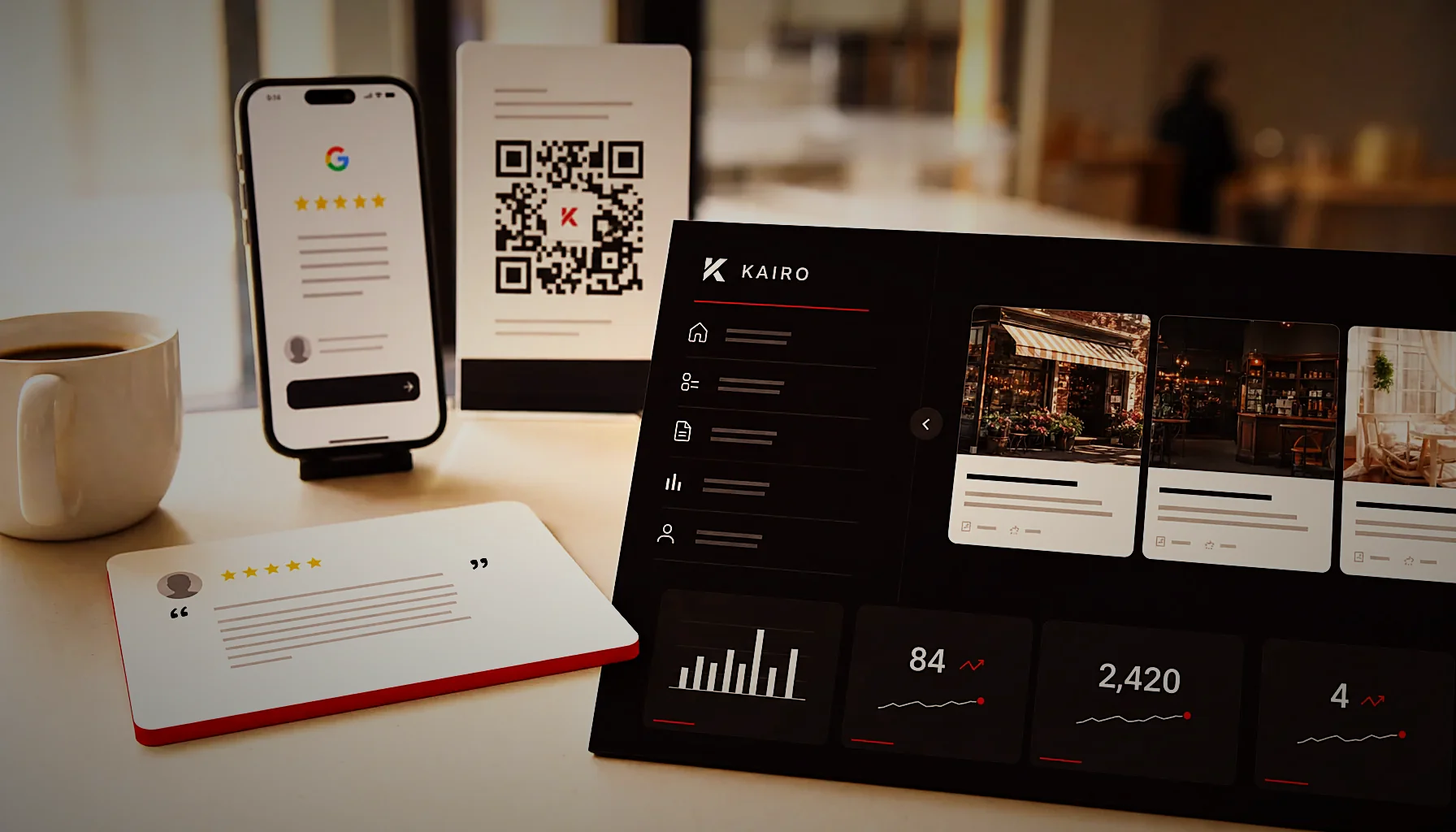
Ask right after the customer gets the result they paid for, in one short message that explains why it helps and links straight to your Google review form. One ask, one link, no pressure, no incentive. Businesses that make the request part of the normal handoff collect reviews steadily — and the awkwardness disappears because the timing does the work.
How do I ask customers for a Google review the right way?
Ask once, in person or by message, within 24 hours of the moment the customer felt happiest. Name the reason (“it helps people nearby find us”), hand over a direct link or QR code, and stop there. Short, specific, no follow-up chain.
The pushy feeling almost never comes from the ask itself. It comes from bad timing, vague wording, or three reminders in a week. Fix those three things and the same request reads as a normal favor between people who just did business.
Timing beats wording every time. A dentist asking at the front desk while the patient is still relieved gets a different answer than the same dentist emailing two weeks later. A roofer asking while the homeowner is looking at a finished roof gets a different answer than one asking after the invoice lands.
There are three places the ask fits naturally:
- At handoff — you deliver the car, the haircut, the keys, the final report.
- At the thank-you — the receipt email, the invoice-paid confirmation, the post-visit text.
- At the compliment — the customer says something kind out loud. That is the single highest-converting moment you will ever get.
When a customer tells you they loved it, answer with the truth: “That means a lot. Would you mind saying that on Google? It’s the main way people find us.” You are not inventing enthusiasm. You are redirecting enthusiasm that already exists.
One rule keeps you compliant and keeps the reviews useful: never offer anything in return. Google’s policies prohibit review incentives, and a discount-for-review scheme produces flat, generic five-star text that tells future customers nothing. Unpaid reviews mention the technician by name, the dish, the waiting time — the details that actually sell.
Which review request channel works best — in person, text, email, or QR code?
In-person asks convert best, text messages are the most reliable at scale, email works when you already have a receipt flow, and QR codes work only where someone is standing still with a phone in hand. Most local businesses need two of the four, not all of them.
Here is how the four channels compare on the things that matter:
| Channel | Typical response | Best for | Main weakness |
|---|---|---|---|
| In person, at handoff | Highest — you can read the room | Salons, auto shops, clinics, restaurants | Depends on staff remembering; no link in hand |
| Text message (SMS) | Strong — opened within minutes | Home services, trades, appointment businesses | Needs a phone number and a clear opt-out |
| Moderate — easy to ignore | Hotels, B2B services, e-commerce pickup | Lands in promotions; slower | |
| QR code on card or receipt | Low volume, zero friction | Cafés, waiting rooms, checkout counters | Scanned only when the customer is idle |
Pair one spoken ask with one written ask. The spoken one creates the intention; the written one carries the link. A hairstylist who says “I’ll text you the link, takes 20 seconds” and then actually texts it will outperform any automated sequence.
Get the link right before you print anything. In your Google Business Profile, open the “Ask for reviews” option and copy the short link Google generates — it opens the star form directly, with no searching. Turn that same URL into a QR code for counter cards, receipts, and the back of business cards.
Where you place the QR code decides whether it gets used. Table tents in a restaurant work because people wait for the check. A sticker on the shop door does not, because nobody scans while walking out. Put the code where there is a two-minute gap: the waiting room, the chair, the invoice, the delivery box.
Skip review-gating funnels that screen customers before showing the Google link. Google treats that as a policy violation, and customers notice the filter. Ask everyone the same way and let the reviews land where they land.
Your reviews can write your next article
Once the reviews start landing, KAIRO reads what your customers actually wrote and turns it into monthly articles that bring more of them in. You keep asking; we handle the writing.
How do I word a request for a Google review? Templates you can copy
Use three sentences: thank them for something specific, ask for the review and say why it helps, then give the link. Keep it under 40 words for text, under 80 for email. Specificity is what makes a template stop sounding like a template.
Text message, home services: “Hi Dana — glad the heating is running again. If you have a minute, a quick Google review really helps other people in the neighborhood find us: [link]. Thanks either way.”
Text message, salon or clinic: “Thanks for coming in today, Mark. If you liked how the cut turned out, would you mind leaving us a Google review? It takes about 30 seconds: [link]”
Email, hotel or restaurant: “Thank you for staying with us this weekend. Reviews are how most guests find us, so if you have two minutes, we’d be grateful for your honest feedback on Google: [link]. If anything fell short, reply to this email and we’ll look into it.”
Spoken, auto shop: “You’re all set. One thing — if the repair holds up well, a Google review helps us a lot. I’ll put the QR code on your receipt.”
B2B service, after a delivered project: “Thanks for the clear brief on this one — it made the work easier. If you’re happy with the result, a short Google review mentioning what we handled for you would help other owners decide. Here’s the link: [link]”
Three words to delete from every version: “please”, repeated twice; “5-star”, which pressures the rating; and “if you have time”, which invites a no. Say “honest” instead of “5-star” — honest requests still average high, and they read as credible.
Ask for one detail, not a general verdict. “If you mention which service you booked, it helps the next person” produces reviews that name the service, the staff member, and the neighborhood. Those specifics are exactly what Google and AI assistants read when deciding which business to surface for a local query.
Send one reminder, maximum, four to seven days later, and make it shorter than the first message: “No worries if not — just resending the link in case it got buried: [link]”. After that, stop. The second silence is an answer.
How many Google reviews does a local business actually need?
Aim for a steady trickle rather than a target number: 2 to 5 new reviews a month keeps your profile looking current, which matters more than a large pile of old ones. A business with 40 recent reviews often outperforms one with 200 reviews from three years ago.
Recency is a signal customers read on their own. A review from last week says the business still operates the way the five-year-old reviews describe. A profile where the newest review is from 2022 raises a question you never want in a buyer’s head.
Volume still matters for comparison. If the three competitors in your map pack each sit at 150 reviews and you sit at 12, you lose the click before anyone reads a word. Closing that gap takes consistency, not a campaign — ten asks a week for six months beats a frantic push in one month.
A realistic target: ask every customer, expect 10% to 30% to follow through, and work backward. A clinic seeing 200 patients a month that asks properly collects 20 to 60 reviews a month. A contractor finishing 8 jobs a month collects 1 to 3. Both are healthy for their size.
Do not panic about the occasional 3-star review. A perfect 5.0 average reads as suspicious; a 4.6 with detailed text reads as real. Negative reviews also give you the one thing nothing else does — a plain description of the gap between what you promise and what people experience.
Reply to all of them, ideally within 48 hours. Your replies are public, indexed text, and they are where you can repeat your service names and your city without sounding like you are stuffing keywords. A reply that says “glad the brake job on your Passat came out well — see you at the next service” does real work for local search.
What should you do with reviews after you collect them?
Turn them into content. Every review tells you which words your customers use, which objections they had, and which questions they asked before booking — and those are the exact questions people type into Google and ask ChatGPT. Reviews are market research you already own.
Read 50 of your reviews end to end and the patterns appear. Six people mention parking. Four mention how fast you answered the phone. Three say they chose you after calling two other places. Each pattern is an article, a Google Business Profile post, or a line on your homepage.
That is the whole idea behind the KAIRO content engine: we read every Google review a business has received, find the questions customers keep asking, and turn them into 4 SEO/AEO articles a month published straight to the site, plus Google Business Profile posts and a monthly proof report. No templates, no invented topics.
This matters more in 2026 than it did five years ago, because answers are increasingly assembled rather than listed. When someone asks an assistant for “a reliable mechanic near me”, the model pulls from review text, business profiles, and the pages on your site. Thin content and a stale profile leave nothing to pull from.
If you want to see whether that is already happening to you, start by checking whether AI mentions your business for the queries your customers actually use. Then compare what the assistant says with what your reviews say. The gap is your content plan.
Reviews also fix the hardest part of blogging: knowing what to write. Most local businesses stall because the topics feel arbitrary. Pulling from review language solves it — if nine customers asked about same-day appointments, the article about same-day appointments is not a guess.
Review requests vs. paid ads vs. content: where should your effort go?
Review requests cost nothing but attention and compound for years. Paid ads buy traffic that stops the day you stop paying. Content sits in between — slower to start, but it keeps answering questions long after publication. Most local businesses need all three, weighted in that order.
| Approach | Cost | Time to effect | Lasts after you stop? | Best use |
|---|---|---|---|---|
| Asking for reviews | Staff time only | Days | Yes — reviews stay | Trust and map-pack ranking |
| Google Ads | Ongoing budget | Immediate | No | Filling a slow week |
| SEO/AEO content | Monthly, moderate | 2 to 6 months | Yes | Questions people search before buying |
| Social posting | Time or small fee | Weeks | Partly | Staying visible to past customers |
Start with reviews because the return is immediate and the cost is zero. A front-desk script and a QR code on the receipt can lift your monthly review count within two weeks, with no budget approval required.
Add content once the reviews are flowing, because the reviews tell you what to write. The sequence matters: reviews first, then articles built on what the reviews reveal, then ads to fill specific gaps. Doing it in reverse means paying for traffic that lands on pages answering nobody’s question.
Budget realistically. Our breakdown of SEO content cost for a small business compares freelancers, agencies, and subscriptions so you can see what a monthly cadence costs before you commit to one. And if you are wondering how often to publish, how many blog posts a month a local business needs covers the cadence question with numbers.
One honest caveat: none of this works in a single month. Reviews build weekly, content compounds across quarters, and anyone promising a different timeline is selling something. What you can check monthly is the direction — review count, review recency, and whether your pages show up for the questions your customers ask.
Put those reviews to work every month
KAIRO takes your public Google reviews and publishes articles built on the words your customers use, so people nearby find you before they ever search your name.
Frequently asked questions
How do I ask customers for a Google review?
Ask in person at the moment you hand over the finished work, then follow up with a text or email containing your direct Google review link. Say why it helps — “it’s how people nearby find us” — and keep the message under 40 words. One ask plus one reminder after four to seven days is enough; anything more reads as pressure.
How to politely ask a customer for a review?
Thank them for something specific first, make the request optional in your wording, and ask for honest feedback rather than a 5-star rating. Phrases like “if you have a minute” and “thanks either way” remove the obligation while still giving a clear next step. Never offer a discount or gift in exchange, because Google prohibits review incentives.
How to encourage customers to leave Google reviews?
Remove friction: use the short review link from your Google Business Profile, turn it into a QR code, and place it where customers are already waiting — the counter, the invoice, the waiting room. Train every staff member to ask at handoff, since in-person requests convert better than any automated message. Replying publicly to existing reviews also encourages others, because it shows someone is reading.
How do I word a request for a Google review?
Use three sentences: a specific thank-you, the ask with a reason, and the link. For example: “Thanks for coming in today, Mark. If you liked how the cut turned out, would you mind leaving a Google review? It takes about 30 seconds: [link].” Swap “5-star” for “honest” and the request reads as credible rather than needy.
How many Google reviews does a small business need?
There is no fixed number — 2 to 5 new reviews a month keeps your profile current, which carries more weight with customers than a large pile of old ones. Match the review counts of the competitors in your local map pack over six months rather than in a single push. Expect 10% to 30% of customers you ask to actually follow through.
Do Google reviews help my business appear in AI answers?
Yes — review text is one of the sources AI assistants read when recommending local businesses, alongside your Google Business Profile and the pages on your website. Reviews that name specific services, staff, and neighborhoods give assistants concrete details to quote. Our guide on getting your business recommended by ChatGPT explains how those sources fit together.
This article was produced by the Kairo engine.
The same system can write for your business — starting from what your customers already say.
Get your free review report