How do you rank in the Google Maps local pack? A complete guide
October 15, 2026 · 12 min read
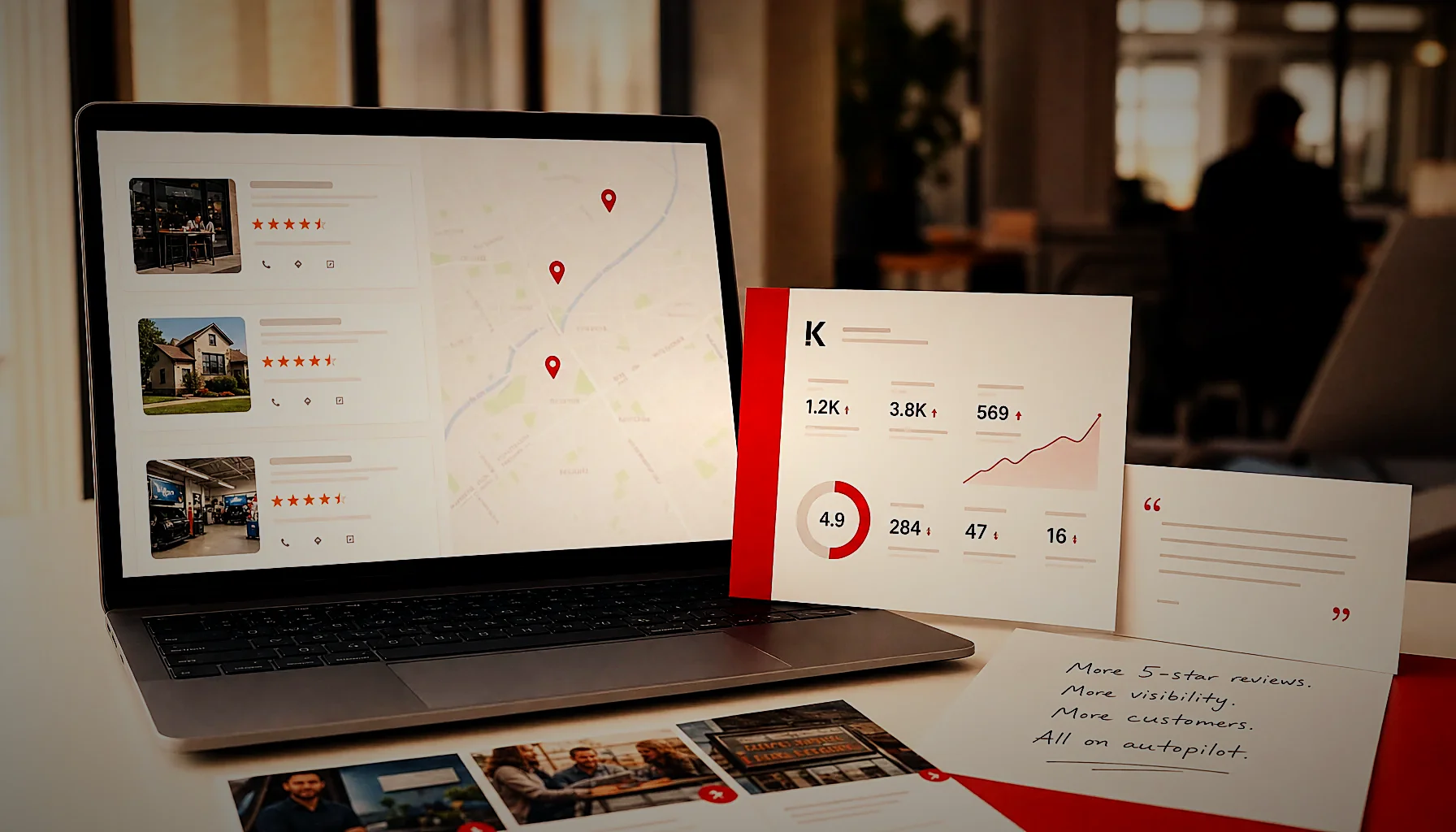
You rank in the Google Maps local pack by matching three signals Google weighs together: proximity to the searcher, relevance of your Google Business Profile to the query, and prominence built from reviews, citations and content about your business. Fix your profile first, then feed it steady reviews and pages that answer real local questions.
What is the Google Maps local pack, and why does it matter?
The local pack is the block of three business listings with a map that Google shows above the normal blue links for searches with local intent. It is also called the “3-pack” or “map pack.” Those three slots take the majority of clicks for queries like “dentist near me” or “pizza downtown.”
Below the three results sits a “More places” link that opens the full Google Maps results. Position 4 and lower still gets traffic, but it is a steep drop. Most local search studies put the first three listings well above 50% of all clicks on the page.
The local pack is also the raw material for AI answers. When someone asks ChatGPT, Gemini or Google AI Overviews for a recommendation in your city, the systems lean on the same public signals: your Google Business Profile, your reviews, and pages on the open web that describe what you do and where.
That overlap matters in 2025. Ranking work you do for Maps now also decides whether an assistant names your business when a customer skips the search page entirely. One body of work, two surfaces.
The pack is query-dependent and location-dependent. The same business can sit at #1 for someone standing outside the door and vanish from the top three for someone four miles away. That is normal, and it is the reason a single rank-tracking screenshot never tells the whole story.
What are the local pack ranking factors Google actually uses?
Google states three local ranking factors: relevance, distance and prominence. Relevance is how well your profile matches the search. Distance is how far you are from the searcher or the searched location. Prominence is how well known your business is, online and offline.
Relevance is the part you control most directly. It comes from your primary category, secondary categories, services list, business description, products, attributes, and the words customers use in reviews. A profile categorized as “Restaurant” will lose “ramen” searches to one categorized as “Ramen restaurant.”
Distance is the part you control least. You cannot move your storefront closer to every searcher, but you can widen the radius where you remain competitive by raising relevance and prominence until Google trusts you enough to show you further out.
Prominence is the slow compounding one. It is built from review count and review velocity, mentions and links across the web, consistent name-address-phone data in directories, and organic strength of your website for the same topics.
Here is how the three compare in practice:
- Relevance — fastest to fix, often within days of editing your profile. Low cost, high leverage.
- Distance — essentially fixed. Service-area businesses can adjust their declared area, but the pin stays put.
- Prominence — slowest, usually 3 to 9 months of consistent effort. Hardest for competitors to copy.
A practical read: if you are invisible even for searches two blocks away, your relevance is broken. If you rank nearby but disappear across town, your prominence is the gap.
Turn your reviews into pages that rank
KAIRO reads your public Google reviews and writes monthly articles that answer the questions your customers actually ask. That is the prominence work, done for you.
How do you optimize your Google Business Profile step by step?
Work through your Google Business Profile in a fixed order: category, name and address, hours, services and description, photos, Q&A, then posts. Each field is a ranking or conversion signal, and an incomplete profile loses to a complete one with the same distance.
Start with the primary category. Pick the single category that describes what you mainly do, not the broadest option. Then add secondary categories only for services you genuinely deliver — padding this list with unrelated categories dilutes relevance instead of expanding it.
Next, lock down your name, address and phone exactly as they appear on your signage and website. Keyword-stuffing the business name violates Google’s guidelines and invites competitor edits or suspension. Use the real name.
Fill the services section item by item, each with its own short description. This is one of the most skipped fields and one of the easiest places to add the exact phrases customers type.
Add photos on a schedule, not once. Interior, exterior from the street, team at work, products, and the parking or entrance. Businesses that upload new images monthly tend to hold attention longer in the pack, and the photos answer questions before anyone calls.
Seed and answer the Q&A section yourself. Post the five questions customers actually ask — parking, price range, walk-ins, pets, payment — and answer each one. Anyone can answer a question on your profile, so get there first with accurate information.
Finally, publish Google Business Profile posts regularly. Posts are not a heavy ranking factor on their own, but they keep the profile active, surface offers and events, and give Google fresh text tied to your location. Weekly is a reasonable rhythm; monthly is the floor.
Reviews vs citations vs content: which one moves the local pack most?
Reviews move the local pack fastest among prominence signals, content moves it furthest over time, and citations mostly prevent damage rather than create gains. Most local businesses already have enough citations and nowhere near enough reviews or content.
This comparison sets expectations before you spend money:
- Reviews — effort: low to medium (asking is the hard part). Time to effect: 4 to 12 weeks. Ceiling: high. Risk: review gating or incentives can get you penalized.
- Citations and directories — effort: low, mostly one-time. Time to effect: 1 to 3 months. Ceiling: low once consistency is reached. Risk: paid “500 citations” packages waste money.
- Website content and local pages — effort: high and ongoing. Time to effect: 3 to 9 months. Ceiling: highest. Risk: thin or duplicated pages do nothing.
- Links from local sites — effort: medium. Time to effect: 2 to 6 months. Ceiling: high. Risk: paid link schemes.
On reviews, quantity and recency both count. A business with 180 reviews where the last one arrived eight months ago looks dormant next to a competitor with 90 reviews and four from this month. Ask every satisfied customer, every week, through a short link.
Review text matters as much as the star rating. When customers write “they fixed my brake pads same day,” that phrase becomes part of your relevance for brake repair searches. You cannot script reviews, but you can ask a specific question — “which service did we do for you?” — and let the detail come out naturally.
Content is where most local businesses stop. A single homepage cannot be relevant for 30 different services across 6 neighborhoods. Pages and articles that answer real local questions give Google and AI assistants something to cite, and they are the reason some businesses rank further from the pin than their competitors.
If you want the cost side of that decision, our breakdown of SEO content cost for a small business compares freelancers, agencies and subscriptions line by line.
DIY vs agency vs content subscription: what should you choose?
Choose DIY if you have 5 hours a week and no budget, an agency if you need technical SEO plus paid media managed together, and a content subscription if your profile is already decent and the real gap is publishing consistently. Most local businesses fail on consistency, not on knowledge.
The honest trade-offs:
- DIY — cost: your time. Strength: you know your customers better than anyone. Weakness: the work stops the first busy week, and local SEO rewards nothing but consistency.
- Full-service agency — cost: highest, usually a retainer with a contract. Strength: handles site speed, structured data, ads and links together. Weakness: content is often the lowest-priority line item and gets outsourced thin.
- Freelance writer — cost: medium, per article. Strength: a real human voice. Weakness: you still have to brief, edit, publish and decide the topics every month.
- Content subscription — cost: flat monthly. Strength: articles and profile posts ship whether or not you remember. Weakness: it will not fix a broken website or replace local link building.
A quick decision rule. If your Google Business Profile is incomplete, fix it yourself this week — that is free and no provider should charge you much for it. If your profile is solid and your website has published nothing in six months, the gap is content.
KAIRO, a content engine run by a team based in Romania and working with local businesses online, sits in that last category. Every month it reads your own Google reviews, turns them into 4 SEO/AEO articles published to your site, plus Google Business Profile posts and a monthly proof report you can check. One subscription, no contract, cancel anytime.
The reason reviews are the input is simple: they already contain the words your customers use, the services they actually buy, and the objections they had. You can see how the pipeline works in our guide to the KAIRO content engine, and if you are deciding on volume, how many blog posts a month a local business needs covers the math.
How do you track local pack rankings and know it is working?
Track local pack performance with three things: a grid-based rank tracker that checks your position from multiple points around your address, the Google Business Profile performance report for calls, direction requests and website clicks, and a monthly log of what changed. One screenshot is not data.
Grid trackers matter because local rank is location-dependent. A tool that samples your rank from a 7×7 grid of points across your city shows you the shape of your visibility — strong within a mile, gone at three miles — which a single-point check hides completely.
Inside Google Business Profile, watch the actions rather than the impressions. Calls, direction requests, bookings and website clicks are the numbers tied to revenue. Impressions rise and fall with seasonality and Google interface changes, so they make a noisy headline metric.
Set a review baseline too: total count, average rating, and reviews received in the last 30 days. Review velocity is the single easiest prominence signal to measure month over month.
Give any change 90 days before judging it. Local rankings move in weeks, not hours, and Google runs updates constantly. Changing five things at once and checking the next morning teaches you nothing.
Then extend the same check to AI answers. Ask ChatGPT, Gemini and Google AI Overviews the questions your customers ask — “best [your service] in [your city]” — and record whether you are named. Our guides on how to check if AI mentions your business walk through a repeatable way to log it.
KAIRO’s monthly proof report exists for this reason: published articles, profile posts and visibility movement in one place, so the decision to continue or cancel is based on something you can verify rather than a feeling.
What mistakes keep businesses out of the local pack?
The most common reasons a business misses the local pack are an unverified or duplicate listing, the wrong primary category, keyword stuffing in the business name, no new reviews for months, and a website that has not published anything relevant in a year. Four of those five are free to fix.
Duplicate listings split your signals. If an old profile from a previous owner or address still exists, your reviews and photos are spread across two entries and neither one wins. Search your business name and address in Maps and request removal of any duplicate.
Fake addresses and virtual offices are a fast route to suspension. Google requires a real, staffed location for storefront listings; service-area businesses should hide the address and declare a service area instead.
Review gating — asking only happy customers, or offering a discount for a 5-star rating — violates Google’s policies and risks removal of your reviews. Ask everyone, equally, and respond to the negative ones in public.
Ignoring negative reviews costs more than the reviews themselves. A calm, specific reply showing what you fixed reads well to the next customer and adds relevant text to your profile. Reply to every review inside 48 hours when you can.
The last mistake is treating local SEO as a project with an end date. Competitors keep collecting reviews and publishing; a profile you optimized once and abandoned slides down slowly. Consistent monthly content and a steady review flow are what hold a position.
One more worth naming: businesses optimize for Maps and never check whether AI assistants describe them correctly. If you want that covered too, read how to get your business recommended by ChatGPT.
Content every month, without the agency retainer
If reviews and profile edits have taken you as far as they can, steady content is the next lever. KAIRO publishes it for you, built from what your customers already wrote.
Frequently asked questions
How to rank higher in Google Local Listings?
Rank higher in Google local listings by completing every field in your Google Business Profile, choosing the most specific primary category, collecting new reviews every month, and publishing website content that answers local questions about your services. Google weighs relevance, distance and prominence together, so profile accuracy and review velocity are the two levers you control. Expect visible movement in 4 to 12 weeks of consistent work, not days.
How do I rank in Google Maps?
You rank in Google Maps by verifying and fully filling out your Google Business Profile, then building prominence through reviews, consistent name-address-phone data across directories, and relevant pages on your own website. Proximity to the searcher still shapes every result, so focus on being the most relevant and best-documented option in your area. Start with the primary category and services list — those two fields change what queries you are even eligible for.
How many level 10 Google local guides are there?
Google does not publish the number of Level 10 Local Guides, so any specific figure you see is an estimate. Level 10 requires 100,000 points, which takes years of reviews, photos, answers and fact checks, so the group is very small relative to the millions of contributors in the program. For a business owner it makes no practical difference: Local Guide level does not give a review extra ranking weight.
Do local Google guides get paid?
No, Google Local Guides are not paid. The program rewards contributors with badges, levels, early access to Google features and occasional perks like extra Google Drive storage, but there is no cash payment for reviews or photos. Paying anyone for reviews, Local Guide or not, violates Google’s policies and can get your reviews removed.
How long does it take to rank in the local pack?
Most businesses see local pack movement within 4 to 12 weeks of fixing their Google Business Profile, and meaningful prominence gains over 3 to 9 months of steady reviews and content. Competitive urban categories take longer than rural or niche ones. Give any single change 90 days before you judge it, and track the result rather than guessing.
Who can write monthly SEO articles for my small business?
You can hire a freelance writer per article, a full-service SEO agency on retainer, or use a content subscription that publishes on a fixed schedule. The deciding factor is consistency: local rankings reward publishing every month, not one burst of ten articles. KAIRO publishes 4 SEO/AEO articles a month built from your own Google reviews, plus Google Business Profile posts and a proof report, with no contract — contact us for details.
This article was produced by the Kairo engine.
The same system can write for your business — starting from what your customers already say.
Get your free review report