How do you respond to a bad Google review without losing customers?
October 15, 2026 · 11 min read
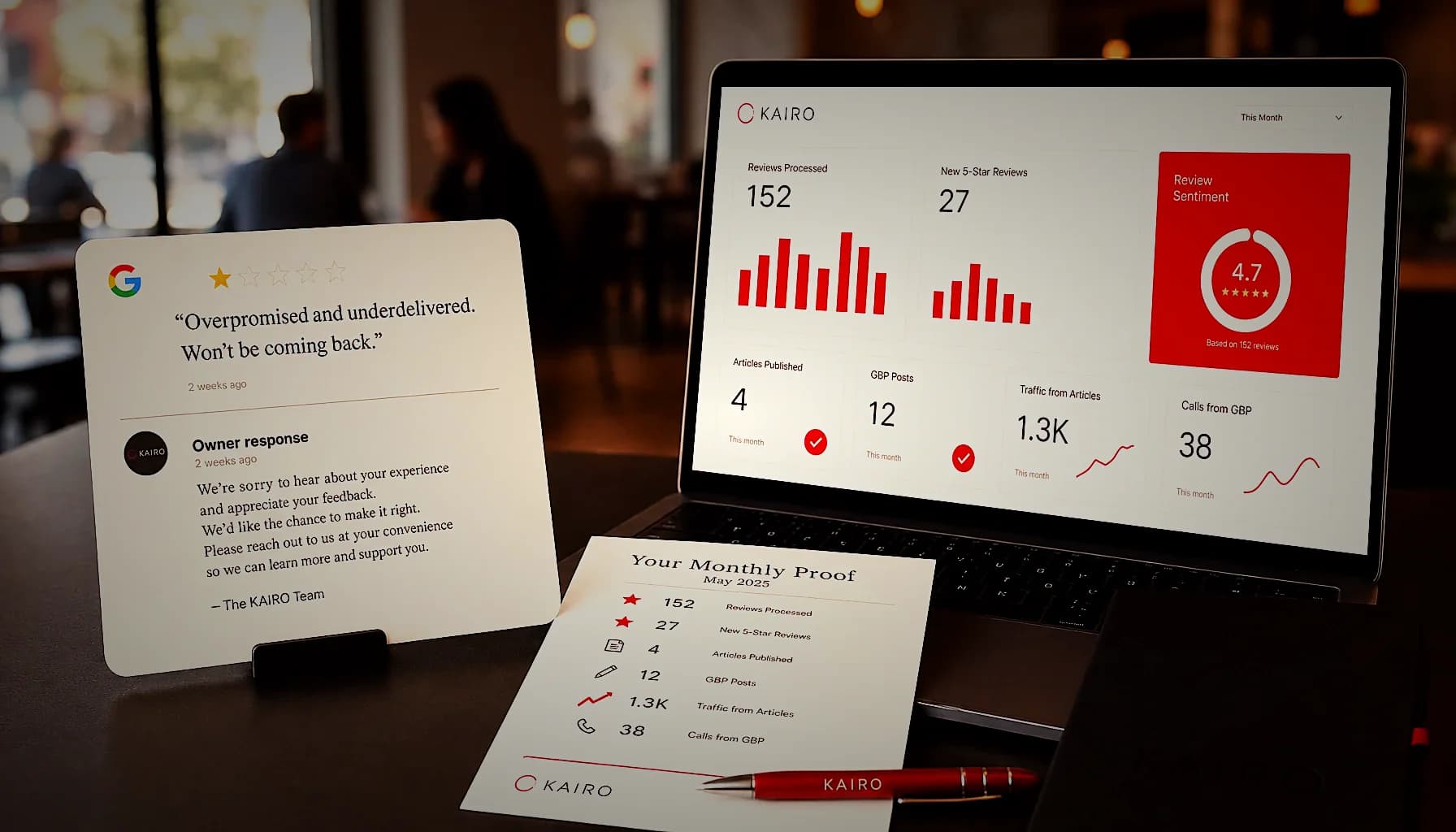
A one-star review lands on a Tuesday morning and your first instinct is to defend yourself. Don’t. Reply within 24 to 48 hours, thank the person by name, acknowledge the specific problem, state what you’re doing about it, and move the conversation offline. That four-part structure protects more customers than any argument ever will.
Why should you reply to a bad Google review at all?
Because the reply isn’t for the angry reviewer — it’s for the 50 people reading it next week. Research across review platforms consistently shows that most consumers read business responses, and a calm, specific reply often matters more to them than the complaint itself.
Silence reads as confirmation. When a reviewer says the kitchen was slow and nobody answers, the next reader assumes the kitchen is always slow. A short reply that explains what changed turns the same review into evidence that someone is paying attention.
There’s a second, quieter reason that matters more every year. AI assistants like ChatGPT, Gemini, and Google AI Overviews summarize businesses by reading what’s publicly written about them — reviews and owner responses included. If every negative review on your profile sits unanswered, that’s the material the summary gets built from.
Google itself has stated that responding to reviews is a signal of an active, well-maintained business profile. It won’t move you to position one on its own, but profiles with consistent owner responses tend to look healthier to both people and algorithms.
And replying changes behavior. A measurable share of reviewers edit or raise their rating after a business responds well — not because they were bribed, but because being heard dissolves most of the anger. You can’t count on it, but it happens often enough to be worth the five minutes.
The practical takeaway: treat every public reply as a tiny piece of marketing copy that will be read by strangers for years. That framing kills the urge to win the argument.
What should you actually say in a response to a Google review?
Use four blocks in this order: thanks, acknowledgment, action, invitation. Keep the whole reply between 40 and 90 words. Anything longer starts to look defensive, and anything shorter reads like a copy-paste.
1. Thanks and the person’s name. “Thanks for telling us, Maria” costs you nothing and immediately lowers the temperature. Using the reviewer’s first name signals a human typed this.
2. Acknowledgment of the specific issue. Name the thing they named. If the wait was 40 minutes, say “a 40-minute wait isn’t what we aim for.” Vague sympathy (“we’re sorry you had a less than ideal experience”) reads as a form letter and makes the complaint look credible by contrast.
3. What you’re doing about it. This is the block almost every business skips, and it’s the one future customers actually read. “We’ve added a second person to Friday evenings” is worth more than three paragraphs of apology.
4. A way to continue offline. Give a direct email or phone number and offer to make it right. This moves the back-and-forth off a public page and shows other readers that you’re accessible.
Two things to leave out: legal language and your side of the story. If the reviewer got a detail wrong, correct it once, briefly, without adjectives — “our kitchen closes at 10, not 9” — and stop there. Public fact-checking a customer, even accurately, costs you more trust than the error ever did.
Never offer a refund or a free visit in public. Say “I’d like to make this right — email me at [address]” instead. Otherwise you’ve just published a price list for complaining.
Turn your reviews into articles people find
KAIRO reads your public Google reviews and writes monthly articles that answer the questions behind them. Same material you reply to, working for you all year.
What do good bad-review response examples look like?
The best responses are specific, short, and signed by a real person. Here are five templates you can adapt in under two minutes each, covering the complaints local businesses actually get.
Slow service (restaurant, salon, clinic)
“Thanks for the honest feedback, James. A 35-minute wait with a reservation isn’t acceptable, and you were right to say so. We’ve changed how we stagger Friday bookings and added a host for the 7–9pm window. If you’d give us another try, email me at [address] and I’ll handle the booking myself. — Ana, owner”
A rude or unhelpful staff member
“I’m sorry, Daniel — that’s not how we treat people, and I’ve spoken with the team about it directly. I’d genuinely like to hear what was said so I can address it properly. My direct line is [number]. — Marcus, manager”
Price complaints
“Thanks for the feedback, Elena. Our $85 service includes a 20-minute consultation and follow-up care, which is where most of that cost sits — but if that wasn’t explained clearly before your appointment, that’s on us. Happy to walk you through it at [email].”
Price complaints are the one case where a short explanation helps every future reader. You’re not arguing with the reviewer; you’re telling the next 200 people what they get for the money.
A complaint about something outside your control
“Appreciate you flagging it, Tom. Street parking around us genuinely is tight on weekends. There’s a paid garage two minutes away on [street] that most of our guests use — we should be saying that at booking, and we will from now on.”
A review you believe is fake or has the wrong business
“We don’t have a record of this visit and we don’t offer the service described, so we think this may be meant for another business. If we’re wrong, please email [address] — we’d like to look into it.” Then report it to Google. Reply publicly either way, because an unanswered one-star review is worse than a disputed one.
How fast should you respond, and who should write the reply?
Reply within 24 to 48 hours for negative reviews and within a week for positive ones. Speed matters because fresh reviews sit at the top of your profile and get the most reads, and because the reviewer’s anger is still live enough to be defused.
Don’t reply in the first hour. Write the response, leave it in a draft, and reread it after a coffee. The replies that get screenshotted and shared are almost always the ones typed in the first ten minutes.
One person should own this. In practice that means the owner or a manager with the authority to say “we’ve changed X” — not a rotating duty that lands on whoever opens the laptop. Inconsistent voice across your responses is visible to anyone who scrolls.
Set a simple rhythm: check reviews twice a week, reply to everything negative, and reply to roughly one in three positive reviews so the profile doesn’t look like it only speaks up when it’s attacked. Fifteen minutes, twice a week, covers most local businesses.
For positive reviews, keep it to two sentences and repeat what they praised. “Glad the lamb shank landed, Sofia — Chef Radu will be pleased. See you soon.” That single mention of a dish is now indexed text on your profile describing what you’re good at, which is exactly the kind of detail an AI assistant picks up when someone asks for a recommendation.
If you want to know whether those answers are reaching AI assistants at all, it’s worth checking whether AI is mentioning your business before you assume the work is invisible.
What should you never do when responding to a negative review?
Four mistakes do real damage: arguing, copy-pasting, going personal, and asking for the review to be removed. Each one is more memorable to readers than the original complaint, and each one lives on your profile permanently.
Don’t argue the facts line by line. A reply longer than the review always looks like the business is the problem. Correct one factual error at most, then stop.
Don’t paste the same template everywhere. Five consecutive responses starting “We’re sorry to hear about your experience” tell readers nobody read anything. Reuse the structure, never the sentences.
Don’t mention the reviewer’s personal details. No “you were the group that arrived 40 minutes late,” no health information, no “you’ve complained before.” In regulated fields like clinics and dental practices, confirming someone was even a patient can create a privacy problem.
Don’t publicly ask them to delete it. “Please consider removing this review” reads as pressure to every other reader. If the review breaks Google’s policies — spam, conflict of interest, hate speech, no actual experience — report it through your Google Business Profile and let the process run quietly.
Also skip sarcasm, exclamation marks stacked three deep, and the phrase “as I explained to you at the time.” And never reply from a personal account that isn’t clearly the business — unverified replies confuse readers and get ignored.
One more: don’t ignore the pattern. If three reviews in two months mention the same 20-minute wait, the reply isn’t the fix. The fix is the schedule, and your replies will keep sounding hollow until the operation changes.
How do you turn review complaints into content that works for you?
Every recurring complaint is a question your future customers are already asking Google. Answer it once in a reply, and 50 people see it. Answer it properly in an article on your own site, and it works for years — in search results and in AI answers.
Take parking. Three reviews mention it’s hard to park near you. The reply fixes the moment; a short page titled “Where to park near [your business]” fixes the objection before anyone ever books. The same logic applies to pricing, wait times, dress codes, kids’ policies, and accessibility.
This is how review intelligence actually pays off: your reviews are an unfiltered list of what confuses, annoys, and delights your customers, written in their own words. Those words are the exact phrases people type into Google and ask ChatGPT.
At KAIRO, our online team (based in Romania) built the content engine around exactly that. We read every Google review a business has received, pull out the recurring themes, and turn them into 4 SEO/AEO articles a month published straight to the client’s WordPress site, plus Google Business Profile posts and a monthly proof report you can check line by line.
No contract, cancel anytime, and zero hours from the owner. If you want the mechanics, here’s how the KAIRO content engine works end to end — and how many blog posts a month a local business actually needs if you’re deciding on volume.
The connection between review replies and AI visibility isn’t abstract. Assistants assemble answers from text about you across the web, so a profile full of specific, well-written responses plus a site that answers the same questions in depth gives them something concrete to quote. That’s the same mechanic behind getting your business recommended by ChatGPT.
Start simple in 2025: reply to every unanswered negative review on your profile, list the three complaints that repeat, and write one page about each. That’s a week of work that keeps paying into 2026.
Answer the complaint before the call
If the same objection keeps showing up in your reviews, KAIRO builds the page that handles it — one article a month, written from what your customers already said.
Frequently asked questions
How to respond to a nasty Google review?
Wait at least an hour, then reply in under 90 words: thank the person by name, acknowledge the specific issue, say what you’re changing, and give a direct email to continue offline. Do not match their tone, do not argue point by point, and never mention their personal details. If the review is abusive or clearly fake, reply calmly once and report it through your Google Business Profile.
How should I respond to a negative review?
Respond within 24 to 48 hours using four blocks: thanks, acknowledgment of the exact problem, the concrete action you’ve taken, and an invitation to contact you directly. Keep it between 40 and 90 words and sign it with a real name and role. For example: “Thanks for telling us, Maria — a 35-minute wait isn’t acceptable. We’ve added a host for Friday evenings. Email me at [address] and I’ll book you myself.”
What to say in response to a Google review?
Say thank you, repeat the specific detail the reviewer mentioned, and add one piece of useful information for future readers. For positive reviews, two sentences are enough and naming the dish, service, or staff member makes the reply more useful in search and AI answers. For negative reviews, add what you’ve changed and how to reach you directly.
Is it good to respond to negative Google reviews?
Yes — responding is almost always better than silence, because future customers read the reply more carefully than the complaint. A calm, specific response shows the business is active and accountable, and some reviewers update their rating after being heard. Google also treats consistent owner responses as a sign of a well-maintained business profile.
How long should a review response be?
Keep responses between 40 and 90 words. Shorter than 40 words usually reads as a template; longer than 90 starts to look defensive and gets skimmed. A reply that runs longer than the original review almost always makes the business look like the problem.
Can you get a bad Google review removed?
Only if it violates Google’s content policies — spam, fake content, conflict of interest, hate speech, or a review from someone with no actual experience of your business. You report it through your Google Business Profile and Google decides, which can take several days with no guarantee of removal. A genuine negative opinion, however unfair it feels, will not be taken down, so your reply is the real tool you control.
This article was produced by the Kairo engine.
The same system can write for your business — starting from what your customers already say.
Get your free review report